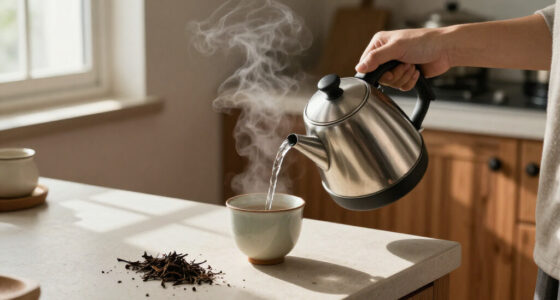

Use an electric kettle to heat the amount of water you need, match its temperature to your tea, and brew a balanced cup. This guide is for beginners using a standard or temperature-controlled kettle; the full process takes about 5-10 minutes, depending on the kettle and tea.

Get coffee and tea gear delivered free with Prime
- Fast, free delivery on millions of items
- Prime Video, Amazon Music and more included
- Member-only deals all year

Chefman Electric Kettle with Temperature Control, 5 Presets LED Indicator Lights, Removable Tea Infuser, Glass Tea Kettle & Hot W…
- ✔ Capacity: 1.8 liters
- ✔ Wattage: 1100 watts
- ✔ Temperature settings: Seven presets, stated range 160–212°F

Cosori Electric Kettle, No Plastic Contact with Water, 1.7L, Black
- ✔ Capacity: 1.7 liters
- ✔ Wattage: 1500 watts
- ✔ Material: Borosilicate glass and stainless steel

Chefman Electric Kettle, 1.8L 1500W, Hot Water Boiler, Removable Lid for Easy Cleaning, Auto Shut Off, Boil-Dry Protection, Stain…
- ✔ Capacity: 1.8 liters
- ✔ Wattage: 1500 watts
- ✔ Material: Borosilicate glass
Difficulty: Beginner | Time: 5-10 minutes
What You’ll Need
Tools & Materials:
- Electric kettle with its base and power cord
- Fresh, cold drinking water
- Tea bag or loose-leaf tea
- Cup or teapot
- Teaspoon or tea infuser for loose leaves
Knowledge:
- Basic familiarity with plugging in and switching on an appliance
- Ability to follow the tea package’s brewing instructions
Check the kettle manual for its minimum and maximum fill lines and cleaning instructions. If you do not know the ideal temperature for your tea, check the package; boiling water is a suitable starting point for many black teas, while green, white, and delicate teas often taste better with cooler water.
Chefman Electric Kettle with Temperature Control, 5 Presets LED Indicator Lights, Removable Tea Infuser, Glass Tea Kettle & Hot W…
For tea drinkers who brew different kinds of leaves, the preset temperature choices make this the most adaptable kettle in the group. Its stated range runs from 160 to 212°F, so we can heat water below boiling for more delicate teas instead of defaulting to the full boil offered by the Cosori and standard Chefman. The removable infuser adds another tea-specific advantage: it lets us steep loose leaves in the kettle itself, which is useful when serving several cups.The tradeoff is that added flexibility brings a more involved setup. Buyers who only make black tea or need hot water for general use may not benefit enough to justify choosing it over the simpler Chefman with a removable lid. Its listed wattage is 1100 watts, lower than the 1500-watt ratings of the other two, and the supplied description does not establish exact temperature accuracy or a long-term keep-warm duration. We would choose this model for varied tea routines, but skip it if we want the quickest, simplest boil-and-pour experience.
Pros:
- Seven presets are stated across a 160–212°F range for different tea styles.
- Removable infuser supports loose-leaf steeping in the kettle.
- 1.8-liter capacity suits serving multiple cups.
- Color-changing LEDs distinguish standby, heating, and steep or keep-warm modes.
Cons:
- Listed at 1100 watts, below the 1500-watt ratings of the other two options.
- More settings and an infuser add parts and steps compared with a basic boiling kettle.
- No gooseneck spout is specified for controlled pour-over pouring.
Best for: Tea drinkers who switch between loose-leaf varieties and want preset water temperatures plus an in-kettle infuser.
Not ideal for: Buyers who mostly boil water for one type of tea, want a simple control layout, or prioritize the higher stated wattage of the other kettles.
Bottom line: Choose the temperature-control Chefman when brewing flexibility and an integrated loose-leaf infuser matter more than a basic, higher-wattage boil.
“Choose the temperature-control Chefman when brewing flexibility and an integrated loose-leaf infuser matter more than a basic, higher-wattage boil.”
Cosori Electric Kettle, No Plastic Contact with Water, 1.7L, Black
The Cosori is the straightforward choice for buyers who care about what touches their water. Its defining feature is a water path without plastic contact, a distinction the two Chefman descriptions do not make. For tea, that makes it a particularly focused option for people who want a simple glass kettle without moving to temperature controls or an infuser. The broad opening and large-angle lid also make it easier to reach inside for routine cleaning than a narrow-neck design.Compared with the standard Chefman, the Cosori has a slightly smaller stated capacity at 1.7 liters and a more explicit emphasis on water-contact materials. Compared with the temperature-control Chefman, it is much less specialized for tea styles: it boils water but does not list selectable temperatures or an infuser. Its 1500-watt rating and automatic shutoff support uncomplicated daily use, while boil-dry protection adds a safety measure if it is switched on without enough water. Choose it for simple boiling and easier access for cleaning; look elsewhere if controlling steeping temperature is central to our routine.
Pros:
- Description states that water does not contact plastic.
- Wide mouth and large-angle lid improve access for cleaning.
- 1500-watt rating and 1.7-liter capacity suit everyday boiling.
- Automatic shutoff and boil-dry protection are included.
Cons:
- No selectable temperature settings are listed for delicate teas.
- No tea infuser is included.
- Capacity is slightly below the 1.8-liter Chefman kettles.
Best for: Buyers who want a simple glass kettle, a wide opening for cleaning, and the stated assurance that water does not contact plastic.
Not ideal for: Tea drinkers who need preset temperatures, a built-in infuser, or the extra stated capacity of the 1.8-liter Chefman models.
Bottom line: The Cosori is a good fit when a simple boil, accessible cleaning, and avoiding plastic contact matter more than tea-specific controls.
“The Cosori is a good fit when a simple boil, accessible cleaning, and avoiding plastic contact matter more than tea-specific controls.”
Chefman Electric Kettle, 1.8L 1500W, Hot Water Boiler, Removable Lid for Easy Cleaning, Auto Shut Off, Boil-Dry Protection, Stain…
This Chefman keeps the routine uncomplicated: fill it, switch it on, and pour once the water boils. Its 1.8-liter capacity matches the temperature-control Chefman and edges out the Cosori on stated volume, making it a practical option when we regularly prepare several cups. The removable lid gives a broad opening for filling and cleaning, while a stainless-steel filter and drip-free spout are described as serving conveniences.For tea specifically, its limitation is also its defining simplicity. There are no temperature presets or infuser listed, so it cannot match the other Chefman’s flexibility for delicate leaves or brewing loose tea in the kettle. The Cosori is the stronger alternative if avoiding plastic contact is our priority; this Chefman suits us better if we want the larger stated capacity and an easy-to-access lid. Its 1500-watt rating is shared with the Cosori, and automatic shutoff and boil-dry protection cover the core safety needs. Choose it for everyday boiling and straightforward cleanup, not for fine control over steeping.
Pros:
- 1.8-liter capacity is the largest stated here, tied with the temperature-control Chefman.
- Removable lid creates a larger opening for filling and cleaning.
- 1500-watt rating matches the Cosori.
- Includes automatic shutoff, boil-dry protection, and a stainless-steel filter.
Cons:
- No temperature presets are listed for teas that need water below boiling.
- No removable tea infuser is included.
- The description does not state that water avoids contact with plastic.
Best for: Households that make several cups at once and want a glass kettle with a removable lid and simple boiling operation.
Not ideal for: Tea drinkers who need temperature presets or an included infuser, and buyers whose main concern is a stated no-plastic-contact water path.
Bottom line: Pick this Chefman for straightforward, multi-cup boiling and lid access; choose its temperature-control sibling for a kettle built around tea variety.
“Pick this Chefman for straightforward, multi-cup boiling and lid access; choose its temperature-control sibling for a kettle built around tea variety.”
As an Amazon Associate we earn from qualifying purchases.
Before You Start
Place the kettle on a dry, level surface near a suitable outlet. Keep the cord away from the edge of the counter so the kettle cannot be pulled down. Do not switch on an empty kettle, and do not fill it above its maximum line. Hot steam can scald: hold the handle, keep your face and hands clear of the spout, and pour slowly.
Step-by-Step Instructions
Step 1: Check the kettle and base
Switch off the kettle and let it cool. Check that the body, lid, plug, cord, and base are dry and free from visible damage. Set the base on a stable, dry counter and plug it into a suitable outlet. Do not use the kettle if the cord or kettle is damaged.
Tip: Keep the plug and electrical base away from splashes. Do not immerse the kettle or base in water.
Check: The kettle is intact, the base sits flat, and the cord reaches the outlet without stretching or crossing a walkway.
Step 2: Measure and add water
Open the lid and pour in fresh, cold drinking water. Add enough for your cup or teapot, while keeping the level between the kettle’s minimum and maximum marks. Close the lid securely before heating. Heating only the water you need usually saves time and energy.
Tip: If your kettle has no clear water gauge, use the cup you plan to fill to measure the amount, then check that the kettle’s minimum fill requirement is met.
Check: The water level is above the minimum mark and below the maximum mark, and the lid is closed.
Step 3: Select a suitable water temperature
Read the tea package for a recommended water temperature. If the kettle has temperature controls, select that setting. As a general starting point, use near-boiling water for black tea and many herbal infusions; use cooler water for green, white, and other delicate teas. If the kettle only boils water, use its manual to stop it at the desired temperature, or let the water cool briefly before brewing.
Tip: Tea types and brands vary, so treat package directions as your first guide. Very hot water can make some delicate teas taste bitter.
Check: The kettle is set to the package temperature, or you have a clear plan to cool boiled water before adding delicate tea.
Step 4: Heat the water
Place the kettle on its base and switch it on. Keep the lid closed while it heats, and do not touch or move the kettle during operation. Wait for the automatic shutoff or temperature signal. If your model requires manual shutoff, watch it closely and switch it off when the target temperature is reached.
Tip: Stay nearby while the kettle heats. Never leave a kettle that requires manual shutoff unattended.
Check: The kettle has stopped heating or displayed its selected temperature, and it remains upright on the base.
Step 5: Prepare the tea
Place one tea bag or the package’s suggested amount of loose-leaf tea in a cup or teapot while the water heats. Use an infuser or strainer for loose leaves. Follow the package’s tea-to-water ratio when making multiple cups; adding extra leaves can make the brew harsh.
Tip: Warm a teapot with a little hot water if you want it to stay warm longer. Empty that water before adding the tea leaves and brewing water.
Check: The measured tea is in the cup, infuser, or teapot, ready for water.
Step 6: Pour and steep
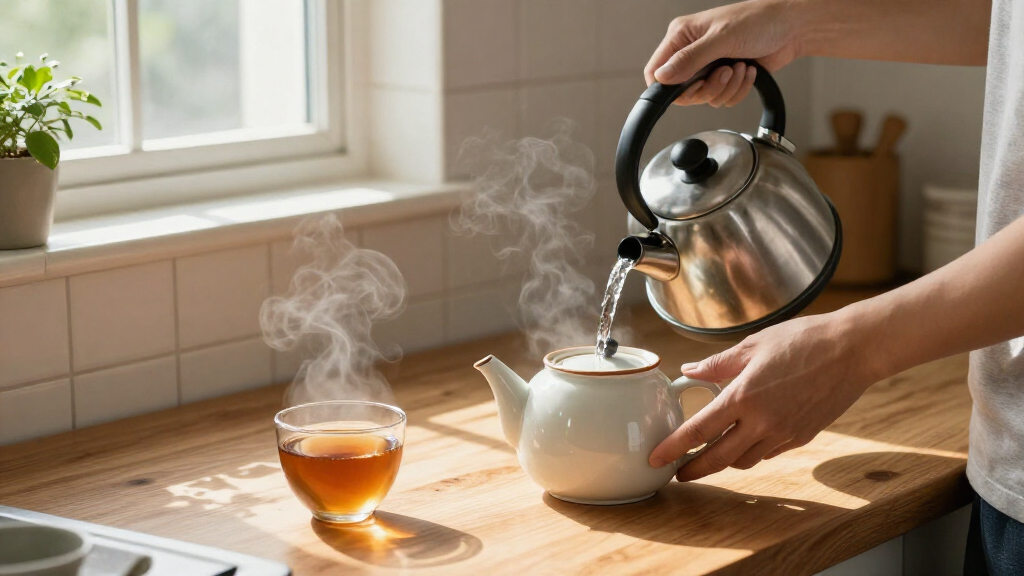
Lift the kettle by its handle and pour slowly into the cup or teapot, directing the stream away from your hands. Cover the tea with enough water and start a timer using the package’s steeping time. Remove the tea bag or infuser when the time is up. If brewing in a teapot, pour the tea into cups at the end of the steep to prevent it from getting stronger.
Tip: Keep your face away from the spout when opening the lid or pouring. Steam rises quickly, and the kettle’s outside may also be hot.
Check: The tea has steeped for the package’s recommended time, and the leaves or bag are removed before serving.
Step 7: Switch off and put the kettle away safely
Return the kettle to its base and switch it off if it did not shut off automatically. Let it cool before emptying leftover water or cleaning it. Wipe up any drips around the base with the kettle unplugged. Store the kettle empty with its lid open or ajar if the manual recommends it, so the interior can dry.
Tip: Do not leave water standing in the kettle for long periods; follow the manufacturer’s care guidance to limit scale buildup.
Check: The kettle is switched off, any spills are cleaned, and the appliance can cool in a safe place.
Common Mistakes to Avoid
- Filling above the maximum mark or below the minimum mark. — Check the level before switching on. Too much water can spill or boil over; too little may cause the kettle to overheat or fail to operate as intended.
- Using boiling water for every kind of tea. — Check the package directions. Let boiled water cool briefly or use a lower temperature setting for delicate teas.
- Leaving the tea to steep too long. — Set a timer when you pour the water and remove the bag or leaves when the recommended time ends.
- Pouring with the lid open or touching the spout. — Close the lid before heating, lift the kettle by its handle, and keep hands and face clear of rising steam.
Troubleshooting
Problem: The kettle does not switch on.
Solution:
Check that the plug is fully inserted, the outlet works, and the kettle is seated correctly on its base. Confirm that it contains water above the minimum line and that the lid is closed. If it still will not heat, unplug it and consult the manual or manufacturer rather than opening the appliance.
Problem: The kettle switches off before the water is hot.
Solution:
Check the water level and make sure the lid is closed. If the kettle has boiled dry or its base has become unusually hot, unplug it and let it cool completely before refilling. Follow the manual’s reset or dry-boil protection instructions.
Problem: The tea tastes bitter or too strong.
Solution:
Shorten the steeping time, use cooler water for delicate tea, or reduce the amount of leaves. Brew another cup using the package’s temperature, quantity, and timing directions as a starting point.
Problem: White flakes or scale appear in the kettle.
Solution:
Mineral scale can form when water is heated repeatedly. Unplug the kettle and follow its manual for descaling; many models permit a diluted vinegar or citric acid solution, but use only an approved method. Rinse thoroughly before making tea again.
What Success Looks Like
Your tea is brewed at a temperature and for a time suited to its type, with the bag or leaves removed before serving. The kettle stayed within its fill limits, switched off safely, and has no spills around its base. The finished cup should taste balanced; adjust the temperature, tea amount, or steeping time next time to suit your preference.
Next Steps
After the kettle cools, empty leftover water and wipe its exterior with a damp cloth, keeping the base and plug dry. Descale it at the interval given in the manual, especially if you see mineral deposits or live in a hard-water area. Store tea sealed away from heat and moisture, and note any temperature or steeping adjustments that gave you the flavor you prefer.
Frequently Asked Questions
Can I use tap water in an electric kettle?
Use water that is safe to drink. Tap water is suitable where the local supply is potable, though its mineral content can affect flavor and leave scale. Filtered water may change the taste and reduce some deposits, depending on the filter.
Do I need a temperature-controlled kettle?
No. A standard kettle works for tea. For teas that need cooler water, let boiled water cool briefly or follow the package’s guidance for your kettle. A temperature-controlled model can make it easier to repeat a specific setting.
Can I boil water in the kettle more than once?
Usually, yes, if the kettle manual allows normal repeated use. Empty stale water and refill with fresh water when you want a better-tasting cup. Avoid repeatedly heating an empty kettle or running it below its minimum fill line.
How much tea should I use per cup?
Start with the package’s suggested amount, since leaf size and strength vary. If the tea tastes weak, add a little more tea next time; if it tastes harsh, use less or shorten the steep.