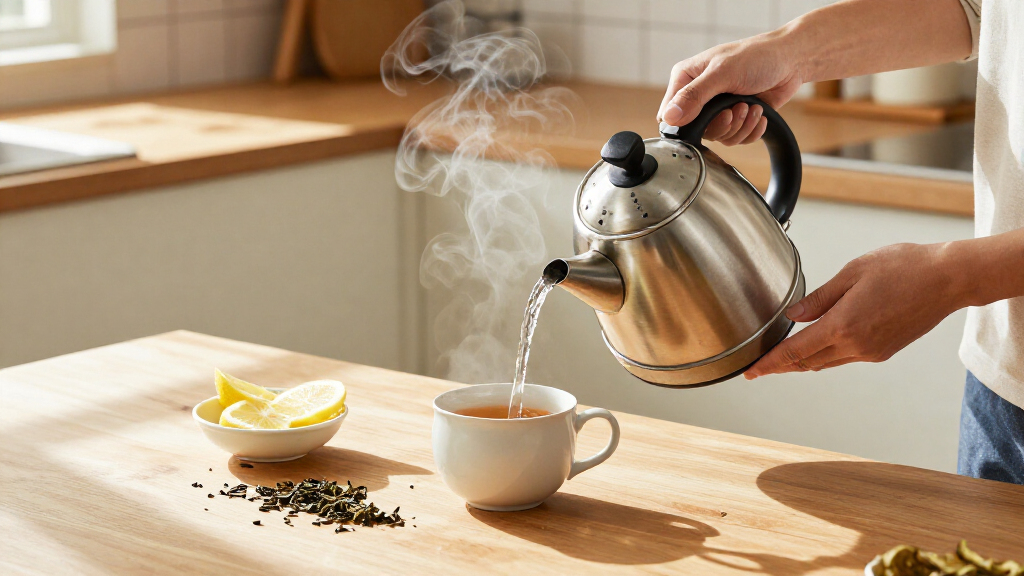

Choosing an electric kettle for tea comes down to how much control you want over the water and how much you want to spend to get it. A variable-temperature gooseneck kettle lets you select a target temperature and pour a narrow stream; a standard electric kettle typically boils water with one button and may hold more for less money. That difference matters if you brew delicate green or white teas, make several cups at once, or want a kettle that also handles pour-over coffee. For everyday black tea, herbal infusions, and quick refills, a standard model may be the better buy. The comparison below focuses on the features that change the experience at home, rather than treating either style as right for every tea drinker.

Get coffee and tea gear delivered free with Prime
- Fast, free delivery on millions of items
- Prime Video, Amazon Music and more included
- Member-only deals all year

Chefman Electric Kettle with Temperature Control and Removable Tea Infuser
- ✔ Capacity: 1.8 liters
- ✔ Wattage: 1100W
- ✔ Temperature settings: Seven presets, 160°F to 212°F

Cosori Electric Kettle, No Plastic Contact with Water, 1.7L, Black
- ✔ Capacity: 1.7 liters
- ✔ Wattage: 1500W
- ✔ Body material: Borosilicate glass

Chefman Electric Kettle, 1.8L, 1500W, Glass
- ✔ Capacity: 1.8 liters
- ✔ Wattage: 1500W
- ✔ Body material: Borosilicate glass
At a Glance
| Criteria | Variable-temperature gooseneck electric kettle | Standard electric kettle | Winner |
|---|---|---|---|
| Temperature control | Often offers selectable temperatures or a hold setting; features vary by model | Often boils to a single shutoff point; some models offer temperature presets | A |
| Pouring control | Narrow spout supports a slower, more directed stream | Wider spout pours quickly but gives less fine control | A |
| Capacity | Commonly around 0.8–1.0 L, though sizes vary | Often available in larger capacities, with size depending on model | B |
| Speed and routine | May need a setting selection; suited to careful brewing and small pours | Simple one-touch boiling suits frequent, straightforward use | B |
| Cleaning and upkeep | Narrow opening can make access and descaling less convenient | Wide openings can make the interior easier to reach | B |
| Price and value | Typically costs more; extra control pays off for users who use it | Usually less expensive; strong value when precise settings are unnecessary | Depends |
Chefman Electric Kettle with Temperature Control and Removable Tea Infuser
For tea drinkers who want more than boiling water, this Chefman is the most complete match in the group. Its temperature settings span 160°F to 212°F, so we can choose a lower setting for delicate teas rather than pouring fully boiling water over every leaf. That flexibility sets it apart from both the Cosori and the basic Chefman, which are designed to bring water to a boil without listed temperature selection.The removable infuser also changes how we can use the kettle: we can steep loose leaves in the vessel and serve multiple cups from one batch. The white, red, and green indicator lights distinguish standby, heating, and keep-warm or steep mode, adding visual feedback as we move through those steps. With a 1.8-liter capacity, it matches the basic Chefman for volume and edges the Cosori’s 1.7-liter capacity slightly.There are tradeoffs. The listed wattage is 1100W, lower than the 1500W figures given for the other two, so buyers should not choose it on the assumption that it will boil faster. Its many controls and infuser also create more parts to handle and clean than a basic kettle. Choose it when temperature and steeping matter; choose Cosori when a no-plastic-contact interior is the priority, or the basic Chefman when simple boiling is enough.
Pros:
- Seven listed temperature presets spanning 160°F to 212°F
- Removable infuser for steeping loose leaves in the kettle
- 1.8-liter capacity for preparing several servings
- Distinct indicator colors for standby, heating, and keep-warm or steep mode
Cons:
- 1100W listed wattage is lower than the 1500W of the other two models
- Infuser and temperature features add parts and steps to cleaning
- No-plastic-contact interior is not specified in the supplied description
Best for: Tea drinkers who brew loose-leaf tea, want selectable water temperatures, and regularly make more than one cup at a time.
Not ideal for: Buyers who only need boiling water, want the simplest controls, or prefer a kettle specifically described as having no plastic contact with water.
Bottom line: The strongest tea-specific choice here, provided we value temperature and steeping control more than the simplicity of a boil-only kettle.
“The strongest tea-specific choice here, provided we value temperature and steeping control more than the simplicity of a boil-only kettle.”
Cosori Electric Kettle, No Plastic Contact with Water, 1.7L, Black
The Cosori’s clearest point of difference is its stated no-plastic-contact interior. For buyers who care about what touches their water, that is a more direct selling point than either Chefman listing provides. The borosilicate glass body keeps the water visible, while the stainless steel filter and inner-lid container are among the listed components. It is the only kettle in this comparison whose product description explicitly centers the water-contact material choice.For everyday tea, the Cosori keeps things uncomplicated: it boils water, shuts off automatically after reaching a boil, and protects against boil-dry operation. The wide opening and large-angle lid are practical advantages when cleaning glass or reaching the interior. Its 1.7-liter capacity is just below the 1.8 liters of both Chefman models, so it remains suitable for several servings, though the Chefman options offer a little more room.The main limitation for tea is that this model does not list temperature presets or an infuser. We need a separate thermometer or another heating method if we want to target a lower temperature for delicate leaves. Compared with the basic Chefman, the Cosori offers a stronger material distinction and a cleaning-friendly opening; compared with the temperature-control Chefman, it gives up brewing precision and integrated steeping. It is the sensible pick when water-contact materials matter more than tea-program features.
Pros:
- Product description states water does not contact plastic
- Wide opening and large-angle lid make interior access easier
- 1.7-liter glass kettle with stainless steel filter and inner lid
- Automatic shutoff and boil-dry protection
Cons:
- No listed temperature presets for delicate teas
- No included tea infuser
- Slightly smaller capacity than the two 1.8-liter Chefman kettles
Best for: Buyers who want a glass kettle with a clearly stated no-plastic-contact water path and a wide opening for cleaning.
Not ideal for: Tea enthusiasts who need preset temperatures or want to steep loose leaves directly in the kettle.
Bottom line: Choose the Cosori when the water-contact material is your leading concern and a straightforward boil is enough for your tea routine.
“Choose the Cosori when the water-contact material is your leading concern and a straightforward boil is enough for your tea routine.”
Chefman Electric Kettle, 1.8L, 1500W, Glass
This basic Chefman is for households that want boiling water without a learning curve. There are no temperature menus or steeping accessories to manage: fill the kettle, switch it on, and watch the blue indicator lights while it heats. At 1.8 liters, it offers the same stated capacity as the more feature-rich Chefman tea kettle and a little more than the Cosori.Its removable lid helps with filling and interior access, while the stainless steel filter and cool-touch handle support everyday serving. The kettle lifts from its 360-degree base for cordless pouring, and the listing includes automatic shutoff and boil-dry protection. For black tea, herbal infusions made with boiling water, or households that also want hot water for other drinks, this focused feature set may be all we need.What it does not do is help us brew different teas at their preferred temperatures. The boil-only design is a clear step down from the temperature-control Chefman for green or white tea, and there is no infuser for steeping loose leaves directly in the kettle. It also lacks the Cosori’s explicit no-plastic-contact claim. So while it is the simplest and highest-capacity option alongside the premium Chefman, it is the least specialized for tea itself.
Pros:
- 1.8-liter capacity for multiple cups
- 1500W listed wattage and rapid-boil design
- Removable lid and stainless steel filter
- Cordless serving base, automatic shutoff, and boil-dry protection
Cons:
- No selectable temperature settings
- No included tea infuser
- Product description does not state that water avoids plastic contact
Best for: Households that mainly brew tea requiring boiling water and want a straightforward kettle for several cups or other hot drinks.
Not ideal for: Buyers who brew delicate teas at lower temperatures, steep loose leaf in the kettle, or prioritize an explicitly stated no-plastic-contact interior.
Bottom line: A capable no-fuss kettle for boiling water in batches, but the temperature-control Chefman is a better fit when tea brewing is the main job.
“A capable no-fuss kettle for boiling water in batches, but the temperature-control Chefman is a better fit when tea brewing is the main job.”
As an Amazon Associate we earn from qualifying purchases.
Key Differences
The strongest case for a gooseneck kettle is control. Temperature presets can help you avoid using freshly boiled water for teas that are commonly brewed cooler, while the spout makes it easier to pour a measured amount. This is useful for careful single-cup brewing and pour-over coffee. It does not make tea automatically better: leaf quality, steeping time, and personal taste still matter, and a temperature setting only helps if you use it.
A standard kettle makes the everyday routine easier for many households. Its simpler controls and often larger capacity suit repeated cups, shared kitchens, and people who mainly want hot water quickly. The tradeoff is less precise pouring and, on basic models, no choice of target temperature. For black tea or herbal infusions that you prefer to brew with boiling water, that limitation may have little practical effect.
Price should follow the features you will actually use. Paying more for temperature selection and a controlled stream can be worthwhile for a tea hobbyist or someone who makes pour-over coffee. If you usually boil a full kettle and pour casually into mugs, a standard model delivers the more sensible value. Compare individual capacity, controls, and cleaning access: kettle styles suggest common patterns, but models differ.
Detailed Comparison
Temperature control (Variable-temperature gooseneck electric kettle wins — moderate)
A variable-temperature gooseneck kettle usually offers more control, often through preset targets and sometimes a hold function. That is a moderate advantage for people who want to brew green, white, or other teas below boiling, though recommended temperatures vary by tea and preference. A standard kettle commonly shuts off after boiling, so you may need to wait for water to cool. Some standard models also include temperature presets, which can narrow the gap; check the actual controls before buying.
Pouring control (Variable-temperature gooseneck electric kettle wins — moderate)
The gooseneck spout gives A a clear advantage when you want a slow, directed stream or a measured pour. This can help with small teapots and pour-over coffee, but it is not a requirement for ordinary mug brewing. A standard kettle’s wider spout generally pours faster and works well when filling several cups. The advantage is moderate for careful brewing and minor for casual use.
Capacity (Standard electric kettle wins — moderate)
Standard kettles are often available in larger sizes, making B the better fit for several drinkers or back-to-back cups. Gooseneck models commonly favor a more compact format, so one may require another heating cycle for a group. This is a moderate practical difference when you routinely serve multiple people, but it may be minor for a one-cup routine. Check listed capacity rather than relying on style alone.
Speed and routine (Standard electric kettle wins — minor)
A standard kettle wins on simplicity: add water, press the switch, and pour when it shuts off. A gooseneck model may take an extra step to set a temperature, and its narrower stream can make filling a large pot slower. Both are electric kettles, so actual heating time depends on wattage, water volume, and the model. The difference is minor if you value the settings and moderate if you want the least involved routine.
Cleaning and upkeep (Standard electric kettle wins — minor)
A wider lid or opening on many standard kettles makes it easier to reach inside for wiping and descaling. The gooseneck’s narrow opening can make interior access less convenient. Either style needs periodic descaling, especially where tap water is hard; follow the maker’s care instructions. This is usually a minor difference, but it matters more if you dislike maintenance or cannot comfortably reach inside the kettle.
Price and value (major difference)
Standard kettles usually cost less, while gooseneck models with temperature controls tend to carry a premium. B is the better value if boiling water is enough for your tea routine. A can justify its higher price for people who regularly use specific temperature settings or need controlled pouring for coffee. The winner depends on whether those features solve a recurring problem; unused controls are not added value.
Variable-temperature gooseneck electric kettle: Pros and Cons
Pros:
- Temperature selection can suit teas brewed below boiling.
- Narrow spout supports controlled pouring for small pots and pour-over coffee.
- May include a temperature hold function, depending on the model.
Cons:
- Usually costs more than a basic standard kettle.
- Often has less capacity than larger standard models.
- Narrow opening may make cleaning and descaling less convenient.
Standard electric kettle: Pros and Cons
Pros:
- Usually has a lower purchase price.
- Often available in larger capacities for households and multiple cups.
- Simple controls and a wider opening can make routine use and cleaning easier.
Cons:
- Basic models offer little or no choice of water temperature.
- Wide spout provides less precise pouring.
- May require waiting for boiled water to cool when a recipe calls for a lower temperature.
Who Should Choose What
Choose Variable-temperature gooseneck electric kettle if:
- You regularly brew green, white, or other teas with water below boiling and want repeatable temperature settings.
- You make pour-over coffee as well as tea and value a slow, directed stream.
- You usually prepare one or two cups and will use the extra controls often.
Choose Standard electric kettle if:
- You mainly drink black tea, herbal infusions, or other brews you make with boiling water.
- You often prepare several cups and prefer a larger kettle with straightforward operation.
- You want a lower-cost kettle and do not need fine temperature or pouring control.
Skip both if: You need a specific brewing temperature or capacity that neither model offers; compare the individual specifications, or consider a stovetop kettle if you do not need electric heating.
Value for Money
Paying more for a gooseneck kettle makes sense when its temperature settings or controlled stream will see regular use. For someone who switches between delicate teas and pour-over coffee, those features can make the extra cost worthwhile. For a household that mainly boils water for ordinary mugs, a standard kettle is usually the stronger value: it handles the same basic job at a lower price, often with more capacity. Compare the models’ actual capacities, wattage, controls, and warranty before deciding, since features and prices vary within both styles.
Final Verdict
Choose a standard electric kettle for the best fit for most everyday tea drinkers: it is typically cheaper, simpler, and more practical for making several cups. Choose a variable-temperature gooseneck kettle if you regularly brew teas at lower temperatures or also make pour-over coffee; its added control can justify the premium for that routine. The deciding factor is whether you will use temperature selection and a narrow pour often. If not, buy the standard kettle and keep the savings.
Frequently Asked Questions
Do you need a gooseneck kettle to make good tea?
No. A gooseneck spout helps control the pour, but it is not necessary for steeping tea in a mug or teapot. Temperature control may be more useful for people who want to brew certain teas below boiling.
Is variable temperature worth paying more for?
It is worth paying more if you regularly use target temperatures for your teas or want the same kettle for pour-over coffee. If you typically boil water and pour it directly, a standard kettle is usually better value.
Can a standard kettle be used for green tea?
Yes. You can boil the water and let it cool before brewing, though that adds a step and makes the temperature less convenient to repeat. A standard model with temperature presets may avoid that wait.
Which kettle is better for a family?
A larger standard kettle is often the more practical choice for several people because it can hold more water and pours quickly. Check the listed capacity: some gooseneck models are also large enough for shared use.