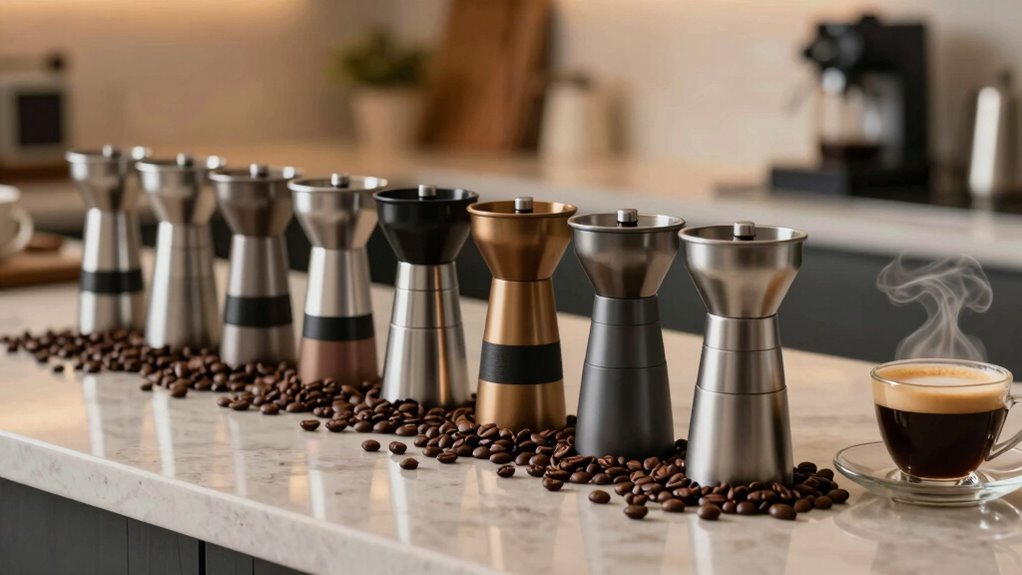

For a conical burr espresso grinder under $800, my best overall pick is the Tuni G2, whose 70 grind settings offer the broadest adjustment range in this lineup. The SHARDOR Professional stands out for its touchscreen controls, while the OXO Brew Compact is a sensible choice when counter space matters more than a large setting count. The main tradeoff is between fine-grained adjustment and straightforward operation: more settings can help with dialing in, but they do not guarantee better espresso. I compare all 15 models by control, usability, capacity, and upkeep so you can match the grinder to your routine. Read on for the full breakdown and buyer guidance.

Get coffee and tea gear delivered free with Prime
- Fast, free delivery on millions of items
- Prime Video, Amazon Music and more included
- Member-only deals all year
Complete the kit


Key Takeaways
- Tuni G2 leads on adjustment range: Its 70 settings exceed the 48- and 51-setting clusters found across several other models, giving espresso drinkers more room to tune grind size.
- Touchscreens are a recurring feature, not a performance guarantee: The Canoly, Tuni G1 and G2, AMZCHEF, and SHARDOR Professional add digital controls, but buyers should still prioritize repeatable dosing and useful adjustment.
- Capacity and footprint point to different routines: The OXO Brew model has a listed 12-ounce capacity, while the Compact version is the lineup’s space-conscious alternative.
- Setting counts bunch together: Several grinders offer 48 settings, so the deciding factors among them are more likely to be controls, timer behavior, cleaning access, and workflow than the headline number.
- There is no single feature that guarantees espresso results: Burr adjustment range, dosing consistency, and the ability to make small changes all matter; a long setting list alone is not proof of espresso suitability.




More Details on Our Top Picks
IAGREEA Conical Burr Coffee Grinder with 48 Grind Settings
The IAGREEA is the clearest fit here for espresso drinkers who want to grind straight into a portafilter: its holder accommodates 51 mm and 58 mm baskets, a practical advantage over the Hauscafe, whose supplied details do not specify portafilter support. Its 40 mm stainless steel conical burrs and 450 RPM motor are designed for steady, lower-speed grinding, while 48 settings cover espresso through French press. A 300 g hopper also holds more beans than the Canoly and Tuni G2’s 250 g hoppers. The tradeoff is limited product detail: dimensions and weight are not provided, and the listed features alone do not establish espresso-level grind consistency. I’d favor it for its portafilter-focused setup, but buyers wanting touchscreen controls should compare the Canoly instead.
Pros:- Portafilter holder supports both 51 mm and 58 mm baskets
- 40 mm stainless steel conical burrs and 450 RPM motor are designed for low-speed grinding
- 300 g hopper holds more beans than the Canoly and Tuni G2
- 48 settings cover a range of brewing styles
Cons:- Dimensions and weight are not provided, making counter-space planning difficult
- The supplied product details do not confirm grind consistency for dialing in espresso
Best for: Home espresso drinkers with 51 mm or 58 mm baskets who want a grinder with a portafilter holder and room for a larger bean load.
Not ideal for: Buyers who need published dimensions for a tight counter space or want touchscreen controls and clearly described dosing modes.
- Grind settings:48
- Burr type and size:40 mm stainless steel conical burr
- Motor speed:450 RPM
- Motor power:150 W
- Timer:Up to 40 seconds
- Bean hopper capacity:300 g
- Portafilter compatibility:51 mm and 58 mm baskets
- Housing:Fingerprint-resistant stainless steel
Our verdict“Choose the IAGREEA if direct grinding into a supported portafilter and a larger hopper matter more than touchscreen controls or detailed size information.”
Aromaster Coffee Bean Grinder with 48 Grind Settings
The Aromaster makes the most sense for households or small offices where one grinder needs to serve different brewing preferences. Its 48 grind settings span espresso to coarser methods, and the 3.9-ounce capacity is larger than the Tuni G2’s listed 250 g hopper. Anti-static features and a removable-parts cleaning setup with an included brush address two everyday annoyances, though more removable pieces can make cleanup less straightforward rather than effortless. Compared with the IAGREEA, the Aromaster’s supplied specs do not identify burr diameter, motor speed, or portafilter compatibility, so I’d be less confident choosing it specifically for espresso workflow. The fixed 120V, 60Hz requirement also makes it a poor match for buyers outside compatible electrical regions.
Pros:- 48 settings accommodate a wide range of brewing methods
- 3.9-ounce capacity is larger than the Tuni G2’s listed 250 g hopper
- Anti-static features are intended to reduce grounds mess
- Removable parts and an included brush support routine cleaning
Cons:- Supplied specifications do not state burr diameter, motor speed, or portafilter compatibility
- Multiple removable parts may make cleaning more involved
- 120V, 60Hz power limits suitability outside compatible regions
Best for: Households or small offices with multiple coffee routines that want a broad grind range, a relatively roomy hopper, and cleaning tools included.
Not ideal for: Espresso-focused buyers who need stated portafilter compatibility or burr and motor details, and international buyers without 120V, 60Hz power.
- Grind settings:48
- Capacity:3.9 ounces
- Burr material:Stainless steel
- Voltage and frequency:120V, 60Hz
- Timer:Adjustable up to 40 seconds
- Anti-static feature:Included
- Cleaning features:Removable parts and included brush
Our verdict“Pick the Aromaster for shared, varied brewing needs, but choose the IAGREEA if portafilter support and more detailed espresso-oriented specifications matter more.”
Hauscafe Electric Conical Burr Coffee Grinder with 38 Grind Settings
The Hauscafe is the straightforward choice for buyers who would rather start grinding with one-touch operation than sort through a touchscreen or a long list of controls. Its 38 settings still cover espresso through French press, though that is fewer adjustment points than the 48 offered by the Canoly and IAGREEA or the Tuni G2’s 70. That makes it a simpler, less fine-grained option on paper—not automatically a better espresso dial-in tool. Removable hopper and grounds container, plus an included brush, give it a clear cleaning advantage over models whose supplied descriptions say less about maintenance. The major drawback is sparse product information: capacity and dimensions are missing, and no portafilter support is specified. I’d choose it for basic home use, not for buyers who need documented espresso workflow details.
Pros:- One-touch operation keeps the control approach simple
- 38 settings cover espresso through French press
- Removable hopper and grounds container support cleaning access
- Cleaning brush is included
Cons:- Offers fewer grind settings than the Canoly, IAGREEA, or Tuni G2
- Capacity and dimensions are not provided
- Portafilter compatibility is not specified
Best for: New home coffee makers who want simple one-touch operation, a range of brew settings, and removable parts for cleaning.
Not ideal for: Espresso enthusiasts who want specified portafilter support, a larger number of grind adjustments, or known hopper capacity and dimensions.
- Grind settings:38
- Grinder type:Conical burr
- Operation:One-touch
- Removable components:Hopper and grounds container
- Cleaning accessory:Cleaning brush included
- Color:Black
Our verdict“Choose the Hauscafe for simple operation and removable cleaning parts, but look to the IAGREEA or Canoly for more documented espresso-oriented features.”
Canoly Electric Burr Coffee Grinder with 48 Grind Settings and Touchscreen
The Canoly stands apart from the button-first Hauscafe with a touchscreen and two dosing approaches: time-based and cup-based. That gives buyers a more configurable routine, while its 48 settings and 40 mm stainless steel conical burr bring it closer to the IAGREEA on core grind-range and burr-size details. The Canoly’s 250 g hopper is smaller than the IAGREEA’s 300 g capacity, so frequent brewing or shared use may mean more refills. Anti-static design is intended to cut down on grounds clinging or scattering, and the compact body suits tighter counters. However, the supplied details do not list portafilter compatibility, a meaningful gap for espresso buyers who want direct dosing. Choose this model for control convenience, not simply because a touchscreen promises finer espresso results.
Pros:- Touchscreen provides a direct control interface
- Time-based and cup-based dosing modes offer different routine options
- 48 grind settings and a 40 mm stainless steel conical burr
- Compact design and anti-static system are suited to tidier counters
Cons:- 250 g hopper is smaller than the IAGREEA’s 300 g capacity
- Portafilter compatibility is not specified
- Touchscreen controls may be unnecessary for buyers who prefer simple operation
Best for: Home brewers who want touchscreen operation, time- or cup-based dosing, and a compact grinder for varied coffee styles.
Not ideal for: Frequent or multi-person brewers who prefer a larger hopper, or espresso users who need confirmed portafilter compatibility.
- Burr size and type:40 mm stainless steel conical burr
- Grind settings:48
- Hopper capacity:250 g
- Power:150 W
- Timer:Up to 40 seconds
- Controls:Touchscreen
- Dosing modes:Time-based and cup-based
- Material:Stainless steel
Our verdict“Choose the Canoly if touchscreen dosing flexibility is your priority; favor the IAGREEA if a larger hopper and specified portafilter support matter more.”
Tuni G2 Conical Burr Coffee Grinder
With 70 grind settings, the Tuni G2 offers the broadest adjustment range in this group, making it the pick for buyers who want more steps to explore across espresso and coarser brewing. That is a larger range than the 48-setting Canoly and IAGREEA, although a higher setting count by itself does not prove better espresso consistency or guarantee useful step spacing. Its 400 RPM motor, 40 mm conical burrs, and anti-static features pair with a 250 g hopper and 100 g grounds container in a compact design. Compared with the IAGREEA, it trades some bean capacity for more adjustment points and a listed grounds-container capacity; compared with the Canoly, it has more settings but lacks a stated touchscreen or dosing modes. The extra choices can take patience to learn.
Pros:- 70 grind settings provide more adjustment points than the 48-setting Canoly and IAGREEA
- 40 mm conical burrs and a listed 400 RPM motor
- 100 g grounds container capacity is specified
- Compact design with anti-static features
Cons:- The number of settings may add a learning curve without guaranteeing better espresso results
- 250 g hopper is smaller than the IAGREEA’s 300 g capacity
- Touchscreen controls and dosing modes are not specified
Best for: Curious home brewers who like experimenting with grind adjustments across espresso and other brewing methods and want a compact grinder.
Not ideal for: Buyers who prefer a simpler setup, need a larger hopper than 250 g, or require stated touchscreen controls and dosing modes.
- Grind settings:70
- Burr type:Conical
- Burr diameter:40 mm
- Motor speed:400 RPM
- Hopper capacity:250 g
- Grounds container capacity:100 g
- Material:Stainless steel
- Color:Ivory
Our verdict“Choose the Tuni G2 if a wide range of grind adjustments matters more than touchscreen controls, a larger hopper, or a simpler learning process.”
SHARDOR Conical Burr Espresso Coffee Grinder with Precision Timer
The SHARDOR stands out for pairing 51 grind settings with a timer adjustable in 0.1-second increments, giving espresso drinkers more control over grind range and repeatable dosing than the OXO Brew’s simpler one-touch setup. Its portafilter cradle also makes direct grinding more convenient, while anti-static technology is intended to keep grounds from scattering around the counter. The cup selector adds flexibility for people who switch between espresso and larger brews, though cup counts are not a substitute for weighing coffee when precise espresso doses matter. Compared with the SHARDOR, the Conical Burr Coffee Grinder with Shot Timer offers fewer settings but specifies fit for both 51 mm and 58 mm portafilters. The main caveat is that the supplied product details do not establish real-world grind consistency or durability.
Pros:- 51 settings span espresso through French press
- Timer adjusts in 0.1-second increments for repeatable timed doses
- Portafilter cradle supports direct grinding
- Anti-static feature is designed to reduce grounds mess
Cons:- No real-world performance information is provided to verify grind consistency
- Portafilter diameter compatibility is not specified
- Cup-based dosing may be less precise than weighing beans for espresso
Best for: Home espresso drinkers who want fine timer adjustments, a wide grind range, and direct-to-portafilter grinding.
Not ideal for: Buyers who need confirmed performance results or exact portafilter compatibility beyond what the supplied product details state.
- Burr type:Conical
- Burr material:Stainless steel
- Burr diameter:40 mm
- Grind settings:51
- Timer:Up to 60 seconds, adjustable in 0.1-second increments
- Cup selection:1 to 12 cups
- Features:Touchscreen, anti-static technology, portafilter cradle
Our verdict“Choose the SHARDOR if fine timer control and a broad grind range matter more than documented performance or specified portafilter sizing.”
Conical Burr Coffee Grinder with Anti-Static Design and Shot Timer
This grinder’s clearest advantage is its stated compatibility with 51 mm and 58 mm portafilters, a useful detail missing from the SHARDOR listing. Its touchscreen offers timed or cup-based grinding, and timer memory recalls the previous setting to simplify repeat doses. That makes it a practical choice for households with more than one compatible espresso machine, though its 34 settings give less adjustment range than the SHARDOR’s 51 or the Tuni G1’s 48. Anti-static design and direct-to-portafilter grinding address everyday mess and workflow, but the provided information does not confirm how well the grinder handles fine espresso settings in practice. Buyers seeking a more clearly specified hopper capacity or footprint should compare the Tuni G1, whose product data includes both.
Pros:- Specifies compatibility with both 51 mm and 58 mm portafilters
- Timer memory recalls the previous timed setting
- Timed and cup-based touchscreen controls offer multiple dosing approaches
- Anti-static design and portafilter holder support a tidier workflow
Cons:- 34 settings provide fewer adjustment points than the SHARDOR and Tuni G1
- No hopper capacity or grinder dimensions are specified
- Supplied information gives no performance results for espresso grinding
Best for: Espresso households using 51 mm or 58 mm portafilters that want saved timer settings for repeatable daily doses.
Not ideal for: Buyers who prioritize the widest grind adjustment range or want product details covering capacity and dimensions.
- Burr type:Conical
- Burr material:Stainless steel
- Burr diameter:40 mm
- Grind settings:34
- Timer precision:0.1 seconds
- Controls:Touchscreen with cup and time control; recalls the last timer setting
- Portafilter compatibility:51 mm and 58 mm
- Anti-static design:Yes; designed to help reduce clumping and scattered grounds
Our verdict“Pick this model if your portafilter size and remembered timer setting matter more than having the most grind adjustments.”
Tuni G1 Conical Burr Coffee Grinder, 48 Grind Settings, Anti-static Burr Mill, Electronic Timer, LED Touchscreen, Stainless Steel, Ivory
At 7.08 x 4.52 inches across, the Tuni G1 has the most clearly stated compact footprint in this group, making it easier to place on a crowded counter than the OXO Brew, which is described as potentially bulky. It still provides 48 grind settings, a 250 g hopper, and a portafilter holder, so its smaller footprint does not mean giving up basic espresso-focused workflow features. The SHARDOR offers more settings and finer stated timer increments, while this Tuni supplies useful capacity and dimensions that the SHARDOR listing omits. Its listed 450 RPM speed and anti-static system add specification detail, but the supplied data does not show how these translate into grind quality or noise. Choose it for fit and stated capacity, not for proven espresso performance.
Pros:- Compact stated footprint suits crowded counters
- 48 settings cover espresso through French press
- 250 g hopper reduces the need for frequent refilling
- Portafilter holder and soft brush support routine use and cleaning
Cons:- Timer adjustment precision is not specified
- Noise level is not stated
- No performance results are provided to validate espresso consistency
Best for: Espresso drinkers with limited counter space who want a compact grinder with a reasonably broad range and a sizable hopper.
Not ideal for: Buyers who need stated 0.1-second timer precision, confirmed noise information, or documented espresso grind results.
- Burr type:Conical
- Burr size:40 mm
- Grind settings:48
- Speed:450 RPM
- Hopper capacity:250 g
- Grounds container capacity:75 g
- Dimensions:7.08 x 4.52 x 14.0 inches
- Finish:Stainless steel, ivory
Our verdict“The Tuni G1 is a sensible fit-first choice for compact kitchens, while the SHARDOR is better specified for fine timer adjustment.”
AMZCHEF Conical Burr Coffee Grinder with Touchscreen, 48 Grind Settings, Anti-Static, Stainless Steel
The AMZCHEF is the capacity-focused option here, with a stated 10.6-ounce hopper and UV protection for beans—details that suit people who prefer keeping a larger supply loaded. Its 48 settings match the Tuni G1’s count, while a touchscreen and anti-static feature promise a more controlled, tidier routine than the OXO Brew’s simpler one-touch controls. The tradeoff is that the product information does not specify a timer, portafilter holder, or dimensions, so espresso workflow and counter fit are harder to judge. The SHARDOR is more explicit about timed dosing and direct portafilter grinding; the AMZCHEF makes more sense when hopper capacity and bean-storage features take priority. Its broad controls may also feel like extra complexity for a buyer who only wants a basic grinder.
Pros:- 10.6-ounce hopper supports fewer refills
- UV protection is included for the bean hopper
- 48 settings cover multiple brewing methods
- Touchscreen and anti-static feature support controlled, less-messy grinding
Cons:- Timer and portafilter-holder details are not provided
- Dimensions are not listed, making counter fit difficult to assess
- Touchscreen controls may be more involved than needed for simple daily grinding
Best for: Home coffee drinkers who make several drinks between refills and value a large hopper with UV protection.
Not ideal for: Espresso users who want a specified shot timer, direct-to-portafilter holder, or published dimensions before buying.
- Burr type:Conical
- Burr material:Stainless steel
- Burr size:40 mm
- Grind settings:48
- Hopper capacity:10.6 ounces
- Controls:LED touchscreen
- Anti-static:Yes
- Bean protection:UV protection
Our verdict“Choose the AMZCHEF if hopper capacity and UV protection matter more than a clearly specified espresso dosing workflow.”
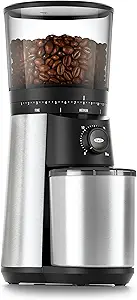
OXO Brew Conical Burr Electric Coffee Grinder – 12 oz Capacity, Stainless Steel Burrs, 15 Grind Settings
The OXO Brew takes a simpler route than the touchscreen grinders in this roundup: one-touch start, a removable 12 oz hopper, and a static-fighting grounds container keep the routine straightforward. Its stainless steel conical burrs and 15 settings cover a range of brewing methods, but that smaller adjustment count makes it less flexible for dialing espresso than the SHARDOR’s 51 settings or the Tuni G1’s 48. The product description includes espresso in its grind range, yet it offers no digital timer or display for repeating timed doses. That makes this a better match for buyers who value uncomplicated operation and capacity over detailed espresso controls. Its stated capacity is slightly larger than the AMZCHEF’s, but its design may take up more counter space.
Pros:- One-touch start keeps operation simple
- 12 oz removable hopper limits frequent refills
- Stainless steel conical burrs
- Static-fighting grounds container supports tidier dispensing
Cons:- 15 settings offer fewer adjustment points than the other listed grinders
- No digital timer or display for repeating timed doses
- May be bulky for small kitchens
Best for: Coffee drinkers who want a straightforward, one-touch grinder with a large hopper and do not need fine digital dosing controls.
Not ideal for: Espresso-focused buyers who want many grind adjustments, a shot timer, or a compact grinder for a small counter.
- Burr type:Conical
- Burr material:Stainless steel
- Grind settings:15
- Hopper capacity:12 oz
- Motor:DC
- Operation:One-touch start
- Grounds container:Static-fighting container
Our verdict“Pick the OXO Brew for simple controls and a large hopper, but choose the SHARDOR or Tuni G1 for more espresso grind adjustments.”
OXO Brew Compact Conical Burr Electric Coffee Grinder
For espresso drinkers short on counter space, the OXO Brew Compact is the most storage-friendly choice here: its 4-inch width and cord wrap suit a small kitchen better than the larger-hopper options from KIDISLE or Ollygrin. Its 15 settings plus 29 micro-adjustments offer fine tuning across the stated fine-to-coarse range, though the listing does not spell out how reliably those steps support dialing in espresso. The 50 g capacity keeps the footprint modest but means refilling for larger batches, unlike the much roomier KIDISLE hopper. Removable upper and lower burrs, along with a chuteless design, make cleanup less of a chore. I’d choose it for compactness and easy maintenance, not for grinding large quantities at once.
Pros:- Compact 4-inch-wide body and cord wrap simplify storage.
- Fifteen settings plus 29 micro-adjustments provide a broad adjustment range.
- Removable upper and lower burrs make deeper cleaning easier.
- Chuteless design helps limit grounds left behind during cleanup.
Cons:- The 50 g bean capacity is small beside the KIDISLE and Ollygrin hoppers.
- The product details do not clarify the espresso-specific range or adjustment increments.
Best for: Espresso drinkers in small kitchens who want fine grind adjustments, straightforward cleaning, and a grinder that stores easily.
Not ideal for: Households grinding beans for several people or multiple brewing rounds at once; the 50 g capacity calls for frequent refills.
- Grinder type:Electric conical burr
- Burr material:Stainless steel
- Grind adjustments:15 settings and 29 micro-adjustments
- Bean capacity:50 g
- Brewing capacity:Up to 6 cups (30 oz)
- Dimensions:11 in tall × 4 in wide
- Cleaning:Removable upper and lower burrs; chuteless design
- Hopper and grounds container:Tritan Renew with certified recycled content
Our verdict“Choose the OXO Brew Compact if storage and easy cleaning matter more than hopper capacity.”
KIDISLE Conical Burr Coffee Grinder – Electric Espresso Grinder with 51 Grind Settings and Electronic Timer
The KIDISLE suits espresso drinkers who also grind for other brew methods and want to keep more beans loaded between sessions. Its 51 settings give it a broader stated range than the OXO Brew Compact’s 15 settings, while its 12.5-ounce hopper is the largest capacity specified among these five picks. A 1–60-second timer adds repeatable control over grinding time, although the listing does not describe dosing by weight or explain how to set a precise espresso dose. Compared with the SHARDOR Professional, KIDISLE offers more listed settings and a larger hopper, while SHARDOR specifies anti-static technology and one-second timer increments. The tradeoff is a potentially busier setup: beginners may find 51 choices harder to manage, and noise information is absent.
Pros:- Fifty-one settings cover a wide range of brewing methods.
- The 12.5-ounce hopper reduces how often beans need to be reloaded.
- A 1–60-second electronic timer supports repeatable grinding time.
- Stainless-steel burr and hopper materials are specified.
Cons:- The number of settings may make dialing in more confusing for new espresso drinkers.
- No noise level or espresso-dose guidance is provided.
- The listing gives no burr size or cleaning details.
Best for: Home espresso drinkers who switch between espresso and other brew methods and want a large hopper with timed grinding.
Not ideal for: Beginners seeking a simple, clearly explained espresso dial-in process, or buyers who need published noise information.
- Grind settings:51
- Timer:1–60 seconds
- Hopper capacity:12.5 oz
- Burr size:40 mm
- Burr material:Stainless steel
Our verdict“Pick the KIDISLE if you want a large hopper and many grind choices more than a beginner-simple interface.”
SHARDOR Professional Conical Burr Coffee Grinder with 48 Settings and Touchscreen
The SHARDOR Professional earns its place for buyers who want a digital workflow and a specific measure to reduce grounds mess. Its anti-static technology is the distinguishing feature against the KIDISLE, which lists more settings and a larger hopper but provides no anti-static claim. SHARDOR offers 48 grind settings and a timer adjustable up to 40 seconds in one-second increments, giving users a defined way to repeat grind duration. That range is slightly narrower than the KIDISLE’s 51 settings, and its 9.7-ounce hopper is smaller than KIDISLE’s 12.5-ounce capacity. The touchscreen may appeal to people who prefer visible controls, but the product details provide little information about durability, warranty, or included cleaning tools. I’d prioritize its mess-reduction feature over assumptions about long-term support.
Pros:- Anti-static technology is intended to reduce grounds sticking and scattering.
- Forty-eight settings support switching between espresso and coarser brew methods.
- Timer adjusts up to 40 seconds in one-second increments.
- LCD touchscreen provides a digital control interface.
Cons:- Its 9.7-ounce hopper is smaller than the KIDISLE’s 12.5-ounce hopper.
- Durability and warranty information are not specified.
- No cleaning tools or accessories are listed.
Best for: Home baristas who make espresso and other brews, prefer touchscreen controls, and want an anti-static feature to help limit mess.
Not ideal for: Buyers who need published durability or warranty details, included cleaning accessories, or the largest hopper in this group.
- Grind settings:48
- Timer:Up to 40 seconds in 1-second increments
- Bean hopper capacity:9.7 oz
- Technology:Anti-static
- Material:Stainless steel
- Controls:LCD touchscreen
Our verdict“Choose the SHARDOR Professional if its anti-static design and timed touchscreen controls matter more than maximum hopper capacity.”
Conical Burr Coffee Grinder with 51 Precise Settings and LED Display
This grinder is the clearest fit for espresso owners who want a listed portafilter connection rather than just a broad grind range. Its compatibility with 51 mm to 58 mm portafilters separates it from the KIDISLE and SHARDOR Professional, whose supplied details do not specify portafilter fit. The 51 settings, dual cup-and-timer controls, and memory function offer plenty of ways to save a repeatable routine, but they may feel like excess controls to someone who only makes espresso. Anti-static design and a removable hopper support easier upkeep; the larger form may take more counter space than the compact OXO Brew Compact. The description does not give dimensions or timer increments, so buyers cannot judge its footprint or time precision from the listing alone.
Pros:- Listed compatibility covers 51 mm to 58 mm portafilters.
- Dual cup and timing modes allow different approaches to repeatable grinding.
- Memory function can retain preferred settings.
- Anti-static design and removable hopper support easier cleaning.
Cons:- The larger size may be awkward on limited counter space, though dimensions are not provided.
- Multiple modes and 51 settings may overwhelm beginners.
- Timer increments and hopper capacity are not specified.
Best for: Home espresso owners with a 51 mm to 58 mm portafilter who want multiple control modes and saved settings.
Not ideal for: Small-kitchen buyers or new users who want a compact grinder with a simple, clearly explained control setup.
- Burr size and type:40 mm stainless steel conical burrs
- Grind settings:51
- Cup capacity:1–12 cups
- Display:LED digital display
- Control modes:Cup and timing modes
- Portafilter compatibility:51 mm to 58 mm
- Additional features:Memory function, anti-static design, removable hopper
Our verdict“Choose this model if portafilter compatibility and saved control settings are priorities and you have room for a larger grinder.”
Ollygrin Electric Conical Burr Coffee Grinder with 30 Grind Settings
The Ollygrin takes a more straightforward middle ground: its 30 settings are fewer than the 48 on the SHARDOR Professional and 51 on the KIDISLE, but the controls may be easier to approach if you do not need dozens of fine options. Its 10-ounce hopper is much larger than the OXO Brew Compact’s 50 g capacity, making it better suited to repeated brewing without constant refills. The listing also names a friction clutch and overheating protection, plus an auto-locking hopper, giving this model a more explicit safety-feature set than the other four. For espresso, however, 30 settings may offer less room to fine-tune than the 48- and 51-setting alternatives. It includes a brush and removable upper burr, but the supplied information does not state noise, timer, or dosing controls.
Pros:- Thirty settings cover espresso through French press without an especially large setting count.
- The 10-ounce hopper holds far more than the OXO Brew Compact’s 50 g capacity.
- Friction clutch and overheating protection are specified.
- Removable upper burr and included brush support cleaning.
Cons:- Fewer settings than the SHARDOR Professional and KIDISLE may limit fine espresso adjustment.
- No timer or digital dosing controls are listed.
- Noise level and dose consistency details are not provided.
Best for: Everyday home coffee drinkers who want a roomy hopper, moderate grind adjustment, and specified safety features.
Not ideal for: Espresso enthusiasts who want the widest adjustment range or a timer and digital controls for repeatable dosing.
- Burr type:Stainless steel conical
- Burr size:40 mm
- Grind settings:30
- Bean hopper capacity:10 oz
- Cup settings:2–12 cups
- Safety features:Friction clutch and overheating protection
- Cleaning:Removable upper burr; cleaning brush included
Our verdict“Pick the Ollygrin for a larger hopper and stated safety features, but choose a 48- or 51-setting option for more espresso adjustment choices.”

How We Picked
I compared the 15 listed grinders by the factors that affect home espresso decisions: grind adjustment range, control and timer design, stated capacity, footprint, cleaning access, and the clarity of the listed features. I gave greater weight to traits that can help a buyer make repeatable adjustments than to a long feature list on its own. The product names provide some useful distinctions—for example, the Tuni G2’s 70 settings, the OXO Brew’s stated 12-ounce capacity, and the OXO Compact’s space-saving positioning—but they do not establish grind consistency, burr quality, or shot performance.
The ranking therefore separates products by their clearest stated strengths and likely buyer fit, rather than treating settings or touchscreen controls as proof of superior espresso. Models with specific workflow or space advantages earn a distinct role; products with similar setting counts are harder to rank confidently without verified details on adjustment precision, retention, or espresso-range performance. This is a shortlist within the requested under-$800 category, not a claim that every listed model has been independently tested or confirmed at a particular price.
Factors to Consider When Choosing Conical Burr Espresso Grinder Under 800
Choosing an espresso grinder takes more than comparing the number of grind settings. I would first match the grinder to the way you prepare coffee, then check whether its controls and maintenance demands fit your daily routine. These broader checks can help prevent paying for features that do little for your shots.
Check That the Adjustment Range Suits Espresso
A grinder can list dozens of settings without making small, repeatable espresso adjustments easy. Look for information about how the adjustment mechanism works and whether the manufacturer identifies espresso as a supported use. A broad range is useful if you also brew drip or French press, but espresso often needs especially fine changes as beans age or humidity shifts. Do not treat a high setting count as a substitute for evidence about grind consistency. If you cannot find clear information on espresso adjustment, contact the seller or choose a model with better-documented capabilities.
Prioritize Repeatable Dosing Over Extra Controls
A timer, touchscreen, or shot counter can make a routine easier to repeat, but it does not automatically dose the same amount of coffee each time. Check whether the grinder offers timed grinding, what the timer controls, and whether you can adjust it in useful increments. If you weigh beans before grinding, a complex display may add little to your workflow. If you grind into a portafilter, check that the outlet and holder arrangement suit your equipment. A simple control scheme that you can use consistently may serve you better than a crowded feature set.
Match Hopper Size and Footprint to Your Routine
A large hopper suits households that grind several coffees in succession, while a compact design can matter more in a small kitchen. Larger capacity does not mean you need to store beans in the grinder: frequent exposure to air and light can work against freshness. Measure your available counter height as well as width, especially if the grinder will sit beneath cabinets. Think about where you will keep beans and accessories before choosing a larger unit. The right capacity is the one that supports your routine without making the grinder awkward to place or maintain.
Treat Static and Retention as Practical Questions
Static can scatter grounds around the counter, and retained coffee can make the next dose less predictable. Product claims such as anti-static are helpful clues, but buyers should look for specifics about the grounds path, removable parts, and cleaning instructions. A brush included with a grinder can help with routine care, though it does not answer how much coffee remains inside after grinding. If you switch beans often or weigh each dose, retention deserves more attention than a decorative control panel. Check whether cleaning requires tools or disassembly you may not want to do regularly.
Decide Which Workflow You Actually Want
Hopper-fed grinding is convenient when you prepare several drinks from the same beans, while single-dose grinding can suit people who rotate beans or prefer weighing each dose. These routines place different demands on capacity, retention, and ease of cleaning. Before buying, decide whether you want to leave beans in the hopper or load only what you need for each session. Then check whether the grinder’s timer and container setup support that approach. Choosing by workflow can prevent paying for capacity or controls you rarely use.
Set a Realistic Budget for the Whole Espresso Setup
Even within an under-$800 search, the grinder is only one part of the setup: a machine, tamper, scale, and cleaning supplies may also matter. Spending more on a grinder makes sense when it provides a clear benefit you will use, such as finer adjustment, a better fit for your counter, or a more suitable dosing workflow. It makes less sense to pay extra for a touchscreen if you prefer weighing doses manually. Compare warranty terms, replacement-part access, and cleaning needs alongside the feature list. A well-matched grinder is a better purchase than the model with the longest specification sheet.
Frequently Asked Questions
Are all 15 grinders confirmed to cost less than $800?
The lineup is framed around the under-$800 search, but prices and availability can change by seller, region, and time. The supplied product details do not establish a current price for every model. Check the live listing and confirm the exact model before buying, especially when a product name has several versions. Also compare the warranty and included accessories, since those can affect the total cost of setting up your grinder.
Does a grinder with 70 settings make better espresso than one with 48?
Not by itself. More settings can provide more adjustment points, which may help when dialing in espresso, but the number does not reveal how evenly the burrs grind or how much change each step produces. A grinder with fewer, well-spaced adjustments can be easier to use than one with many steps that are hard to distinguish. Look for documented espresso suitability and repeatable adjustment, then treat the setting count as one part of the decision.
Should I choose a touchscreen grinder or a simpler control panel?
Choose based on the way you dose, not the screen alone. A touchscreen may make timer settings easier to change, while a simpler interface can be quicker if you use the same routine every morning. Neither control type proves that grind output will be consistent. Check whether the timer can be set in useful increments and whether the controls are easy to understand without relying on a phone or manual. If you weigh beans separately, advanced timing features may matter less.
Is the OXO Brew Compact a better choice for a small kitchen than the 12-ounce OXO Brew?
The Compact model is the clearer candidate when counter space is limited, while the standard OXO Brew listing specifies a 12-ounce capacity that may suit a household grinding multiple servings. Capacity and footprint are separate needs: a larger hopper does not automatically mean a better fit for your kitchen. Check the actual dimensions and clearance under your cabinets before deciding, since the product names alone do not provide measurements. Also consider whether you prefer to keep beans in a hopper or grind smaller amounts as needed.
What should I verify before choosing a grinder specifically for espresso?
Confirm that the manufacturer supports espresso grinding and look for clear information about fine adjustment, not just a general range of settings. Check whether the grinder can make changes small enough for your machine and beans, and whether it doses in a way that matches your routine. Cleaning access, retained grounds, and the portafilter setup can affect daily use as much as display features. If those details are missing from a listing, seek the manual or seller’s specifications before committing. This extra check is especially useful for models whose names make espresso claims without explaining their adjustment design.
Conclusion
For most buyers comparing this lineup, I would start with the Tuni G2 as best overall because its 70 listed settings give it the broadest adjustment range. For the best value, compare the 48-setting IAGREEA, Aromaster, Hauscafe, Tuni G1, Canoly, AMZCHEF, and SHARDOR options by their controls, cleaning details, and warranty rather than assuming their similar setting counts make them interchangeable. I would reserve best premium for whichever model offers verified construction and support details that justify its position, since the supplied specifications alone do not establish a premium build winner. For beginners, the OXO Brew line is a straightforward shortlist to compare, with the Compact suited to tighter counters and the 12-ounce model to higher-capacity routines. If your specific need is the widest listed adjustment range, choose the Tuni G2; if it is touchscreen operation, compare the SHARDOR Professional, Canoly, AMZCHEF, and Tuni models; and if it is compact placement, investigate the OXO Brew Compact’s dimensions before deciding.
Halloween Picks

12.5-Foot Lighted Halloween Inflatable Archway

10ft Halloween Inflatable Archway – Pumpkin Skeleton Yard Décor

10.5 ft Lighted Pumpkin and Ghost Halloween Inflatable Archway
As an affiliate, we earn on qualifying purchases.