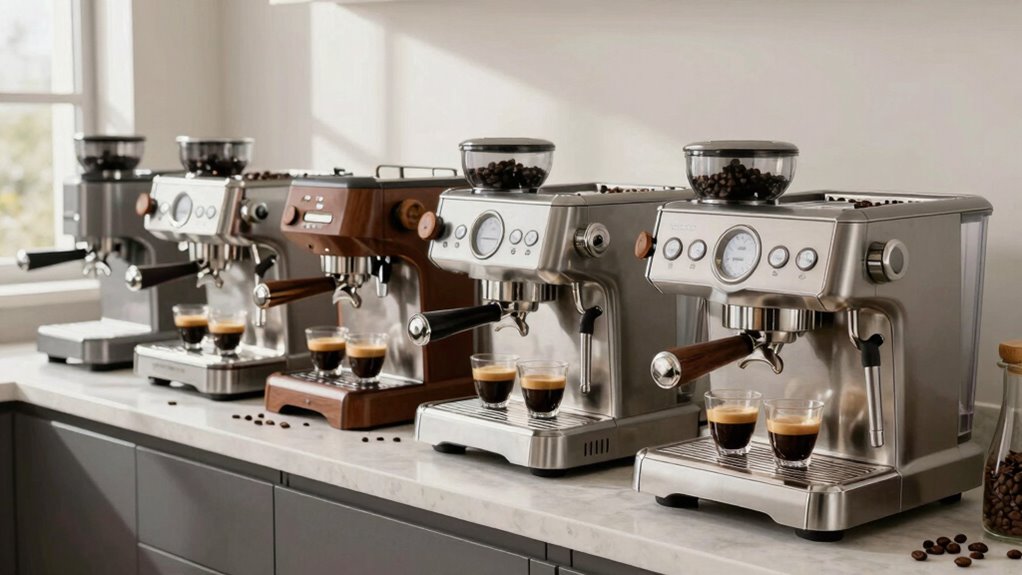

For a prosumer espresso machine under $3,000, my best overall pick is the Meraki MEM03 Gen2, which combines a dual boiler, grinder, and built-in scales in one setup. The Rancilio Silvia Pro X is a strong alternative for buyers who want separate boilers and a more traditional machine-and-grinder workflow, while the Breville Bambino keeps the entry point compact and simple. The main tradeoff is whether to prioritize integrated convenience, upgrade flexibility, or a smaller footprint. I compare all seven options by capability, usability, and likely fit for different home routines. Read on for the full breakdown and guidance on choosing the right machine for your counter and coffee habits.

Get coffee and tea gear delivered free with Prime
- Fast, free delivery on millions of items
- Prime Video, Amazon Music and more included
- Member-only deals all year
Complete the kit


Key Takeaways
- The Meraki MEM03 Gen2 is the most integrated choice: its dual boilers, grinder, and built-in scales reduce the number of separate pieces of equipment, but leave less room to choose or upgrade those parts individually.
- The Rancilio Silvia Pro X favors espresso-focused control: it offers a dual-boiler setup without a built-in grinder, so buyers can select their own grinder and replace it independently.
- The Bambino and Barista Express serve different entry-level needs: the Bambino is the more compact machine-only option, while the Barista Express pairs espresso brewing with an integrated grinder.
- The Diletta Bello is the traditional-machine choice: its semi-automatic format suits buyers who want a dedicated machine and are comfortable building a separate grinder setup.
- The two Gaggia Classic models share a familiar manual approach: choose between the Cherry Red Classic Pro and Brushed Stainless Steel Classic Evo Pro based on the specific model and finish you want, not an assumption that the color alone signals a capability difference.
| Meraki MEM03 Gen2 Dual Boiler Espresso Machine with Grinder and Built-In Scales |  | Best Integrated Precision Setup | Machine type: Semi-automatic espresso machine | Boiler capacity: 350 ml brew boiler; 550 ml steam boiler | Grinder settings: 45 marked settings with micro-adjustment | VIEW ON AMAZON | See Our Full Breakdown |
| Rancilio Silvia Pro X Espresso Machine, 1 Liter, Stainless Steel |  | Best for Traditional Dual-Boiler Control | Boiler type: Dual boiler | Capacity: 1 liter | Material: Stainless steel | VIEW ON AMAZON | See Our Full Breakdown |
| Breville Bambino Espresso Machine, Brushed Stainless Steel |  | Best Compact Entry to Prosumer Espresso | Model: BES450BSS | Heating system: ThermoJet | Heat-up time: 3 seconds | VIEW ON AMAZON | See Our Full Breakdown |
| Diletta Bello Semi-Automatic Espresso Machine, Stainless Steel |  | Best for Hands-On Heat-Exchanger Brewing | Boiler: Insulated stainless-steel heat exchanger | Controls: Manual brew and steam controls | Capacity: 3 liters | VIEW ON AMAZON | See Our Full Breakdown |
| Breville Barista Express Espresso Machine, Black Truffle |  | Best Value Integrated Grinder Setup | Operation mode: Semi-automatic | Grinder: Integrated precision conical burr grinder | Water tank capacity: 67 fl oz | VIEW ON AMAZON | See Our Full Breakdown |
| Gaggia RI9380/47 Classic Pro Espresso Machine, 1.3 liters, Cherry Red |  | Best for Traditional Home Baristas | Housing material: Solid steel | Capacity: 1.3 liters | Pressure: 9 bar | VIEW ON AMAZON | See Our Full Breakdown |
| Gaggia RI9380/46 Classic Evo Pro Espresso Machine, Brushed Stainless Steel |  | Best Stainless-Steel Workhorse | Material: Steel | Capacity: 2.1 liters | Extraction pressure: 9 bar | VIEW ON AMAZON | See Our Full Breakdown |
| prosumer espresso machine under 3000 | Dimensions | Weight | Capacity |
|---|---|---|---|
| Meraki MEM03 Gen2 Dual Boiler | 14.57 × 14.57 × 16.33 in (D × W × H) | 15 kg | — |
| Rancilio Silvia Pro X Espresso | — | — | 1 liter |
| Breville Bambino Espresso Mach | 13.7 × 6.3 × 12 in (D × W × H) | 10.9 lb | — |
| Diletta Bello Semi-Automatic E | 17.75 × 11 × 14.5 in (D × W × H) | 50 lb | 3 liters |
| Breville Barista Express Espre | 13.8 × 12.5 × 15.9 in | 22.1 lb | — |
| Gaggia RI9380/47 Classic Pro E | — | — | 1.3 liters |
| Gaggia RI9380/46 Classic Evo P | 8"D x 9.5"W x 14.2"H | 20 pounds | 2.1 liters |
More Details on Our Top Picks
Meraki MEM03 Gen2 Dual Boiler Espresso Machine with Grinder and Built-In Scales
The Meraki MEM03 Gen2 is the most self-contained choice here for buyers who want control over both grinding and extraction without assembling a separate grinder-and-machine setup. Its integrated grinder and built-in scales let you measure dose and yield at the machine, while the 45 settings with micro-adjustment give room to tune different beans. Unlike the Rancilio Silvia Pro X, it includes a grinder and scales, but the Rancilio’s established dual-boiler focus may appeal more to buyers who already own a grinder and want a simpler machine purchase. Meraki’s dual boilers, PID control, heated grouphead, and pre-infusion support repeatable shots and simultaneous steaming. The tradeoff is a 120-volt specification, 15 kg weight, and a less familiar brand than Rancilio or Breville.
Pros:- Integrated grinder has 45 marked settings plus micro-adjustment.
- Built-in scales measure dose and espresso yield to a stated accuracy within 0.2 g.
- Dual boilers allow brewing and milk steaming at the same time.
- PID control, a heated grouphead, and controlled pre-infusion support extraction adjustments.
Cons:- The 120-volt specification may not suit electrical standards in some regions.
- At 15 kg, it is cumbersome to move or reposition.
- The integrated grinder and scales mean fewer reasons to choose this if you already own preferred versions of those tools.
Best for: Home baristas who want a single machine with an adjustable grinder, dose-and-yield weighing, and separate brew and steam boilers.
Not ideal for: Buyers outside 120-volt regions, or those who already own a preferred grinder and want a lighter, simpler machine.
- Machine type:Semi-automatic espresso machine
- Boiler capacity:350 ml brew boiler; 550 ml steam boiler
- Grinder settings:45 marked settings with micro-adjustment
- Scale accuracy:Within 0.2 g
- Pump pressure:9 bar
- Portafilter:58 mm, E61-compatible
- Water capacity:2 liters
- Dimensions:14.57 × 14.57 × 16.33 in (D × W × H)
- Weight:15 kg
Our verdict“Choose the Meraki if you want a feature-rich, all-in-one dual-boiler setup with built-in weighing, and skip it if you already have a grinder or need a lighter machine.”
Rancilio Silvia Pro X Espresso Machine, 1 Liter, Stainless Steel
The Rancilio Silvia Pro X suits buyers who want a dedicated espresso machine built around temperature management and hands-on shot control. Its dual boilers support brewing while steaming, and adjustable low-pressure pre-infusion gives users another way to shape extraction. A shot timer and programmable auto-on add practical help without turning the machine into an automatic workflow. Compared with the Meraki MEM03 Gen2, the Silvia Pro X does not include a grinder or built-in scales, so it makes more sense for someone with a grinder already chosen—or willing to select one separately. Its feature set is also more involved than the Breville Bambino, which prioritizes quick startup and compact size. The main tradeoffs are a steeper learning curve and a stated 1-liter capacity that may feel limiting for frequent, larger-volume service.
Pros:- Dual boilers allow simultaneous brewing and steaming.
- PID temperature control supports consistent brew temperature.
- Adjustable low-pressure pre-infusion gives users control over the start of extraction.
- Shot timer and programmable auto-on add useful workflow cues and scheduling.
Cons:- A separate grinder is required, unlike the Meraki MEM03 Gen2 and Breville Barista Express.
- Advanced controls can add a learning curve for new espresso makers.
- The stated 1-liter capacity may not suit frequent high-volume use.
Best for: Experienced home espresso drinkers who own or plan to choose a separate grinder and want dual boilers, adjustable pre-infusion, and scheduled startup.
Not ideal for: Beginners seeking a compact, quick-to-learn machine, or households that need a larger stated capacity for serving many drinks.
- Boiler type:Dual boiler
- Capacity:1 liter
- Material:Stainless steel
- Temperature control:PID
- Pre-infusion:Adjustable low-pressure
- Shot timer:Included
- Auto-on:Programmable
Our verdict“Pick the Silvia Pro X if you want a dedicated dual-boiler machine and have a grinder plan; choose the Bambino for simpler, more compact everyday espresso.”
Breville Bambino Espresso Machine, Brushed Stainless Steel
The Breville Bambino is the compact, lower-complexity option for buyers who want manual espresso preparation without giving up temperature control or adjustable milk texture. Its ThermoJet system heats in 3 seconds, which makes a quick morning shot more practical than waiting for a larger machine to warm up. PID control and low-pressure pre-infusion support more controlled extraction, while the automatic steam wand reduces the skill needed to texture milk. Compared with the Rancilio Silvia Pro X or Diletta Bello, it gives up dual-boiler or heat-exchanger simultaneous brewing and steaming; it is built around small size and convenience instead. It also has a 54 mm portafilter and requires ground coffee, so buyers seeking a 58 mm setup or integrated grinder should look to the Meraki MEM03 Gen2 or Barista Express.
Pros:- ThermoJet system reaches extraction temperature in 3 seconds.
- Compact dimensions suit kitchens with limited counter space.
- PID control and low-pressure pre-infusion support more controlled shots.
- Automatic steam wand offers adjustable milk temperature and texture.
Cons:- Requires separately ground coffee and does not include a grinder.
- Its 54 mm portafilter differs from the 58 mm format on the Meraki MEM03 Gen2.
- Does not offer the dual-boiler or heat-exchanger workflow of the Rancilio Silvia Pro X and Diletta Bello.
Best for: Newer home baristas with limited counter space who want fast heat-up, guided milk texturing, and room to practice manual espresso preparation.
Not ideal for: Buyers who want an integrated grinder, a 58 mm portafilter, or to brew and steam simultaneously.
- Model:BES450BSS
- Heating system:ThermoJet
- Heat-up time:3 seconds
- Portafilter size:54 mm
- Portafilter dose:19 g
- Water capacity:47 fl oz
- Dimensions:13.7 × 6.3 × 12 in (D × W × H)
- Weight:10.9 lb
Our verdict“Choose the Bambino for compact, fast-starting espresso and easier milk steaming, but look elsewhere if integrated grinding or simultaneous brew-and-steam capability matters.”
Diletta Bello Semi-Automatic Espresso Machine, Stainless Steel
The Diletta Bello is the hands-on choice for buyers who value a substantial stainless-steel machine and want to brew and steam at once without moving to a dual-boiler design. Its heat-exchanger boiler supports that workflow, while manual brew and steam controls keep operation direct and tactile. The 3-liter capacity also gives it a different scale from the Breville Bambino, which favors a compact footprint and quick startup, and the Rancilio Silvia Pro X, which offers dual boilers and PID control. The Bello’s appeal is its traditional, manual approach rather than a long list of electronic conveniences; an optional 60-minute eco timer is the one listed automation feature. At 50 lb and nearly 18 inches deep, it needs a settled counter location, and buyers seeking automated temperature control should compare it with the Rancilio.
Pros:- Heat exchanger supports brewing and steaming at the same time.
- Stainless-steel case, frame, and insulated boiler offer a substantial all-metal construction.
- Manual brew and steam controls suit users who want direct control.
- 3-liter capacity is larger than the stated capacity of the Rancilio Silvia Pro X.
Cons:- At 50 lb, it is difficult to move or reposition.
- Manual operation demands more involvement than the Bambino’s automatic steam wand.
- No PID temperature control is listed, unlike the Rancilio Silvia Pro X and Breville Bambino.
Best for: Experienced home baristas who prefer manual controls, want simultaneous brewing and steaming, and have room for a heavy stainless-steel machine.
Not ideal for: Small-kitchen owners, frequent movers, or buyers who want PID temperature control and a lighter, more automated workflow.
- Boiler:Insulated stainless-steel heat exchanger
- Controls:Manual brew and steam controls
- Capacity:3 liters
- Wattage:1500 watts
- Voltage:120 volts
- Dimensions:17.75 × 11 × 14.5 in (D × W × H)
- Weight:50 lb
- Country of manufacture:Italy
- Eco mode:Optional 60-minute timer
Our verdict“Choose the Diletta Bello for a heavy-duty, manual heat-exchanger workflow with ample capacity, and skip it if compactness or electronic temperature control is a priority.”
Breville Barista Express Espresso Machine, Black Truffle
The Breville Barista Express is the straightforward pick for buyers who want grinding and espresso preparation in one package, with fewer separate choices than a machine-and-grinder pairing. Its integrated conical burr grinder doses directly into the portafilter, while PID control and low-pressure pre-infusion provide useful extraction support as skills develop. Unlike the Meraki MEM03 Gen2, it does not list dual boilers or built-in dose-and-yield scales; its advantage is a more familiar, all-in-one workflow with a manual steam wand. That wand gives users direct control over milk texture but asks for more practice than the Bambino’s automatic steaming. The 67 fl oz tank and 0.5 lb hopper suit regular home use, though the 22.1 lb body is not especially easy to move and the included warranty is one year.
Pros:- Integrated conical burr grinder sends freshly ground coffee into the portafilter.
- PID temperature control and low-pressure pre-infusion support controlled extraction.
- Manual steam wand allows hands-on milk texturing for lattes and cappuccinos.
- Includes brewing and cleaning accessories, including a 54 mm stainless-steel portafilter and milk jug.
Cons:- Manual milk texturing takes practice compared with the Bambino’s automatic steam wand.
- Does not list dual boilers or simultaneous brewing and steaming like the Meraki MEM03 Gen2.
- At 22.1 lb, it is relatively cumbersome to move.
Best for: Home baristas who want an integrated grinder, manual milk texturing, and a single appliance for learning espresso and latte preparation.
Not ideal for: Buyers who need simultaneous brewing and steaming, built-in weighing, or an especially light machine to move around.
- Operation mode:Semi-automatic
- Grinder:Integrated precision conical burr grinder
- Water tank capacity:67 fl oz
- Bean hopper capacity:0.5 lb
- Power:1600 W
- Portafilter:54 mm stainless steel
- Dimensions:13.8 × 12.5 × 15.9 in
- Weight:22.1 lb
- Warranty:1-year limited
Our verdict“Choose the Barista Express if an integrated grinder and hands-on workflow matter more than dual boilers, built-in scales, or effortless milk steaming.”
Gaggia RI9380/47 Classic Pro Espresso Machine, 1.3 liters, Cherry Red
The Gaggia Classic Pro is a straightforward pick for home baristas who want a commercial-style 58mm portafilter and manual milk steaming without an integrated grinder or extra automation. Its steel housing and 9-bar brewing pressure make it a sturdier, more hands-on alternative to the compact Breville Bambino, while the three-way solenoid valve supports a more traditional espresso workflow. The 1.3-liter capacity suits regular household use, but it offers less room for repeated drinks than the larger-capacity Classic Evo Pro listed here. That smaller footprint of capability also means fewer conveniences: beginners may need time to learn dosing, tamping, and steaming, and there is no grinder specified. The Cherry Red finish gives it more visual character than the stainless Evo Pro, though it will be less discreet in kitchens with restrained finishes.
Pros:- Solid steel housing is suited to regular home use.
- 58mm commercial-style portafilter supports a familiar prosumer workflow.
- Commercial steam wand gives hands-on control over milk texture.
- Three-way solenoid valve adds a traditional espresso-machine feature.
Cons:- The 1.3-liter capacity is less suited to serving larger groups than the Classic Evo Pro’s listed capacity.
- Manual preparation and steaming can be a learning curve for new baristas.
- Cherry Red may clash with kitchens where a subtle finish is preferred.
Best for: Home baristas who already have, or plan to buy, a grinder and want a durable, manual machine with a commercial-style portafilter.
Not ideal for: Beginners seeking guided controls, households making many drinks back-to-back, or buyers who want a neutral stainless-steel finish.
- Housing material:Solid steel
- Capacity:1.3 liters
- Pressure:9 bar
- Portafilter:58mm commercial-style
- Steam wand:Commercial
- Valve:Three-way solenoid
- Color:Cherry Red
Our verdict“Choose the Classic Pro if you want a durable, hands-on espresso machine with a distinctive red finish and are comfortable supplying your own grinder.”
Gaggia RI9380/46 Classic Evo Pro Espresso Machine, Brushed Stainless Steel
The Classic Evo Pro suits buyers who want a classic, repairable-feeling manual machine in a brushed stainless-steel finish. Its 58mm portafilter, 9-bar extraction, and commercial steam wand put the core brewing and milk-texturing tasks in the barista’s hands; ground coffee and ESE pods provide some flexibility, though this is not a grinder-equipped setup like the Meraki MEM03 Gen2. Compared with the Cherry Red Classic Pro, this version lists a larger 2.1-liter capacity, which gives it more headroom for several drinks, as well as explicit dimensions and self-serviceability. The tradeoff is a substantial 20-pound build and a semi-automatic workflow that rewards practice rather than convenience. Buyers should also make room for a separate grinder if they plan to use fresh whole beans.
Pros:- Brushed stainless-steel housing offers a durable, neutral finish.
- Commercial-style 58mm portafilter and steam wand support manual espresso and milk preparation.
- Listed 2.1-liter capacity exceeds the Cherry Red Classic Pro’s 1.3 liters.
- Self-serviceable design and compatibility with ground coffee and ESE pods offer flexibility.
Cons:- At 20 pounds and 9.5 inches wide, it needs a stable, dedicated counter spot.
- Semi-automatic operation calls for barista skill and hands-on preparation.
- No built-in grinder is included, adding a separate purchase and counter-space requirement.
Best for: Experienced or motivated home baristas who want a stainless-steel machine, a larger listed capacity, and the option to service the machine themselves.
Not ideal for: Small-kitchen buyers, beginners who prefer automated drink preparation, or anyone expecting a built-in grinder.
- Material:Steel
- Capacity:2.1 liters
- Extraction pressure:9 bar
- Portafilter size:58mm
- Operation mode:Semi-automatic
- Wattage:1200 watts
- Dimensions:8″D x 9.5″W x 14.2″H
- Weight:20 pounds
- Self-serviceable:Yes
Our verdict“Pick the Classic Evo Pro if you want a stainless, serviceable manual machine with more listed capacity than the Classic Pro and already have space for a separate grinder.”

How We Picked
I ranked these machines around the decisions that shape daily ownership: how much control they give the home barista, how quickly they fit into a routine, whether they include a grinder, and how much equipment a buyer must source separately. I also weighed practical tradeoffs such as counter space, workflow complexity, and the freedom to upgrade components. A higher feature count did not automatically earn a higher place; an integrated setup can save space and simplify purchasing, while a separate grinder can be a better long-term fit for buyers who value choice.
The Meraki MEM03 Gen2 leads for its broad, all-in-one capability, while the Silvia Pro X ranks highly for buyers who want a dedicated dual-boiler machine and independent grinder choice. The Bello and the Gaggia models suit more traditional, hands-on setups. The Bambino and Barista Express make espresso more approachable in different ways: one keeps the machine compact, and the other consolidates brewing and grinding. These rankings reflect fit and capability, not a claim that one workflow suits every household.
Factors to Consider When Choosing Prosumer Espresso Machine Under 3000
Before choosing a machine, decide what you want your espresso routine to feel like. The right fit depends as much on grinder plans, drink habits, and available space as on the machine itself.
Choose Your Grinder Strategy Before the Machine
A grinder affects espresso quality and day-to-day consistency, so treat it as part of the machine decision rather than an afterthought. An integrated grinder can reduce counter clutter and make a single purchase easier, but a separate grinder gives you more choice and lets you upgrade that component without replacing the espresso machine. A common mistake is spending the whole equipment budget on the machine, then relying on a grinder that cannot make consistent espresso adjustments. If you already own a capable grinder, a machine-only option may be the better use of your budget. If you are starting from nothing, compare the full setup rather than judging a machine in isolation.
Match Boiler Design to Your Drink Routine
Think about how often you make milk drinks, how many you prepare at once, and whether you want to move quickly between brewing and steaming. A dual-boiler design can let those tasks happen with less waiting, which matters more during back-to-back drinks than during a single morning espresso. Buyers who mostly drink straight espresso may gain less from that arrangement than someone regularly making several cappuccinos. Boiler type is only one part of workflow: warm-up, controls, and how the machine handles your usual sequence also matter. Avoid paying for capacity you will rarely use; choose around the drinks you actually make.
Be Honest About How Much Manual Work You Want
Semi-automatic machines put more of the process in your hands, including dosing, tamping, and stopping the shot. That control can help you learn how grind size and coffee freshness affect extraction, but it also means the result depends on your routine. A more guided setup may be easier to share with someone who wants a repeatable drink without learning every variable. Buyers sometimes mistake a more hands-on machine for a simpler one because it has fewer integrated features. Consider who will use it, how much practice they enjoy, and whether consistency or experimentation matters more at home.
Measure the Whole Setup, Not Just the Machine
Check the available counter depth and height, including room for opening a hopper, filling a water tank, and working with a portafilter. A separate grinder adds another footprint, while an integrated model may still need clearance for routine cleaning and access. Also account for nearby outlets, the location of the water source, and space for a scale, tamper, and knock box. A frequent buying mistake is measuring only the machine’s base and discovering that normal use feels cramped. Sketch the full workflow on your counter before choosing between a compact setup and a more capable arrangement.
Plan for Maintenance and Long-Term Ownership
Every espresso machine needs regular cleaning, and the effort varies with how you use it and the design of its components. Before buying, check the manufacturer’s guidance for backflushing, descaling, water quality, and access to replacement parts. Water hardness can affect maintenance frequency and machine longevity, so learn what water treatment is suitable for your home instead of assuming tap water is fine. Integrated equipment can simplify setup but may make a future component replacement less flexible than a separate grinder and machine. Choose a design whose care routine you can realistically keep up with.
Spend on Capabilities You Will Use
A higher-spec machine is a better purchase only when its features solve a real problem in your routine. Paying more can make sense if you regularly prepare several milk drinks, want tighter control, or value a consolidated setup. It makes less sense to buy extra capacity simply because it sounds more advanced. Also leave room in your plan for a grinder, fresh coffee, and basic accessories; those can shape results as much as the machine. Compare the total setup and your expected use, not just the machine’s feature list.
Frequently Asked Questions
Should I choose an integrated-grinder machine or buy the grinder separately?
Choose an integrated grinder if you value a compact counter and want one coordinated setup, as with the Meraki MEM03 Gen2 or Breville Barista Express. A separate grinder is a better fit if you already own one or want to upgrade it independently, as with the Rancilio Silvia Pro X or Diletta Bello. Neither route guarantees better espresso on its own; grinder capability and consistent preparation matter more than whether it shares a housing with the machine. Check how much counter space you have and whether you expect to change equipment over time. Compare the cost and footprint of the complete setup before deciding.
Is a dual-boiler machine worth choosing if I mostly make espresso?
It can be useful, but the benefit is clearest when you make milk drinks or several beverages in succession. A dual-boiler machine can reduce the wait between brewing and steaming, while a buyer who mainly pulls a single espresso may not use that advantage often. Consider whether your household shares the machine during a short morning window and whether steaming speed affects your routine. Also think about whether you want the extra control and machine complexity that can come with a more capable setup. Choose based on your regular drinks, not on the assumption that more boiler capacity always means a better fit.
Can a beginner start with a traditional semi-automatic espresso machine?
Yes, if you are willing to learn a repeatable routine for grinding, dosing, tamping, and timing. Machines such as the Gaggia Classic models and Diletta Bello can suit buyers who enjoy hands-on preparation, but they may feel less straightforward than a compact option designed around a simpler setup. A capable grinder and fresh coffee make the learning process more productive. If you want to explore espresso technique, manual control can be a benefit rather than a drawback. If several people need quick, consistent drinks with minimal practice, prioritize ease of use over room to experiment.
What should I prioritize if I have limited counter space?
Measure the usable area and consider the grinder, accessories, and clearance needed for filling and cleaning—not only the machine’s footprint. The Bambino is a machine-only option that can leave you flexibility to pair it with a grinder that fits your space. An integrated design can consolidate equipment, though it still needs working room and access for upkeep. A traditional machine with a separate grinder may take more counter area but gives you freedom to place each component where it works best. Decide whether your tighter constraint is total footprint, vertical clearance, or room to work in front of the machine.
How do I choose between the Gaggia Classic Pro and Classic Evo Pro?
Start by checking the exact model details and the seller’s current specifications rather than treating finish as proof of a performance difference. In this roundup, the Classic Pro is listed in Cherry Red and the Classic Evo Pro in Brushed Stainless Steel; buyers should verify the precise version, included accessories, and any stated component changes before ordering. Both are aimed at people who want a hands-on, traditional espresso workflow rather than an all-in-one grinder setup. If you are choosing between listings, compare support and replacement-part information as well as appearance. The better fit is the specific version that matches your preferences and maintenance expectations.
Conclusion
For the broadest feature set in one package, I recommend the Meraki MEM03 Gen2 as best overall; its grinder and built-in scales reduce setup decisions, though buyers give up some component flexibility. The Breville Barista Express is my best value-style pick for a first all-in-one setup, while the Bambino is best for beginners who want a compact machine and are comfortable choosing a separate grinder. For a more dedicated, higher-control machine, the Rancilio Silvia Pro X is my best premium choice among these options, especially for buyers who want to select their own grinder. The Diletta Bello fits buyers drawn to a traditional semi-automatic workflow; the Gaggia Classic Pro and Classic Evo Pro suit hands-on users who value a familiar manual format. Choose the setup that matches your drinks, counter, and appetite for learning—not simply the machine with the longest feature list.