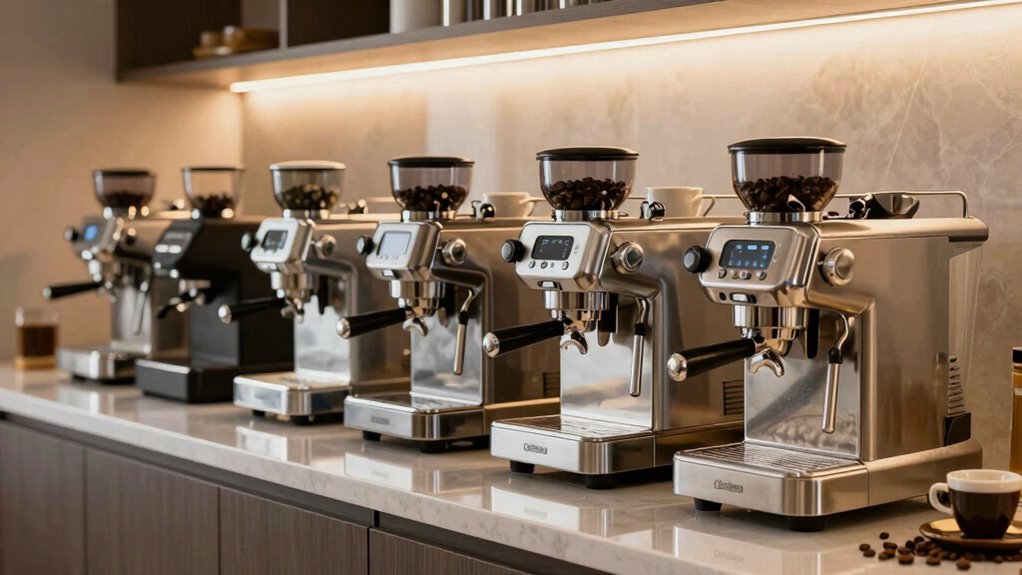
For a premium espresso machine with built-in grinder, I’d start with the Breville Barista Express as the best overall pick for hands-on control, while the Breville Barista Pro suits buyers who want a more streamlined workflow and the De’Longhi Magnifica Duo favors push-button convenience. The key tradeoff is how much control you want over grinding, dosing, and milk preparation: semi-automatic machines ask for more practice, while fully automatic models handle more steps for you. Grinder adjustment, steaming method, counter space, and cleanup can matter as much as pressure claims. The lineup also includes several lower-profile alternatives whose value depends on their controls and support, not just feature lists. Read on for the full breakdown and a buying guide to help match a machine to your coffee routine.

Get coffee and tea gear delivered free with Prime
- Fast, free delivery on millions of items
- Prime Video, Amazon Music and more included
- Member-only deals all year
Complete the kit


Key Takeaways
- The Breville Barista Express is the clearest all-around choice for buyers who want an integrated grinder and room to develop manual espresso skills without moving to a more complex setup.
- The Barista Pro and Barista Express serve different priorities: the Pro favors a quicker, more modern workflow, while the Express is the more straightforward pick for learning and adjusting each step.
- The De’Longhi Magnifica Duo stands apart through automation; it is better suited to convenience-first households than buyers who want to control every shot.
- The two La Specialista Arte Evo listings are closely related options, so buyers should compare the exact model details and included accessories rather than assume the similar names mean different capabilities.
- Many of the remaining models advertise 20-bar pressure, but that figure alone does not establish espresso quality; grinder adjustment, temperature control, usability, and ongoing support are more useful comparison points.
| Semi-Automatic Espresso Machine with Built-In Grinder and Steam Wand |  | Best for Straightforward Setup | Operation: Semi-automatic | Grind settings: 30 | Portafilter: 58 mm | VIEW ON AMAZON | See Our Full Breakdown |
| AMZCHEF Espresso Machine with Grinder, 20 Bar, Latte & Cappuccino, Black |  | Best for Brewing Adjustments | Pressure: 20 bar | Power: 1350 W | Pre-infusion: Adjustable from 3 to 10 seconds | VIEW ON AMAZON | See Our Full Breakdown |
| SHARDOR 20 Bar Espresso Machine with Built-In Grinder, Stainless Steel |  | Best Compact Pick | Operation mode: Semi-automatic | Grind settings: 45 | Output pressure: 10 bar | VIEW ON AMAZON | See Our Full Breakdown |
| EUHOMY Espresso Machine with Grinder and Milk Frother, 20 Bar Pressure |  | Best for Milk-Drink Craft | Pressure: 20 bar | Portafilter: 58 mm | PID stability: Within ±1°C | VIEW ON AMAZON | See Our Full Breakdown |
| Breville Barista Express Espresso Machine – Black Truffle |  | Best Premium All-Rounder | Grinder: Integrated conical burr | Bean hopper: ½ pound | Water tank: 67 ounces | VIEW ON AMAZON | See Our Full Breakdown |
| Espresso Machine with Grinder and Steam Wand, Stainless Steel |  | Best for a Large Water Tank | Power: 1350 W | Water tank capacity: 77.77 oz | Grinder settings: 15 adjustable settings | VIEW ON AMAZON | See Our Full Breakdown |
| AMZCHEF Semi-Automatic Espresso Machine with Grinder |  | Best for Grind and Temperature Control | Model: CM1626 | Machine type: Semi-automatic espresso machine | Grind settings: 44 | VIEW ON AMAZON | See Our Full Breakdown |
| Espresso Machine with Grinder, 20 Bar, 44 Grind Settings, Milk Frother |  | Best for Precise Dose and Temperature Tuning | Grinder: Built-in conical burr | Grind settings: 44 | Pressure system: 20 bar | VIEW ON AMAZON | See Our Full Breakdown |
| De’Longhi La Specialista Arte Evo Espresso Machine with Grinder |  | Best Compact Pick for Multiple Drink Styles | Grinder: Built-in conical burr | Grind settings: 8 | Pump pressure: 15 bar | VIEW ON AMAZON | See Our Full Breakdown |
| De’Longhi La Specialista Arte Evo Espresso Machine with Coffee Grinder |  | Best for a More Adjustable Arte Evo Setup | Grinder: Built-in conical burr | Grind settings: 15 | Cold brew technology: Cold Extraction Technology | VIEW ON AMAZON | See Our Full Breakdown |
| Gevi 20-Bar Espresso Machine with Built-In Grinder and Steam Wand |  | Best for Hands-On Customization | Operation: Semi-automatic | Grinder: Built-in conical burr grinder, 30 settings | Pump pressure: 20 bar | VIEW ON AMAZON | See Our Full Breakdown |
| De’Longhi Magnifica Duo Fully Automatic Espresso Machine with Milk Frother |  | Best for One-Touch Drink Variety | Model: ECAM33080SXB | Operation: Fully automatic | Drink presets: 20 | VIEW ON AMAZON | See Our Full Breakdown |
| Breville BES878BTR Barista Pro Espresso Machine, Black Truffle |  | Best for Fast, Barista-Style Workflow | Model: BES878BTR | Heating system: ThermoJet | Grinder: Built-in conical burr grinder | VIEW ON AMAZON | See Our Full Breakdown |
| premium espresso machine with built in grinder | Grind settings | Grinder |
|---|---|---|
| Semi-Automatic Espresso Machin | 30 | — |
| AMZCHEF Espresso Machine with | 20 | — |
| SHARDOR 20 Bar Espresso Machin | 45 | — |
| EUHOMY Espresso Machine with G | 30 | — |
| Breville Barista Express Espre | — | Integrated conical burr |
| Espresso Machine with Grinder | — | — |
| AMZCHEF Semi-Automatic Espress | 44 | — |
| Espresso Machine with Grinder | 44 | Built-in conical burr |
| De’Longhi La Specialista Arte | 8 | Built-in conical burr |
| De’Longhi La Specialista Arte | 15 | Built-in conical burr |
| Gevi 20-Bar Espresso Machine w | — | Built-in conical burr grinder, 30 settings |
| De’Longhi Magnifica Duo Fully | — | Integrated conical burr grinder |
| Breville BES878BTR Barista Pro | — | Built-in conical burr grinder |
More Details on Our Top Picks
Semi-Automatic Espresso Machine with Built-In Grinder and Steam Wand
This model makes a strong case for a ready-to-use home barista setup: it comes with a 58 mm portafilter, tamper, milk jug, and filter baskets, so fewer essentials need to be sourced separately. Its 30 grind settings give you room to adjust extraction, while the steam wand handles milk drinks. Compared with the Breville Barista Express, the listed specifications are less detailed about grinder type and temperature control, but this machine includes a larger stated 2.3-liter water tank. The tradeoff is hands-on brewing: its semi-automatic operation asks you to manage the shot, and frequent drink makers may still need to refill the tank. I’d choose it for a practical accessory bundle, not for the most documented temperature-control setup.
Pros:- 30 grind settings allow adjustments for different beans and shot preferences.
- Includes a 58 mm portafilter, tamper, milk jug, and single- and dual-wall filter baskets.
- Removable 2.3-liter water tank and detachable drip tray support routine cleaning.
- Steam wand allows preparation of lattes and cappuccinos.
Cons:- Semi-automatic brewing requires the user to manage the shot rather than relying on full automation.
- The water tank may need refilling during frequent or multi-person use.
- The listed specifications do not identify grinder type or PID temperature control.
Best for: Home baristas who want a 58 mm portafilter, milk jug, and core brewing accessories included with the machine.
Not ideal for: Buyers seeking push-button automation or documented PID temperature control; this is semi-automatic and its supplied specs do not list PID.
- Operation:Semi-automatic
- Grind settings:30
- Portafilter:58 mm
- Water tank:2.3 liters
- Output pressure:15 bar
- Power:1500 watts
- Heat-up time:45 seconds
- Dimensions:11.5 × 13.03 × 16.1 inches
Our verdict“Choose this machine if you want a generous accessory bundle and adjustable grinding, and skip it if you prefer automated brewing or specified PID control.”
AMZCHEF Espresso Machine with Grinder, 20 Bar, Latte & Cappuccino, Black
The AMZCHEF stands out for buyers who want to tune more than grind size: its PID temperature control and adjustable 3–10-second pre-infusion offer ways to shape brewing across different beans. The stated temperature range is 197–205°F, giving the user a defined window for experimentation. Compared with the SHARDOR, which lists 45 grind settings and a cold brew mode, this model offers fewer grinder steps and no listed cold brew feature, but it makes pre-infusion and temperature adjustment explicit. That flexibility comes with a learning curve: the controls may feel like extra work for someone who just wants a dependable one-button drink. Its 20-bar rating is part of the specification, but I’d focus more on the adjustable brewing controls when deciding whether it fits your routine.
Pros:- PID temperature control supports more controlled brewing.
- Adjustable pre-infusion time gives users a way to vary shot preparation.
- Temperature range is specified as 197–205°F.
- Built-in grinder and steam wand cover grinding and milk frothing in one machine.
Cons:- Its adjustment options may be demanding for beginners.
- The supplied information does not give dimensions, making counter fit harder to judge.
- At 20 grind settings, it offers fewer listed grind steps than the SHARDOR’s 45.
Best for: Espresso drinkers who already enjoy adjusting temperature and pre-infusion to suit different beans.
Not ideal for: Beginners who want a simple guided workflow, or small-kitchen buyers who cannot accommodate a larger machine.
- Pressure:20 bar
- Power:1350 W
- Pre-infusion:Adjustable from 3 to 10 seconds
- Grind settings:20
- Temperature range:197–205°F
- Built-in grinder:Yes
- Milk frother:Steam wand
Our verdict“Pick the AMZCHEF if you want explicit temperature and pre-infusion adjustments, but choose a simpler machine if you do not plan to tune your shots.”
SHARDOR 20 Bar Espresso Machine with Built-In Grinder, Stainless Steel
For a tighter counter, the SHARDOR pairs a compact listed footprint—9.57 inches wide—with a built-in grinder and milk frother. Its 45 grind settings give it the broadest stated adjustment range among these five machines, and the cold brew mode adds a use the Breville Barista Express does not list. It also accepts whole beans, ground coffee, and espresso pods, which makes it more flexible about what goes into the machine. The tradeoff is that it remains semi-automatic, and the supplied data gives its output pressure as 10 bar, not the 20 bar highlighted in the product title. Fine adjustment may take some patience, especially since the supplied notes warn that incorrect grind settings can cause clogs. I’d favor it for space and format flexibility over the Breville’s larger tank and stated PID control.
Pros:- Listed width of 9.57 inches suits counters with limited space.
- 45 grind settings provide a wide range for dialing in beans.
- Accepts whole beans, ground coffee, and espresso pods.
- Cold brew mode adds an option beyond espresso-based drinks.
Cons:- Semi-automatic operation requires user involvement during brewing.
- The supplied specs list 10-bar output pressure, despite the 20-bar product title.
- Incorrect grind adjustment may lead to clogs and require troubleshooting.
Best for: Apartment dwellers or office users who need a narrow machine with several grind options and support for beans, grounds, or pods.
Not ideal for: Buyers prioritizing a large water reservoir, a simple automated workflow, or a clearly documented 20-bar output specification.
- Operation mode:Semi-automatic
- Grind settings:45
- Output pressure:10 bar
- Water capacity:60.9 fluid ounces
- Dimensions:11.6 × 9.57 × 14.69 inches
- Weight:12.8 pounds
- Display:LED
- Supported inputs:Espresso pods, ground coffee, and whole beans
Our verdict“Choose the SHARDOR for its narrow footprint and flexible inputs, but look elsewhere if tank size or clearly specified higher-pressure output matters most.”
EUHOMY Espresso Machine with Grinder and Milk Frother, 20 Bar Pressure
The EUHOMY is the clearest fit here for someone who wants to work on milk texture: its high-pressure steam wand is described as capable of producing microfoam for latte art. That focus sits alongside a 58 mm portafilter and PID control specified within ±1°C, a useful combination for a hands-on brewing routine. Compared with the AMZCHEF, it lists 30 rather than 20 grind settings and gives a tighter stated temperature-stability figure, while the AMZCHEF provides a defined temperature range and adjustable pre-infusion time. The EUHOMY’s anti-clog system is another practical point for users who change beans. Its weak spot is missing fit information: dimensions and capacity are not supplied, and setup may be more involved than a beginner wants. I’d select it for milk technique, not for predictable counter planning.
Pros:- 58 mm portafilter pairs with a familiar hands-on espresso format.
- PID control is specified as stable within ±1°C.
- High-pressure steam wand is intended for microfoam and latte art.
- 30 grind settings and an anti-clog system support grind adjustment and maintenance.
Cons:- Setup may be challenging for beginners.
- The supplied product data does not state dimensions or tank capacity.
- The supplied notes flag potentially high operating noise.
Best for: Home baristas who regularly make milk drinks and want a 58 mm portafilter, PID control, and a wand aimed at microfoam.
Not ideal for: First-time espresso buyers who want a simple setup, or shoppers who need published dimensions and capacity before buying.
- Pressure:20 bar
- Portafilter:58 mm
- PID stability:Within ±1°C
- Grind settings:30
- Steam wand:High-pressure, for microfoam
- Anti-clog system:Yes
Our verdict“Choose the EUHOMY if milk texture and stated temperature stability matter more than beginner-friendly setup or published size details.”
Breville Barista Express Espresso Machine – Black Truffle
The Barista Express earns the premium all-rounder spot by pairing an integrated conical burr grinder with PID temperature control, a steam wand designed for microfoam, and substantial bean and water capacity. Its 67-ounce water tank and half-pound hopper reduce interruptions for households making several drinks, while the 1600-watt specification and semi-automatic format suit buyers who want control rather than a fully automated cycle. Compared with the SHARDOR, it is heavier and lacks that model’s listed cold brew mode, but its grinder type and PID control are explicitly specified. The tradeoff is a more substantial machine at 22.1 pounds that needs regular grinder and steam-wand cleaning. I’d choose it for a fuller espresso-and-milk workflow, not for portability or minimal upkeep.
Pros:- Integrated conical burr grinder is explicitly identified.
- PID temperature control supports more consistent extraction.
- 67-ounce water tank and half-pound bean hopper reduce refill interruptions.
- Steam wand is designed to produce microfoam for milk drinks.
Cons:- At 22.1 pounds, it is heavier than the SHARDOR and less convenient to move.
- Regular grinder and steam-wand cleaning adds maintenance.
- No cold brew mode is listed, unlike the SHARDOR.
Best for: Regular espresso and milk-drink makers who want a named burr grinder, PID control, and larger stated bean and water capacities.
Not ideal for: Buyers who need a lightweight machine, want cold brew mode, or prefer not to clean a grinder and steam wand regularly.
- Grinder:Integrated conical burr
- Bean hopper:½ pound
- Water tank:67 ounces
- Power:1600 watts
- Voltage:120 volts
- Dimensions:13.8 × 12.5 × 15.9 inches
- Weight:22.1 pounds
- Temperature control:PID
Our verdict“Choose the Barista Express for a well-specified grinder, PID control, and larger stated capacities, but skip it if low weight and minimal maintenance are priorities.”
Espresso Machine with Grinder and Steam Wand, Stainless Steel
This machine pairs a 77.77-ounce water tank with a built-in grinder and 58mm portafilter, making it a practical fit for households that prepare several drinks between refills. Its 15 grind settings offer less fine-tuning than the 44 settings on the AMZCHEF CM1626, but the larger tank and stated 45-second heat-up favor a simpler, faster routine. The steam wand gives hands-on control over milk texture, while the self-cleaning function can reduce some upkeep. The tradeoff is that quick heating does not make espresso preparation automatic: dialing in grind and extraction still takes practice. Its larger footprint may also be harder to accommodate than the compact De’Longhi La Specialista Arte Evo.
Pros:- Large 77.77-ounce water tank can reduce refill frequency during busy household use.
- 58mm portafilter provides a larger format than the 51mm setup listed for the 44-setting machine.
- Built-in grinder offers 15 adjustable settings for dialing in different beans.
- Steam wand and stated self-cleaning function support milk drinks and routine maintenance.
Cons:- Fewer grinder settings than the AMZCHEF CM1626, limiting fine adjustment.
- Manual espresso preparation and dialing in may challenge beginners.
- Larger size can be difficult to fit on a crowded counter.
Best for: Households making multiple espresso and milk drinks each day that want fewer water refills and a 58mm portafilter.
Not ideal for: First-time espresso buyers seeking guided, low-effort operation, or people with limited counter space.
- Power:1350 W
- Water tank capacity:77.77 oz
- Grinder settings:15 adjustable settings
- Portafilter size:58 mm
- Extraction pressure:20 bar
- Heat-up time:45 seconds
- Auto shut-off:30 minutes
Our verdict“Choose this model if a large water tank and 58mm portafilter matter more to your household than extensive grind adjustment or compact size.”
AMZCHEF Semi-Automatic Espresso Machine with Grinder
The AMZCHEF CM1626 is the clearest pick here for buyers who want to adjust both grind and brew temperature: it offers 44 grind settings and a 190°F–201°F temperature range. That gives more room to tailor extraction to different beans than the 15-setting machine with a 58mm portafilter, though its listed specifications do not include that model’s larger water tank. Touchscreen controls and one-touch hot or cold brew modes add convenience, but the semi-automatic workflow still calls for hands-on preparation; these modes do not remove the work of grinding and making espresso. At 60 ounces, the tank is ample for regular home use, though frequent drink-making may mean refills. Its 13.9-pound weight and stated dimensions also make it easier to place than bulkier options.
Pros:- 44 grind settings provide a broad range of adjustment for different beans and brewing preferences.
- Adjustable brew temperature offers more control than machines with fixed or fewer stated settings.
- Touchscreen and one-touch hot or cold brew modes simplify access to alternate drinks.
- 13.9-pound weight and listed dimensions make placement more manageable than larger machines.
Cons:- Semi-automatic operation still requires hands-on preparation and milk frothing.
- The 60-ounce tank may need refilling during frequent use.
- Its many adjustment options may add setup work for someone new to espresso.
Best for: Home baristas who regularly switch beans or brewing preferences and want broad grind adjustment with variable brew temperature.
Not ideal for: Buyers who want fully automatic espresso, or households that need a larger water tank for frequent back-to-back drinks.
- Model:CM1626
- Machine type:Semi-automatic espresso machine
- Grind settings:44
- Brew temperature:190°F–201°F
- Water tank capacity:60 oz
- Steam wand:8 mm stainless steel
- Wattage and voltage:1500 W; 120 V
- Dimensions:12.5 × 10.82 × 13.38 in
Our verdict“Pick the CM1626 if you value adjustable grind and temperature more than fully automatic operation or a particularly large tank.”
Espresso Machine with Grinder, 20 Bar, 44 Grind Settings, Milk Frother
This machine stands out for combining a 44-setting conical burr grinder with three stated PID temperature levels and pre-infusion, giving hands-on brewers several ways to shape an espresso shot. Compared with the AMZCHEF CM1626, it lists specific temperature choices—194°F, 198°F, and 205°F—and dose amounts, while the AMZCHEF provides a continuous stated range and one-touch hot or cold brew modes. The tradeoff is its 51mm standard portafilter; buyers seeking the listed 58mm size on the stainless-steel 15-setting machine may find this setup less appealing, and the description frames 58mm as an upgrade. Anti-static technology and a bean-hopper air blower are aimed at keeping grounds manageable, but the many adjustments are better suited to a curious home barista than someone expecting push-button simplicity.
Pros:- 44 grind settings allow detailed adjustment for different coffees.
- Three stated PID temperature levels support deliberate shot tuning.
- Pre-infusion and listed dose options give hands-on brewers more control over preparation.
- Anti-static technology and a bean-hopper air blower are designed to limit messy grounds.
Cons:- The standard 51mm portafilter may not suit buyers who want the listed 58mm format.
- The number of settings and dose choices can create a steeper learning curve.
- The provided specifications do not state tank capacity or machine dimensions, making fit and refill planning harder.
Best for: Experiment-minded home baristas who want to tune grind, dose, and brew temperature and are comfortable with a 51mm standard portafilter.
Not ideal for: Beginners seeking a simple workflow, or buyers who want a 58mm portafilter without relying on an upgrade.
- Grinder:Built-in conical burr
- Grind settings:44
- Pressure system:20 bar
- Temperature levels:3: 194°F, 198°F, and 205°F
- Standard portafilter size:51 mm
- Single dose:7 g
- Double dose:14 g standard; 18–20 g with aftermarket setup
- Pre-infusion:Included
Our verdict“Choose this machine if precise shot adjustments matter more than beginner-friendly operation or a standard 58mm portafilter.”
De’Longhi La Specialista Arte Evo Espresso Machine with Grinder
The La Specialista Arte Evo suits a buyer who wants a recognizable set of drink options without giving up a hands-on espresso routine. Its built-in conical burr grinder has eight settings, fewer than the 44 on the AMZCHEF CM1626 or the other 44-setting machine here, so it offers less scope for fine grind adjustments. In return, it pairs espresso preparation with Americano, hot water, and cold brew presets; the stated cold-brew extraction takes under five minutes. The included barista kit and steam wand support manual dosing and milk work, while detachable dishwasher-safe parts simplify cleanup. This is the compact choice in this group, but buyers focused on dialing in beans above all else may prefer a more adjustable grinder, such as the CM1626.
Pros:- Compact design is a useful fit where counter space is limited.
- Four beverage presets include espresso, Americano, cold brew, and hot water.
- Cold brew extraction is stated to take under five minutes.
- Detachable dishwasher-safe parts and included barista tools support cleanup and manual preparation.
Cons:- Eight grind settings offer less adjustment than the 44-setting AMZCHEF models.
- Hands-on preparation is required rather than fully automatic brewing.
- The four presets may feel limited to buyers seeking a wider menu of automated drinks.
Best for: Space-conscious home baristas who want espresso, milk drinks, and quick cold brew from one machine with easier cleanup.
Not ideal for: Coffee tinkerers who want extensive grind adjustment, or buyers who expect fully automatic drink preparation.
- Grinder:Built-in conical burr
- Grind settings:8
- Pump pressure:15 bar
- Infusion temperatures:3 settings
- Beverage presets:Espresso, Americano, cold brew, and hot water
- Cold-brew extraction time:Under 5 minutes
- Included accessories:Barista kit with tamper and dosing funnel
- Cleaning:Detachable dishwasher-safe parts
Our verdict“Choose this Arte Evo if a compact footprint and quick cold-brew option matter more than extensive grinder adjustment.”
De’Longhi La Specialista Arte Evo Espresso Machine with Coffee Grinder
This Arte Evo variant is the better fit for buyers drawn to De’Longhi’s cold-brew and barista-tool approach but wanting more grinder adjustment than the eight-setting version. Its 15-setting conical burr grinder offers additional room to tune beans, while the commercial-style steam wand is intended for microfoam and the included barista kit keeps preparation hands-on. Like its Arte Evo counterpart, it offers espresso, Americano, cold brew, and hot water rather than a broad automated menu. It also lists a 56-ounce tank and 1600W power, details not provided for the other Arte Evo entry. Compared with the 44-setting AMZCHEF CM1626, it has fewer grind choices, but it brings cold extraction technology and a stated 15-bar Italian pump. Its feature set and footprint may be a lot for beginners or small kitchens.
Pros:- 15 grinder settings provide more adjustment than the eight-setting Arte Evo variant.
- Cold Extraction Technology adds a cold-brew option alongside espresso and Americano.
- Commercial-style steam wand is designed for milk microfoam.
- 56-ounce tank and included barista kit support regular hands-on drink preparation.
Cons:- Fewer grind settings than the 44-setting AMZCHEF machines.
- Semi-automatic preparation and multiple features may be challenging for beginners.
- Relatively large size may not suit a compact counter.
Best for: Home baristas who want a De’Longhi machine with cold-brew capability, a milk-focused steam wand, and more grinder settings than the eight-setting Arte Evo.
Not ideal for: Beginners who want minimal setup, or buyers whose priority is the widest possible grind range or a small footprint.
- Grinder:Built-in conical burr
- Grind settings:15
- Cold brew technology:Cold Extraction Technology
- Steam wand:Commercial-style
- Pump pressure:15-bar Italian pump
- Water tank capacity:56 fl oz
- Power:1600 W
- Beverage presets:Espresso, Americano, cold brew, and hot water
Our verdict“Pick this Arte Evo version if you want De’Longhi’s cold-brew and milk tools with more grind adjustment than the eight-setting model, but not the broadest grinder range.”
Gevi 20-Bar Espresso Machine with Built-In Grinder and Steam Wand
The Gevi suits buyers who want to adjust their espresso routine without giving up an integrated grinder. Its 30-setting conical burr grinder, customizable shot volumes, and PID temperature control give more room to tune grind and brewing than the push-button approach of the De’Longhi Magnifica Duo. Pre-infusion supports a more even start to extraction, while the steam wand doubles as a hot-water dispenser for Americanos and tea.
The tradeoff is involvement: this is a semi-automatic machine, so grinding, tamping, and milk preparation take attention. Its 2.3-liter tank and 58 mm portafilter make it a substantial home setup, but it is less convenient for users who want the Magnifica Duo’s preset drinks and automatic milk system. I’d choose the Gevi for control, not one-touch convenience.
Pros:- Built-in conical burr grinder has 30 adjustable settings.
- PID temperature control and pre-infusion support more controlled brewing.
- Customizable single- and double-shot volumes.
- Steam wand also dispenses hot water.
Cons:- Semi-automatic operation requires manual grinding, tamping, and drink preparation.
- The 120-volt requirement may limit where it can be used.
- The 16.53-inch height may be awkward under some kitchen cabinets.
Best for: Home espresso drinkers who want to adjust grind settings and shot volume and are willing to handle tamping and milk steaming.
Not ideal for: Buyers who want preset drinks, automatic milk frothing, or espresso with minimal hands-on steps.
- Operation:Semi-automatic
- Grinder:Built-in conical burr grinder, 30 settings
- Pump pressure:20 bar
- Temperature control:NTC and PID
- Water tank:2.3 liters
- Portafilter:58 mm
- Power and voltage:1450 watts; 120 volts
- Dimensions:12.01 × 11.5 × 16.53 inches (D × W × H)
Our verdict“Choose the Gevi if you want an adjustable grinder and hands-on espresso control rather than the Magnifica Duo’s automated drink preparation.”
De’Longhi Magnifica Duo Fully Automatic Espresso Machine with Milk Frother
The Magnifica Duo is the convenience pick in this group: its 20 hot and iced drink presets cover more than espresso, and its integrated grinder and LatteCrema Hot and Cool systems handle coffee and milk foam at the touch of a button. That makes it a stronger fit for households with varied drink preferences than the Gevi, which puts more of the brewing and steaming work in the user’s hands. Cold brew is listed as taking under three minutes, adding another quick option.
Convenience comes with less manual control over the process, and the machine’s 19.69-inch depth calls for generous counter space. The removable frothing parts are dishwasher-safe and auto-clean helps with routine care, but its 20.8-pound weight makes moving it less appealing than a lighter, simpler setup. I’d favor it for drink variety and automation, not for learning hands-on espresso technique.
Pros:- Offers 20 preset hot and iced drinks, including espresso, drip coffee, and cold brew.
- Integrated conical burr grinder prepares coffee from whole beans.
- LatteCrema systems make hot or cold milk foam.
- Removable frothing components are dishwasher-safe, with auto-clean support.
Cons:- Fully automatic operation offers less hands-on control than the Gevi or Breville Barista Pro.
- Nearly 20 inches deep, so it needs substantial counter space.
- At 20.8 pounds, it is cumbersome to move regularly.
Best for: Households that want a built-in grinder, automatic hot and cold milk foam, and a wide selection of preset coffee drinks.
Not ideal for: Espresso hobbyists who want to control each shot manually, or buyers with limited counter depth or a need to move the machine often.
- Model:ECAM33080SXB
- Operation:Fully automatic
- Drink presets:20
- Grinder:Integrated conical burr grinder
- Milk system:LatteCrema Hot and Cool
- Water capacity:3.8 pounds
- Power and voltage:1450 watts; 120 volts
- Dimensions and weight:19.69 × 12.2 × 16.14 inches; 20.8 pounds
- Warranty:2 years, plus 1 additional year with product registration
Our verdict“Pick the Magnifica Duo if preset drink variety and automated milk preparation matter more than manual espresso adjustments.”
Breville BES878BTR Barista Pro Espresso Machine, Black Truffle
The Barista Pro is the speed-and-control choice for someone who wants to make espresso drinks manually but values a quick start. Its ThermoJet heating system is designed for fast heat-up, while the built-in conical burr grinder and adjustable settings keep grinding and extraction in the same machine. Compared with the Gevi, the Breville emphasizes a faster heating workflow and includes a milk jug, dose-trimming tool, cleaning kit, and water filter—useful for buyers building a more complete home-barista setup.
That capability asks for practice: its LCD interface and adjustable controls may take time to learn, and manual dosing and milk steaming are not one-touch tasks like the De’Longhi Magnifica Duo. The supplied specs list a 67-ounce tank and half-pound hopper, but do not give grinder settings or pump pressure, limiting direct spec comparisons. This makes the most sense for engaged espresso makers, not casual users seeking simplicity.
Pros:- ThermoJet heating system is designed for fast heat-up.
- Built-in conical burr grinder supports fresh grinding in the same machine.
- Adjustable settings and LCD interface support a hands-on brewing routine.
- Includes a milk jug, dose-trimming tool, cleaning kit, and water filter.
Cons:- Manual espresso and milk preparation require practice and attention.
- The interface and adjustment options may feel complex to new users.
- Uses 1680 watts and requires a 120-volt supply.
Best for: Home baristas who want an integrated grinder, fast heat-up, and hands-on control, plus accessories for dialing in espresso and steaming milk.
Not ideal for: Casual coffee drinkers who prefer preset drinks and automatic milk preparation, or buyers who want a simple interface with little adjustment.
- Model:BES878BTR
- Heating system:ThermoJet
- Grinder:Built-in conical burr grinder
- Water tank:67 ounces
- Bean hopper:0.5 pound
- Power and voltage:1680 watts; 120 volts
- Included accessories:Milk jug, cleaning kit, water filter, and dose-trimming tool
- Warranty:2 years
Our verdict“Choose the Barista Pro over the Gevi if a fast-heating, accessory-rich manual workflow is your priority, and skip it if you want the Magnifica Duo’s automation.”

How We Picked
I ranked these machines by how well their built-in grinder and espresso functions work together for a home buyer. I gave the most weight to useful grind and shot control, a workable learning curve, milk preparation, build and interface quality, and the effort required to clean and maintain the machine. A premium label or a high pressure figure did not earn a higher place on its own.
The ranking favors machines with a clearer balance of control, convenience, and established feature sets, then separates them by the type of buyer they serve. Semi-automatic models rank higher for people who value adjustment and skill-building; the fully automatic Magnifica Duo earns its own place for users who prefer less manual work. Several generically named options have limited identifying detail in the supplied product names, so I treat their advertised features as starting points rather than proof of superior performance. Buyers should verify the exact model, warranty, and included accessories before choosing among similar listings.
| premium espresso machine with built in grinder | Grinder |
|---|---|
| Semi-Automatic Espresso Machin | — |
| AMZCHEF Espresso Machine with | — |
| SHARDOR 20 Bar Espresso Machin | — |
| EUHOMY Espresso Machine with G | — |
| Breville Barista Express Espre | Integrated conical burr |
| Espresso Machine with Grinder | — |
| AMZCHEF Semi-Automatic Espress | — |
| Espresso Machine with Grinder | Built-in conical burr |
| De’Longhi La Specialista Arte | Built-in conical burr |
| De’Longhi La Specialista Arte | Built-in conical burr |
| Gevi 20-Bar Espresso Machine w | Built-in conical burr grinder, 30 settings |
| De’Longhi Magnifica Duo Fully | Integrated conical burr grinder |
| Breville BES878BTR Barista Pro | Built-in conical burr grinder |
Factors to Consider When Choosing Premium Espresso Machine With Built In Grinder
Choosing an integrated grinder is not just about saving counter space. I’d match the machine to how much control you want, how many drinks you make, and how much daily cleanup you are willing to handle.
Decide How Much of the Process You Want to Control
A semi-automatic machine gives you more say over dosing, tamping, shot timing, and milk texture, but it also asks you to repeat those steps consistently. That control can be rewarding if you enjoy dialing in coffee and changing beans. A fully automatic machine takes more decisions off your hands, which can be a better fit for a busy household or several people with different skill levels. Do not assume that a machine with more buttons is easier to master; settings still need to make sense for your routine. Before buying, decide whether you want espresso-making to be a small daily craft or a quick route to a drink. That answer may matter more than a long feature list.
Look Beyond the Pressure Number
Pressure figures are easy to compare, but they do not tell you how consistently a machine grinds, heats, and delivers water through the coffee. A grinder with practical adjustment can make it easier to correct a sour or bitter shot as beans age or change. Ask whether the controls let you make repeatable adjustments rather than focusing on a headline pressure rating. Fresh beans, a suitable grind, and a consistent dose all affect results at home. A common mistake is paying extra for a larger number while overlooking limited grind control. Treat pressure as one specification among several, not a shortcut for judging the finished espresso.
Match the Grinder to Your Coffee Habits
An integrated grinder saves space and keeps the workflow together, but it also ties the grinder choice to the espresso machine. If you switch beans often, look for a useful range of grind settings and a way to change them without frustration. If you usually buy one type of bean and make the same drink each morning, a simpler adjustment system may be enough. Consider how easy it is to clear old grounds when changing beans, since residue can affect the next dose. Buyers sometimes focus on the number of settings without asking whether those adjustments are practical for espresso. The right grinder is the one that supports the way you actually brew, not the one with the longest specification list.
Check Milk Preparation and Drink Volume
A steam wand offers more control over milk texture, but learning to steam well takes practice and adds cleanup after each drink. Automatic milk features can make repeat drinks simpler, though they may limit how much you can adjust the texture or process. Think about how often you make milk-based drinks and whether you prepare one cup or several in a row. For a mostly espresso routine, a capable grinder and shot workflow should take priority over elaborate milk options. For a household that makes cappuccinos back-to-back, steaming speed and a comfortable workflow matter more. Avoid choosing based on the drink names printed on a machine; check how milk is actually prepared and cleaned.
Measure the Full Countertop Footprint
Machines with built-in grinders reduce the need for separate equipment, but they can still occupy substantial counter space and need room for access. Measure the machine’s width, depth, and height, including space to open the hopper, fill the water tank, and remove the drip tray. Also check whether the portafilter, tamper, milk pitcher, and other daily tools need a nearby place to live. A machine that fits under a cabinet may still be awkward if the hopper cannot be reached. Think about noise and where grounds collect, especially in an open kitchen or shared living space. A compact-looking listing photo is not a reliable substitute for checking the actual dimensions.
Plan for Cleaning, Support, and Long-Term Ownership
Daily cleanup shapes whether an espresso machine remains enjoyable to use after the novelty wears off. Check which parts need rinsing after each session, how the brew path is cleaned, and whether the machine prompts you for descaling or other maintenance. A milk system can add useful convenience while also adding parts that need regular attention. For lesser-known or generically named models, confirm the warranty terms, access to replacement parts, and availability of clear instructions before ordering. A low-maintenance routine may be worth more to a casual user than fine control they rarely use. Paying more makes sense when it buys a workflow, support, or durability advantage that you will rely on often.
Frequently Asked Questions
Is the Breville Barista Express or Barista Pro a better choice for a first espresso machine?
I’d choose the Barista Express if learning the steps matters more than getting through them quickly. The Barista Pro is a stronger fit for someone who wants a more streamlined workflow and expects to make espresso regularly. Neither removes the need to practice grind adjustment and milk preparation. Before deciding, compare the controls and workflow against the amount of time you want to spend on each drink. If convenience matters more than manual technique, the fully automatic De’Longhi Magnifica Duo is another type of solution in this lineup.
Does a 20-bar machine make better espresso than a machine with a lower advertised pressure?
Not by itself. The pressure number does not show how well the grinder can produce a suitable, consistent dose or how repeatable the brewing process is. I’d give more attention to grind adjustment, usable controls, and how the machine handles routine preparation. A high pressure claim can look impressive on a listing, but it is not a reliable ranking method on its own. Compare the complete workflow and verify the machine’s specific features before making a decision.
Should I choose a built-in grinder or buy a separate grinder?
A built-in grinder is appealing when you want fewer appliances and a single, connected workflow. A separate grinder can offer more flexibility if you later want to change grinder styles or keep grinding independent of the espresso machine. The tradeoff is added counter space and another purchase to research. If you are still learning what grind adjustments you need, check that the integrated grinder has controls you can use comfortably. Choose the integrated setup for simplicity, and consider separate equipment if long-term grinder choice is a priority.
Are the two De’Longhi La Specialista Arte Evo listings different machines?
The names in this roundup are very similar, so the product titles alone do not establish a meaningful difference. I’d compare the model number, included accessories, finish, and any stated revisions on the seller’s listing before treating them as separate choices. Small listing variations can reflect a bundle or naming difference rather than a different brewing platform. If the specifications and warranty match, choose based on the seller and included items rather than the wording alone. Check the current manufacturer information if an exact feature distinction affects your decision.
When is a fully automatic espresso machine a better fit than a semi-automatic model?
A fully automatic machine makes more sense when speed and a simpler routine matter more than hands-on control. It can suit a household where people want repeatable drinks without learning to dose, tamp, and manage every shot. A semi-automatic option is a better match if you enjoy adjusting the process or want more control over milk texture. Automation does not mean zero maintenance: the machine still needs cleaning and care. For this lineup, the Magnifica Duo is the convenience-led option, while the Breville and La Specialista models better fit buyers who want more involvement.
Conclusion
For most buyers seeking a premium espresso machine with a built-in grinder, I’d start with the Breville Barista Express for its balance of manual control and an integrated workflow. Choose the Barista Pro as the best premium fit if a more streamlined process matters more than keeping the setup simple. For beginners who want to learn espresso hands-on, the Express is the clearest starting point; for convenience-first households, the De’Longhi Magnifica Duo is the better match. If you value a De’Longhi semi-automatic workflow, compare the exact La Specialista Arte Evo listings and verify what each package includes. Buyers drawn to the AMZCHEF, SHARDOR, EUHOMY, Gevi, and other less specifically identified options should confirm model details, warranty, and support before choosing. The best pick is the one whose control level, milk routine, and upkeep fit your everyday coffee habits.