

To pick a reverse osmosis system for coffee, match its water profile, daily output, and setup to the way you brew. I rank the iSpring RCC7AK-UV as the best overall because it pairs RO filtration with alkaline remineralization, while the Philips 600 GPD Tankless stands out for higher flow and the DREO Countertop RO for installation-free use. The main tradeoff is between convenience and capacity: countertop units avoid plumbing work, while under-sink systems suit steady household demand. Remineralization can also matter for flavor, since very low-mineral water may not bring out coffee’s character as well as water with a suitable mineral balance. Read on for the full comparison, buying advice, and picks for different brewing setups.

Get coffee and tea gear delivered free with Prime
- Fast, free delivery on millions of items
- Prime Video, Amazon Music and more included
- Member-only deals all year
Complete the kit


Key Takeaways
- Remineralization is the clearest coffee-focused divider: several iSpring and Express Water models add minerals after RO filtration, while basic five-stage options such as the APEC ROES-50 leave water-profile decisions to you.
- High flow and a tankless design favor frequent use: the Philips 600 GPD and Waterdrop T3-T target faster access than conventional tank-based systems, but buyers should check installation and filter requirements.
- Countertop models trade plumbing work for counter space and refill routines: DREO and Bluevua suit renters or smaller households better than a permanent under-sink setup.
- More filtration stages do not automatically mean better coffee: models with alkaline, UV, or extra stages offer specific functions, but water taste and service needs matter more than stage count alone.
- The top picks separate by use case, not by a single winning spec: iSpring’s alkaline options suit mineralized-water preferences, Philips suits higher demand, and the APEC ROES-50 is a simpler choice for buyers who want a familiar five-stage layout.
| Philips Reverse Osmosis Water Filter System, 400G Under Sink Water Filter |  | Best Tankless Pick for Frequent Coffee Brewing | Filtration method: Reverse osmosis | Filter life cycle: 2 years | Maximum supported TDS: 1000 ppm | VIEW ON AMAZON | See Our Full Breakdown |
| iSpring RCC7-BN 5-Stage Under-Sink Reverse Osmosis Water Filter System, 75 GPD, Brushed Nickel Faucet |  | Best Traditional Under-Sink Value | Filtration stages: 5 | Purification methods: Reverse osmosis, activated carbon, carbon block | Contaminant reduction: Up to 99% of over 1,000 listed contaminants | VIEW ON AMAZON | See Our Full Breakdown |
| DREO Reverse Osmosis Water Filter Countertop – Installation-Free, Self-Cleaning RO System with TDS Meter and Autofill Pitcher (3:1 Pure to Drain) |  | Best for Renters and No-Plumbing Setups | Installation type: Countertop | Purification method: Reverse osmosis | Pitcher capacity: 3 liters | VIEW ON AMAZON | See Our Full Breakdown |
| Reverse Osmosis Water Filter Countertop with Mineralization and Hot Water |  | Best for Hot Water and Mineralized Coffee | Filtration stages: 10 | Installation type: Countertop | Capacity: 5 liters | VIEW ON AMAZON | See Our Full Breakdown |
| Express Water ROELITE9 9-Stage Alkaline Reverse Osmosis Under-Sink Water Filtration System |  | Best Under-Sink Pick for Remineralization | Filtration stages: 9 | Installation type: Under sink | Purification method: Alkaline reverse osmosis | VIEW ON AMAZON | See Our Full Breakdown |
| iSpring RCC7AK-UV 7-Stage Under-Sink Reverse Osmosis Water Filter System with Alkaline and LED UV Filters |  | Best for Added UV Protection | Filtration stages: 7 | RO membrane capacity: 75 GPD | Tank capacity: 3.2 gallons | VIEW ON AMAZON | See Our Full Breakdown |
| Express Water 10-Stage Under Sink Reverse Osmosis Water Filtration System with Alkaline |  | Best for Leak Monitoring | Filtration stages: 10 | Capacity: 100 gallons | Flow rate: 0.8 gpm | VIEW ON AMAZON | See Our Full Breakdown |
| iSpring RCC7AK-BLK 6-Stage Alkaline Reverse Osmosis Water Filtration System with Black Faucet |  | Best Simple Mineralized Pick | Filtration stages: 6 | Purification method: Reverse osmosis | Certification: NSF/ANSI 58 | VIEW ON AMAZON | See Our Full Breakdown |
| Express Water ROALKUV10D 11-Stage Reverse Osmosis Water Filter System with Alkaline & UV | 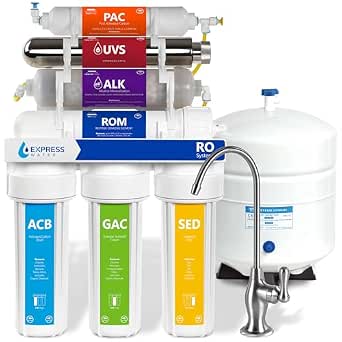 | Best for Layered Treatment | Filtration stages: 11 | Filtration types: Reverse osmosis, UV sterilization, alkaline mineralization | Targeted contaminants: Lead, chlorine, fluoride, nitrates, calcium, arsenic, bacteria, viruses | VIEW ON AMAZON | See Our Full Breakdown |
| Philips Tankless Reverse Osmosis System, 600 GPD, Self-Cleaning RO System |  | Best Tankless High-Flow Pick | RO capacity: 600 GPD | Maximum flow rate: 0.41 gpm | Filtration method: Reverse osmosis, carbon block, post carbon block | VIEW ON AMAZON | See Our Full Breakdown |
| APEC Water ROES-50 5-Stage Under-Sink Reverse Osmosis System, 50 GPD |  | Best Established Under-Sink Pick | Filtration stages: 5 | Daily capacity: 50 gallons per day | Purification methods: Activated carbon and reverse osmosis | VIEW ON AMAZON | See Our Full Breakdown |
| iSpring RCC7AK-BN 6-Stage Reverse Osmosis Water Filtration System with Alkaline Remineralization |  | Best for Mineral-Restored Coffee Water | Filtration stages: 6 | Daily output: 75 gallons | Purification methods: Reverse osmosis, alkaline, activated carbon, and carbon block | VIEW ON AMAZON | See Our Full Breakdown |
| Waterdrop T3-T Remineralization Reverse Osmosis System, 220 GPD Faster Flow |  | Best Compact High-Output Pick | Filtration stages: 7 | Daily output: 220 GPD | Remineralization: Yes | VIEW ON AMAZON | See Our Full Breakdown |
| Bluevua RO100ROPOT Countertop Reverse Osmosis Water Filter System |  | Best No-Plumbing Coffee Station | Filtration stages: 5 | Installation: Countertop; no plumbing required | Carafe material: High-borosilicate glass | VIEW ON AMAZON | See Our Full Breakdown |
| pick reverse osmosis system for coffee | Filtration stages | Dimensions | Maximum supported TDS |
|---|---|---|---|
| Philips Reverse Osmosis Water | — | 12.32 × 4.33 × 15.83 in | 1000 ppm |
| iSpring RCC7-BN 5-Stage Under- | 5 | 23.62 × 15.75 × 11.81 in | 750 ppm |
| DREO Reverse Osmosis Water Fil | — | 14.5 × 6.7 × 13.4 in | 1200 ppm |
| Reverse Osmosis Water Filter C | 10 | 11 × 14.8 × 17.7 in | — |
| Express Water ROELITE9 9-Stage | 9 | — | 300 ppm |
| iSpring RCC7AK-UV 7-Stage Unde | 7 | 15 × 8 × 18 in | — |
| Express Water 10-Stage Under S | 10 | 15 × 5 × 17 in | — |
| iSpring RCC7AK-BLK 6-Stage Alk | 6 | 15.5 × 16 × 18 in | — |
| Express Water ROALKUV10D 11-St | 11 | — | — |
| Philips Tankless Reverse Osmos | — | 12.3 × 4.3 × 15.8 in | — |
| APEC Water ROES-50 5-Stage Und | 5 | 15.5 × 5.25 × 17 in | 2,000 ppm |
| iSpring RCC7AK-BN 6-Stage Reve | 6 | — | 750 ppm |
| Waterdrop T3-T Remineralizatio | 7 | 12.6 × 6.1 × 14.69 in | 500 ppm |
| Bluevua RO100ROPOT Countertop | 5 | — | — |
More Details on Our Top Picks
Philips Reverse Osmosis Water Filter System, 400G Under Sink Water Filter
I’d choose the Philips 400G when I want RO water available at the sink without waiting for a storage tank to refill. Its 400 GPD output and tankless format suit households that brew coffee throughout the day, while the stated 2.3:1 pure-to-drain ratio is a useful efficiency advantage over systems with less favorable water recovery. The filtration claim down to 0.0001 microns is extensive, though it does not tell me what mineral profile the brewed coffee will have; buyers seeking a specific extraction balance may need to check the resulting water chemistry. Compared with the countertop DREO, this Philips requires plumbing work and an electrical outlet, but it avoids taking up counter space. I’d skip it if I need a simple, non-electric installation or want to avoid ongoing filter costs.
Pros:- Tankless design supplies filtered water without relying on a storage tank
- 400 GPD flow rating suits frequent kitchen use
- Stated 2.3:1 pure-to-drain ratio supports more efficient water use
- Lead-free materials and safety certification are listed
Cons:- Installation may require drilling and can be difficult for some buyers
- Needs an electrical outlet beneath or near the sink
- Filter replacements add ongoing maintenance expense
Best for: Households that make several cups of coffee a day and have under-sink space, an electrical outlet, and the ability to arrange installation.
Not ideal for: Renters or buyers who want a no-plumbing countertop setup, since installation involves sink work and an electrical connection.
- Filtration method:Reverse osmosis
- Filter life cycle:2 years
- Maximum supported TDS:1000 ppm
- Water-saving ratio:2.3:1 pure-to-drain
- Dimensions:12.32 × 4.33 × 15.83 in
- Operating pressure:14.5–58 psi
Our verdict“Choose the Philips 400G if you want high-output, tankless RO water for regular coffee brewing and can handle a more involved under-sink installation.”
iSpring RCC7-BN 5-Stage Under-Sink Reverse Osmosis Water Filter System, 75 GPD, Brushed Nickel Faucet
The iSpring RCC7-BN is the straightforward choice for coffee drinkers who want conventional under-sink RO filtration without adding an electrical appliance. Its five-stage system combines RO with activated carbon and carbon block filtration, and the supplied lead-free brushed-nickel faucet gives it a finished look at the sink. A transparent first-stage housing also makes it easier to see when that stage needs attention. Compared with the tankless Philips 400G, the iSpring has a much lower 75 GPD rating and a bulkier installation footprint, so it is less suited to heavy, continuous demand. In return, it needs no power and offers a familiar setup. The listed six-month filter cycle means more frequent maintenance, and the system’s contaminant reduction does not specify a coffee-oriented mineral target.
Pros:- Five filtration stages include RO, activated carbon, and carbon block
- Operates without electricity
- Includes a lead-free brushed-nickel faucet
- Transparent first-stage housing allows a quick visual check
Cons:- 75 GPD rating is modest beside the Philips 400G tankless system
- Listed filter life cycle is six months
- Under-sink installation needs considerable cabinet space
Best for: Coffee drinkers who want a conventional, non-electric under-sink RO system with an included faucet and room for a standard installation.
Not ideal for: Households seeking tankless high-volume output or minimal filter upkeep, since this model is rated at 75 GPD and lists a six-month filter cycle.
- Filtration stages:5
- Purification methods:Reverse osmosis, activated carbon, carbon block
- Contaminant reduction:Up to 99% of over 1,000 listed contaminants
- Maximum supported TDS:750 ppm
- Filter life cycle:6 months
- Power:No power needed
- Dimensions:23.62 × 15.75 × 11.81 in
Our verdict“Pick the iSpring RCC7-BN for a conventional, no-power under-sink setup, but choose the Philips 400G if faster, higher-volume output matters more.”
DREO Reverse Osmosis Water Filter Countertop – Installation-Free, Self-Cleaning RO System with TDS Meter and Autofill Pitcher (3:1 Pure to Drain)
The DREO countertop RO system suits coffee drinkers who want filtered water without modifying a sink or cabinet. Its installation-free format, three-liter autofill pitcher, and built-in TDS meter make daily use and basic water monitoring easier than with the under-sink iSpring RCC7-BN. The stated 3:1 pure-to-drain ratio is another practical point for frequent brewing, while self-cleaning and a filter-life indicator reduce guesswork around upkeep. I would not treat a TDS reading as a full measure of coffee suitability, though: it shows dissolved solids, not which minerals remain. The tradeoffs are counter space, a six-month filter cycle, and a 9.5-pound body that is less portable than the simple pitcher format might suggest. Its 1200 ppm maximum supported TDS is broad, but buyers with very hard source water should verify compatibility.
Pros:- Countertop setup avoids plumbing changes
- Three-liter autofill pitcher supports everyday brewing
- Built-in TDS meter and filter-life indicator simplify monitoring
- Self-cleaning feature reduces routine maintenance effort
Cons:- Takes up counter space and weighs 9.5 pounds
- Filter life cycle is listed as six months
- TDS readings do not identify mineral composition for coffee brewing
Best for: Renters, apartment dwellers, and coffee drinkers who want countertop RO water with a visible TDS reading and no plumbing changes.
Not ideal for: People with limited counter space or those who want long filter intervals; its footprint is fixed and the stated filter cycle is six months.
- Installation type:Countertop
- Purification method:Reverse osmosis
- Pitcher capacity:3 liters
- Pure-to-drain ratio:3:1
- Maximum supported TDS:1200 ppm
- Filter life cycle:6 months
- Dimensions:14.5 × 6.7 × 13.4 in
- Weight:9.5 lb
Our verdict“Choose DREO if you need installation-free countertop RO and monitoring features; choose the iSpring RCC7-BN if you prefer a permanent under-sink system.”
Reverse Osmosis Water Filter Countertop with Mineralization and Hot Water
This countertop system has a distinct advantage for coffee routines: it combines RO filtration, mineralization, and hot water on demand in one appliance. Five temperature options can be useful for different brewing habits, while the 5-liter capacity means fewer refills than the DREO and its three-liter pitcher. The mineralization stage may appeal to buyers who do not want their water to remain as demineralized after RO, although the supplied details do not identify mineral amounts or let me predict the resulting brew profile. Its larger capacity comes with a substantial 11 × 14.8 × 17.7-inch footprint, so it is a poor fit for crowded counters. The listed four-year filter cycle is longer than the DREO’s six months, but replacement needs and the system’s larger size still make this a more involved countertop choice.
Pros:- Hot water is available at five temperature settings
- Mineralization adds a post-RO treatment stage
- Five-liter capacity reduces refill frequency compared with the DREO
- Built-in TDS meter provides a basic dissolved-solids reading
Cons:- Large footprint can crowd a kitchen counter
- Mineral content is not specified, limiting predictions about coffee-water composition
- Filter replacement and purchase cost may be higher than for a basic countertop unit
Best for: Home coffee drinkers who want countertop RO, mineralization, multiple hot-water settings, and enough stored water for repeated brewing.
Not ideal for: Small-kitchen users or buyers who want a compact, light countertop unit; this model is 16.5 pounds and nearly 18 inches tall.
- Filtration stages:10
- Installation type:Countertop
- Capacity:5 liters
- Water temperature range:41°F–212°F
- Mineralization:Included
- Filter life cycle:4 years
- Dimensions:11 × 14.8 × 17.7 in
- Weight:16.5 lb
Our verdict“Choose this model if hot water and mineralization matter more than counter space; the smaller DREO is a better fit for basic installation-free RO.”
Express Water ROELITE9 9-Stage Alkaline Reverse Osmosis Under-Sink Water Filtration System
The Express Water ROELITE9 is the under-sink choice for buyers who want RO followed by mineral addition rather than only contaminant reduction. Its nine-stage process adds calcium, potassium, and magnesium, which gives coffee drinkers a reason to compare it with the five-stage iSpring RCC7-BN: the Express Water is designed to return minerals after filtration, while the iSpring’s listed stages do not specify remineralization. Quick-twist filters and a leak shutoff make routine changes and water-safety management more approachable. The tradeoff is that it still needs under-sink plumbing, and its 0.8 gpm maximum flow rate is less compelling for high-volume use than the Philips 400G. The listed maximum supported TDS is only 300 ppm, so I’d check source-water conditions before choosing it.
Pros:- Nine-stage filtration includes post-RO mineral addition
- Adds calcium, potassium, and magnesium
- Quick-twist filter design is intended to simplify replacement
- Automatic shutoff responds to detected moisture
Cons:- Maximum supported TDS is listed as 300 ppm
- Requires under-sink plumbing and suitable water pressure
- 0.8 gpm maximum flow is less suited to high-volume demand than the Philips 400G
Best for: Coffee drinkers who want an under-sink RO system with added minerals, quick-twist filter changes, and automatic leak shutoff.
Not ideal for: Homes with source water above the listed 300 ppm maximum TDS, or buyers who want a tankless, high-output system without under-sink plumbing.
- Filtration stages:9
- Installation type:Under sink
- Purification method:Alkaline reverse osmosis
- Maximum flow rate:0.8 gpm
- Maximum supported TDS:300 ppm
- Filter life cycle:1 year
- Operating pressure range:40–80 psi
- Leak detection:Automatic water-flow shutoff when moisture is detected
Our verdict“Choose the ROELITE9 if you want under-sink RO with remineralization and leak protection, but verify your source-water TDS before buying.”
iSpring RCC7AK-UV 7-Stage Under-Sink Reverse Osmosis Water Filter System with Alkaline and LED UV Filters
For coffee drinkers who want remineralized RO water plus a final UV treatment, the iSpring RCC7AK-UV combines seven filtration stages with an alkaline filter and an 11 W LED UV lamp. The mineral stage is the coffee-specific advantage: it restores some minerals after RO filtration, unlike systems that leave water with fewer minerals for brewing. Compared with the six-stage iSpring RCC7AK-BLK, this model adds UV protection, but that also means a powered component and another maintenance point. Its 75 GPD membrane and 3.2-gallon tank suit regular household use, though a tankless system such as the Philips 600 GPD avoids the under-sink tank. The top-mounted faucet fastener can simplify faucet installation, but the whole setup still needs under-sink room and adequate feed pressure.
Pros:- Alkaline mineral stage adds minerals back to RO water for coffee brewing.
- LED UV stage adds another treatment step beyond the RCC7AK-BLK.
- Transparent first-stage housing makes sediment buildup visible.
- Top-mounted faucet fastener supports installation from above the countertop.
Cons:- UV operation requires power and adds a component that needs attention.
- Low-pressure supplies may require a booster-pump model.
- The tank takes under-sink space, and the first few seconds of UV-treated water may be warm.
Best for: Households wanting remineralized RO water for coffee alongside UV treatment and a stored supply for everyday use.
Not ideal for: Renters, buyers without a nearby power outlet, or homes with water pressure below 45 psi that do not want to add a booster pump.
- Filtration stages:7
- RO membrane capacity:75 GPD
- Tank capacity:3.2 gallons
- UV lamp:11 W Philips
- Feed water pressure:40–95 psi
- Maximum feed water TDS:2000 ppm
- Filter life cycle:6 months
- Dimensions:15 × 8 × 18 in
Our verdict“Choose this iSpring if you want remineralized coffee water with UV treatment and can accommodate a powered, tank-based under-sink system.”
Express Water 10-Stage Under Sink Reverse Osmosis Water Filtration System with Alkaline
The Express Water 10-Stage is a fit for coffee drinkers who want alkaline-treated RO water and a leak alert built into the under-sink setup. Its automatic leak detection addresses a practical risk of a plumbed system, while the alkaline stage adds a mineral-restoration step that a basic RO unit such as the APEC ROES-50 does not list. That makes it more tailored to brewing than a standard five-stage system, though the stated flow rate of 0.8 gpm is a dispensing figure, not a guarantee of fast tank recovery. The 10 stages and upgrade options offer flexibility, but more filter stages can mean more replacement tasks. Compared with the UV-equipped Express Water ROALKUV10D, this model keeps the feature set simpler but does not specify UV treatment.
Pros:- Alkaline stage adds minerals after reverse osmosis for coffee water.
- Automatic leak detection provides an added warning for under-sink plumbing.
- Upgrade options allow the system to be expanded.
- Compact stated dimensions of 15 × 5 × 17 inches may fit narrower spaces than some tank systems.
Cons:- Manual installation may be difficult for buyers unfamiliar with plumbing connections.
- Multiple stages can increase filter upkeep.
- The listed 0.8 gpm flow rate does not remove the need to account for tank replenishment.
Best for: Coffee drinkers who want an alkaline RO system with leak detection and are comfortable maintaining multiple filters.
Not ideal for: Buyers who want UV treatment, a low-maintenance setup, or a system that avoids DIY under-sink installation.
- Filtration stages:10
- Capacity:100 gallons
- Flow rate:0.8 gpm
- Maximum temperature:100°F
- Maximum supported water TDS:1000 ppm
- Installation type:Under sink
- Dimensions:15 × 5 × 17 in
- Weight:27 lb
Our verdict“Pick this Express Water model if leak monitoring and mineralized RO water matter more to you than UV treatment or minimal filter upkeep.”
iSpring RCC7AK-BLK 6-Stage Alkaline Reverse Osmosis Water Filtration System with Black Faucet
The iSpring RCC7AK-BLK makes sense for buyers who want the coffee-focused benefit of remineralization without adding a UV stage. Its six-stage design includes an alkaline filter, while the black faucet gives the system a more coordinated look than the brushed-nickel iSpring RCC7AK-BN. A transparent first-stage housing lets you check sediment buildup, and quick-fit connectors support DIY installation. The listed NSF/ANSI 58 certification is a useful distinction when comparing it with the Express Water 10-Stage, whose supplied data does not list a certification. This is a more straightforward option than the UV-equipped RCC7AK-UV, but buyers should check their source-water conditions: the listed maximum supported TDS is only 97 ppm, and the system still needs under-sink plumbing connections.
Pros:- Alkaline remineralization restores minerals after RO filtration for brewing.
- NSF/ANSI 58 certification is specified in the product data.
- Transparent first-stage housing makes sediment easier to monitor.
- Quick-fit connectors and included instructions support DIY installation.
Cons:- The listed maximum supported TDS level is 97 ppm, limiting fit for some water supplies.
- Under-sink installation requires space and water-supply connections.
- Unlike the RCC7AK-UV, it has no listed UV stage.
Best for: Coffee drinkers who want an alkaline remineralization stage, a black faucet, and a relatively straightforward under-sink RO setup.
Not ideal for: Homes with source water above the listed 97 ppm TDS limit, or buyers who want UV treatment or a countertop system.
- Filtration stages:6
- Purification method:Reverse osmosis
- Certification:NSF/ANSI 58
- RO membrane filtration:0.0001 microns
- Contaminant reduction:Up to 99% of over 1,000 contaminants
- Maximum supported water TDS:97 ppm
- Dimensions:15.5 × 16 × 18 in
- Included components:Extra filter
Our verdict“Choose the RCC7AK-BLK for a certified, remineralizing under-sink system if your source water fits its stated TDS limit and you do not need UV.”
Express Water ROALKUV10D 11-Stage Reverse Osmosis Water Filter System with Alkaline & UV
For buyers who want several treatment steps alongside coffee-oriented mineral restoration, the Express Water ROALKUV10D combines 11 stages, UV sterilization, alkaline mineralization, and leak detection. Its mineral additions include calcium, magnesium, and potassium, giving it a more explicit remineralization pitch than the Philips tankless system, which lists RO and carbon stages but no alkaline filter. UV and leak-warning features also make this a more treatment-heavy choice than the iSpring RCC7AK-BLK. That added complexity has a cost in upkeep: the UV lamp and multiple filters need regular attention, and the product data does not give a membrane capacity or tank size to help buyers estimate output. The under-sink format also calls for installation effort, so this is better for households prioritizing layered treatment than a simple coffee-water setup.
Pros:- Alkaline stage adds calcium, magnesium, and potassium after RO filtration.
- UV sterilization adds a treatment step beyond the iSpring RCC7AK-BLK.
- Leak detection and a UV warning light provide system-status cues.
- Product data identifies a broad set of targeted contaminants, including lead, fluoride, and bacteria.
Cons:- Regular filter and UV lamp maintenance adds ongoing work.
- Installation may be challenging for buyers without plumbing experience.
- The supplied specifications do not state membrane capacity or tank size.
Best for: Households seeking alkaline-rem mineralized RO water, UV treatment, and leak monitoring in one under-sink system.
Not ideal for: Buyers who want a simple installation, minimal maintenance, or clear published capacity figures for planning daily output.
- Filtration stages:11
- Filtration types:Reverse osmosis, UV sterilization, alkaline mineralization
- Targeted contaminants:Lead, chlorine, fluoride, nitrates, calcium, arsenic, bacteria, viruses
- Container type:Tank
- Leak detection:Yes
- UV warning light:Yes
Our verdict“Choose the ROALKUV10D if you value UV, mineralization, and leak alerts more than simple upkeep or clearly stated output capacity.”
Philips Tankless Reverse Osmosis System, 600 GPD, Self-Cleaning RO System
The Philips 600 GPD tankless system is the lineup’s space-saving choice for buyers who value a direct supply over a stored tank. Its tankless design and auto-cycle self-flushing distinguish it from tank-based alkaline options such as the iSpring RCC7AK-UV, while the listed 600 GPD capacity points to a higher-output design. For coffee, though, the key tradeoff is that its listed filtration stages are RO and carbon, with no alkaline remineralization stage; buyers seeking minerals restored after filtration may prefer the RCC7AK-BLK or Express Water ROALKUV10D. The product lists a maximum flow rate of 0.41 gpm, so the GPD figure should not be read as a cup-filling speed. It also needs under-sink power, and installation or filter changes may call for extra help.
Pros:- Tankless design frees the space used by systems such as the iSpring RCC7AK-UV.
- Auto-cycle self-flushing helps manage membrane maintenance.
- Listed 600 GPD capacity suits buyers seeking a high-output RO design.
- Water-saving percentage is listed as 70%.
Cons:- No alkaline mineralization stage is listed, unlike the iSpring RCC7AK-BLK.
- Requires an under-sink power outlet.
- Installation and filter replacement may be difficult without assistance.
Best for: Coffee drinkers with limited under-sink space who prefer a tankless system and do not require an alkaline remineralization stage.
Not ideal for: Buyers seeking mineral-restored RO water for brewing, or kitchens without an under-sink power outlet.
- RO capacity:600 GPD
- Maximum flow rate:0.41 gpm
- Filtration method:Reverse osmosis, carbon block, post carbon block
- Design:Tankless
- Auto-cycle self-flushing:Yes
- Operating pressure range:14.5–58 psi
- Maximum supported water TDS:500 ppm
- Water saving percentage:70%
- Dimensions:12.3 × 4.3 × 15.8 in
Our verdict“Pick the Philips if you want a powered, tankless RO system with self-flushing and can do without remineralization for coffee.”
APEC Water ROES-50 5-Stage Under-Sink Reverse Osmosis System, 50 GPD
The APEC ROES-50 is a straightforward choice for coffee drinkers who want a dedicated under-sink RO supply and are comfortable handling routine filter changes. Its five-stage filtration is described as reducing chlorine, fluoride, lead, and heavy metals, while the included tank and faucet make it a complete setup. For coffee, that treated water gives you a consistent starting point; the listed kit does not specify remineralization, so I would not assume it delivers a particular mineral profile for extraction.
Compared with the iSpring RCC7AK-BN, the APEC has lower daily output and lacks the stated alkaline remineralization stage, but it supports a higher maximum incoming TDS and has a narrower footprint. Its tradeoff is a conventional tank-based installation and recurring filter maintenance, rather than the faster, compact design of the Waterdrop T3-T.
Pros:- Five-stage treatment is described as reducing chlorine, fluoride, lead, and heavy metals.
- Includes storage tank, brushed nickel faucet, filter set, and installation kit.
- 50 GPD output suits routine household coffee and drinking-water use.
- Color-coded tubing and quick-connect fittings support installation and maintenance.
Cons:- No remineralization stage is listed, so the product data does not establish a mineral profile tailored to coffee brewing.
- Under-sink installation requires cabinet space and a connection to household plumbing.
- Filters require periodic replacement, with timing dependent on incoming water quality.
Best for: Coffee drinkers who want a conventional under-sink RO system with a supplied faucet and tank, and whose incoming water may exceed the TDS limit listed for some alternatives.
Not ideal for: Buyers seeking remineralized water for a preferred brewing profile, higher daily output, or a countertop system that avoids plumbing work.
- Filtration stages:5
- Daily capacity:50 gallons per day
- Purification methods:Activated carbon and reverse osmosis
- Installation:Under sink
- Operating pressure:40–85 psi
- Maximum supported TDS:2,000 ppm
- Dimensions:15.5 × 5.25 × 17 in
- Certifications:NSF/ANSI 372 and 58
Our verdict“Choose the APEC ROES-50 for a complete, conventional under-sink RO setup, but pick the iSpring RCC7AK-BN if you specifically want an alkaline remineralization stage.”
iSpring RCC7AK-BN 6-Stage Reverse Osmosis Water Filtration System with Alkaline Remineralization
The iSpring RCC7AK-BN makes the most sense here for buyers who want RO filtration followed by alkaline remineralization. That final stage distinguishes it from the APEC ROES-50, whose listed setup does not include mineral restoration. For coffee, remineralization may suit drinkers who prefer water with minerals returned after RO, though the supplied data does not state the finished-water mineral concentrations or guarantee a specific brewing profile.
Its 75 GPD output exceeds the APEC’s 50 GPD rating, and a transparent first-stage housing makes sediment buildup easier to see. The top-mounted fastener and quick-fit connections can also ease setup, but this remains a tank-based under-sink system with a six-month listed filter cycle. Compared with the compact Waterdrop T3-T, it is less space-conscious and has a lower stated daily output.
Pros:- Alkaline stage remineralizes water after RO filtration.
- 75 GPD stated daily output is higher than the APEC ROES-50.
- Transparent first-stage housing makes filter buildup visible.
- NSF/ANSI 58 certification is listed for the system.
Cons:- Under-sink installation and storage tank require cabinet space and plumbing access.
- Listed filter cycle is six months, creating a regular replacement task.
- Finished-water mineral concentrations are not specified, so coffee mineral balance cannot be inferred from the listing.
Best for: Home coffee drinkers who want under-sink RO water with a stated remineralization stage and a visible way to check the first-stage filter.
Not ideal for: Renters or small-kitchen households that cannot accommodate under-sink plumbing and a storage tank, or buyers seeking a compact high-output system.
- Filtration stages:6
- Daily output:75 gallons
- Purification methods:Reverse osmosis, alkaline, activated carbon, and carbon block
- Installation:Under sink
- Certification:NSF/ANSI 58
- Maximum supported TDS:750 ppm
- Operating pressure:70 psi
- Warranty:1-year limited manufacturer warranty
Our verdict“Pick this iSpring if you want an under-sink RO system with remineralization, and choose the Waterdrop T3-T instead if compact size and higher stated output matter more.”
Waterdrop T3-T Remineralization Reverse Osmosis System, 220 GPD Faster Flow
The Waterdrop T3-T pairs a compact under-sink form with a stated 220 GPD output, making it the strongest fit in this group for households that want a steady supply without the larger listed dimensions of the iSpring RCC7AK-BN. Its seven-stage process includes remineralization, which gives coffee drinkers a mineral-restoration feature absent from the APEC ROES-50. The listing does not provide finished-water mineral levels, so I would treat that stage as a general taste and mineral feature rather than a precise coffee-water recipe.
The stated 2:1 pure-to-drain ratio also helps limit wastewater compared with less efficient RO setups, while the compact body may free cabinet space. Those gains come with installation demands: a countertop hole is required for the faucet, and filter changes vary by cartridge from six to 24 months. Its maximum supported TDS is 500 ppm, below the APEC’s listed 2,000 ppm limit.
Pros:- 220 GPD stated output can reduce waiting for brewing and household water.
- Seven-stage filtration includes remineralization.
- Compact dimensions suit tighter under-sink cabinets.
- 2:1 pure-to-drain ratio is specified.
Cons:- Faucet installation requires drilling a countertop hole.
- Maximum supported TDS is 500 ppm, lower than the APEC ROES-50 listing.
- Filter replacement intervals vary by cartridge, and setup or changes may be more involved.
Best for: Coffee-focused households with limited under-sink space that want high stated daily output, remineralization, and a specified pure-to-drain ratio.
Not ideal for: Buyers with incoming water above the listed 500 ppm TDS limit, those who cannot drill for a faucet, or anyone wanting a no-plumbing countertop unit.
- Filtration stages:7
- Daily output:220 GPD
- Remineralization:Yes
- Pure-to-drain ratio:2:1
- Installation:Under sink
- Maximum supported TDS:500 ppm
- Dimensions:12.6 × 6.1 × 14.69 in
- Filter life:CF: 6 months; CBM: 12 months; TRO: 24 months
Our verdict“Choose the Waterdrop T3-T if cabinet space, high stated output, and remineralization lead your priorities, provided its TDS limit and faucet installation fit your kitchen.”
Bluevua RO100ROPOT Countertop Reverse Osmosis Water Filter System
The Bluevua RO100ROPOT is the clear fit for coffee drinkers who want treated water without modifying a kitchen. Unlike the under-sink APEC ROES-50 and iSpring RCC7AK-BN, this countertop system needs no plumbing installation and serves water into a high-borosilicate-glass carafe. That makes it easier to place beside a coffee setup or move if your kitchen arrangement changes.
Its five-stage filtration and stated mineral enrichment are relevant to brewing, though the product details do not give finished-water mineral concentrations or a daily output figure. The tradeoff is countertop space and a more hands-on fill-and-pour routine rather than a dedicated faucet. A listed 2:1 pure-to-drain ratio and filter-life monitor add useful maintenance and water-use cues, but this is not the pick for buyers who want a high-volume, plumbed-in supply like the Waterdrop T3-T.
Pros:- No plumbing or installation is required.
- Glass carafe provides a separate vessel for storing treated water.
- Five-stage filtration includes mineral enrichment.
- 2:1 pure-to-drain ratio and filter-life monitor are specified.
Cons:- Countertop placement uses space and requires manual filling and pouring.
- Daily production capacity and finished-water mineral levels are not provided.
- Filter replacement is listed at 12–24 months, so ongoing cartridge upkeep remains necessary.
Best for: Renters, apartment dwellers, and coffee-station owners who want mineral-enriched RO water without installing an under-sink system.
Not ideal for: Households needing high-volume water on demand, buyers with little counter space, or anyone who prefers a dedicated faucet over a separate carafe.
- Filtration stages:5
- Installation:Countertop; no plumbing required
- Carafe material:High-borosilicate glass
- Mineral enrichment:Yes
- Pure-to-drain ratio:2:1
- Filter life:12–24 months
- Warranty:1 year
Our verdict“Choose the Bluevua for a flexible, no-plumbing coffee-water setup, but choose the Waterdrop T3-T if you need greater stated output and a dedicated under-sink supply.”

How We Picked
I ranked these systems around the job coffee water needs to do: provide consistent filtered water, fit the household’s brewing volume, and allow a buyer to manage mineral content. I gave greater weight to practical water access, stated output, remineralization options, and setup style than to a high stage count by itself. A feature such as UV treatment can serve a water-safety preference, but it does not automatically improve coffee flavor; similarly, hot-water dispensing adds convenience rather than proving better extraction.
The order reflects how broadly useful each system appears for coffee-focused buyers, balanced against its tradeoffs. Systems with useful mineralization and a workable everyday format rank ahead of options with narrower benefits, while countertop models earn a place for renters and low-volume users despite their refill and counter-space demands. Product names and listed features guide this comparison; actual water performance depends on source water, installation, filter condition, and the brewer.
Factors to Consider When Choosing Pick Reverse Osmosis System For Coffee
Choosing an RO system for coffee is partly a water decision and partly a workflow decision. These factors help you avoid buying extra stages you do not need or choosing a setup that makes daily brewing inconvenient.
Match mineral content to the coffee you brew
RO filtration removes much of the dissolved material in source water, but coffee extraction responds to the water left behind. A remineralization stage can add minerals back after filtration, which may produce a more balanced brewing profile than using very low-mineral water directly. It is not a universal flavor fix: the result still depends on your incoming water, roast, grinder, and brewing method. Buyers who prefer control can start with a basic RO system and adjust water separately, while those who want a built-in approach can favor alkaline or mineralization models. Avoid treating an alkaline label or a particular pH claim as a guarantee of better coffee. If flavor consistency matters, track changes in taste when replacing filters or altering your water recipe.
Choose output for your real brewing routine
Daily output and the way water is delivered affect whether an RO system keeps up with your coffee habit. A higher stated GPD capacity can help a busy household or someone who brews several pots, but it does not tell the whole story about immediate access or installation. Tank systems store filtered water for use; tankless models make water on demand and may suit kitchens where space is tight. Countertop units commonly require a reservoir to be filled, so their convenience depends on how often you are willing to refill it. Count coffee, cooking, and drinking water together rather than buying for a single morning cup. Check the manufacturer’s output conditions and your household’s water use before comparing capacity figures.
Decide whether countertop or under-sink fits your kitchen
Countertop RO systems avoid permanent plumbing changes, making them a practical fit for renters, temporary homes, and buyers who want a simpler setup. That convenience can cost counter space and may involve manual filling or dispensing limits. Under-sink systems keep the main equipment out of sight and generally suit households that use filtered water throughout the day, but installation may require a compatible faucet, cabinet room, and a drain connection. Before purchasing, measure the cabinet and check whether the unit needs a dedicated faucet or power outlet. A compact design is only useful if its service access and tubing can fit your actual space. Choose around the kitchen you have, not a hoped-for renovation.
Treat stage count as a feature list, not a score
A system with more stages is not automatically better for coffee. Additional stages may provide remineralization, UV treatment, or another stated function, but each part can add replacement tasks and potential service costs. Start by identifying the issue you want to address: taste, dissolved solids, mineral balance, or a specific water concern. UV can be relevant to buyers focused on microbial treatment, yet it does not replace routine filter care or establish a preferred coffee profile. Compare what each stage does, how often the manufacturer recommends replacement, and whether the replacement parts are easy to source. A simpler system can be the more sensible choice when its filtration and water profile fit your needs.
Plan for filter changes and water consistency
Filter maintenance influences both convenience and cup-to-cup consistency. As filters age, performance can change, so a system that is easy to service may be more useful than one with extra features you rarely use. Check replacement schedules for every filter type, not just the main RO membrane, and confirm whether the system has a reminder or monitoring feature. A TDS meter can show changes in dissolved solids, but it does not measure every factor that affects taste or prove that water is ideal for coffee. Keep a record of filter changes and brewing results if you are sensitive to flavor shifts. Skipping maintenance to save effort can undermine the reason for buying RO in the first place.
Pay more only for a benefit you will use
Extra spending makes sense when it solves a real workflow or water-profile problem, such as frequent high-volume use, built-in remineralization, or avoiding under-sink installation. A tankless unit may be worth prioritizing when cabinet space and steady access matter more than a simple setup. A countertop model can be a better fit when plumbing changes are off the table, even if its capacity is less suited to a large household. Do not pay for UV, hot-water dispensing, or a long list of stages solely because those features sound more advanced. Compare the ongoing filter costs and the time needed to maintain the system alongside its purchase features. The right choice is the one you can keep serviced and use comfortably.
Frequently Asked Questions
Does coffee taste better with remineralized reverse osmosis water?
It can, but there is no single mineral profile that suits every coffee, brewer, and source water. RO water with very few minerals may produce a cup that tastes flat to some people, while a remineralization stage can add back some dissolved minerals. The result depends on the system’s output and your brewing recipe, so treat remineralization as a useful option rather than a guarantee. If you already adjust brewing water yourself, a basic RO unit may give you more control. Change one variable at a time when comparing cups.
Should I choose a tankless system or one with a storage tank for making coffee?
Choose based on how much filtered water you use and how you value access versus storage. A tankless model can save cabinet room and provide water on demand, which may suit frequent use, though its stated production rate is not the same as instant unlimited output. A tank-based system keeps a reserve ready, but the tank takes up space and needs room beneath the sink. For a few cups a day, either format may work; households with several users should check capacity and replenishment details. Also confirm the installation requirements before deciding.
Is a countertop reverse osmosis system suitable for espresso and pour-over?
It can be suitable if its water profile and output meet your needs, but the countertop format alone does not determine brewing quality. Check whether the unit offers remineralization or whether you will need to adjust the water separately, especially if you are particular about espresso extraction. Consider reservoir capacity and refill frequency if you make multiple drinks in a row. Models with hot-water functions may streamline preparation, but they do not replace a kettle or brewer’s temperature control in every setup. Confirm that the dispensing method works with the containers you use.
Do I need an alkaline or UV stage if my main goal is better coffee?
Neither feature is automatically necessary for coffee. Alkaline or mineralization stages may help buyers who want minerals added back after RO filtration, while UV is aimed at a different water-treatment concern and is not a coffee flavor feature by itself. If your priority is taste, focus first on the resulting water profile, maintenance, and brewing consistency. If you have a specific concern about source-water safety, choose treatment based on that concern and reliable product documentation. Extra stages also mean more parts to maintain, so buy them for a clear reason.
Can I use any reverse osmosis system with a coffee machine?
Usually, filtered RO water can be used for many coffee makers, but extremely low-mineral water may not suit every machine or produce the flavor you want. Some manufacturers specify water requirements for operation or warranty coverage, so check your brewer’s manual before connecting it. For espresso equipment, water composition can also affect scale management and maintenance. A remineralization stage may help, but verify the resulting profile rather than relying only on the product label. If the machine has a reservoir, confirm that the RO system’s dispensing setup makes filling practical.
Conclusion
For the broadest coffee-focused fit, I recommend the iSpring RCC7AK-UV as best overall because it combines RO filtration with remineralization and UV treatment, though its extra stages bring added maintenance. For best value and a simpler five-stage layout, the APEC Water ROES-50 is a practical choice for buyers who do not need built-in mineralization. The Philips 600 GPD Tankless is my best premium-style pick for higher-demand kitchens that favor faster, space-conscious access, while the DREO Countertop RO is best for beginners who want to avoid under-sink installation. Choose the Waterdrop T3-T if faster flow with remineralization is your priority, or a Bluevua RO100ROPOT if you want a countertop alternative. The best match comes down to your water profile, daily volume, available space, and willingness to maintain the filters.


