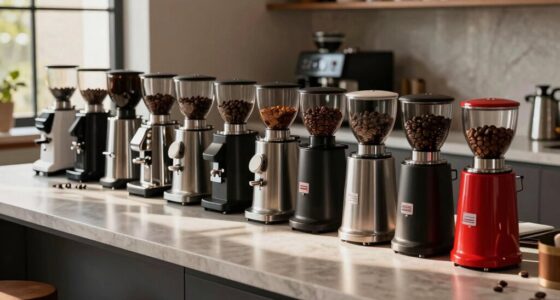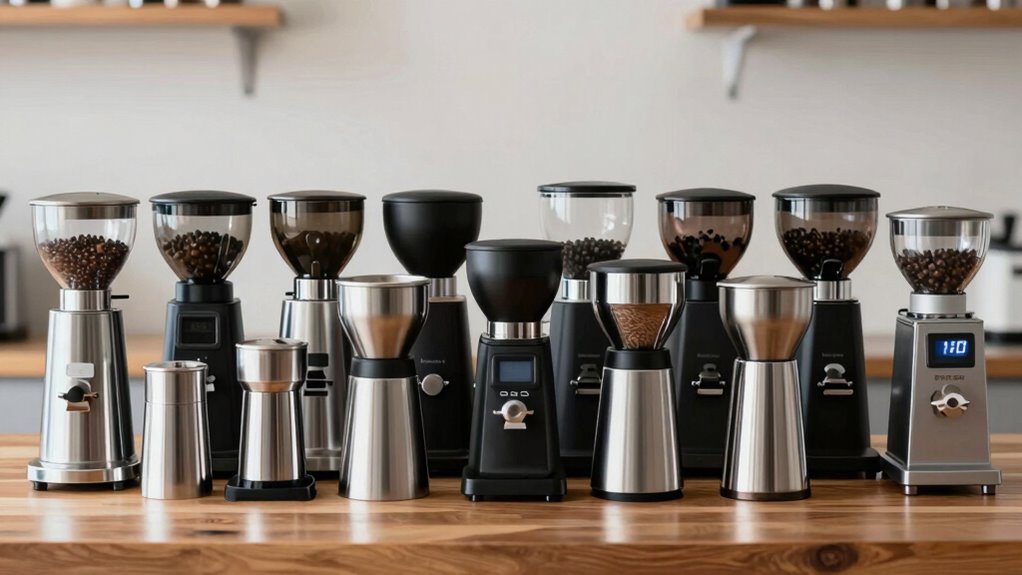

For an espresso grinder for light roast under $800, my best overall pick is the MOKKOM 64mm Flat Burr Coffee Grinder: its large flat burrs and broad adjustment range make it the most compelling option here for fine-tuning demanding shots. The 51-setting LED-display grinder stands out for visible, repeatable adjustments, while the SHARDOR Conical Burr Espresso Grinder is a practical choice for shoppers who want a timer-led workflow. The main tradeoff is between fine control for light-roast espresso and simpler operation, lower capacity, or broader brew versatility. Read on for the full breakdown, the limits of each design, and help matching a grinder to your routine.

Get coffee and tea gear delivered free with Prime
- Fast, free delivery on millions of items
- Prime Video, Amazon Music and more included
- Member-only deals all year
Complete the kit


Key Takeaways
- The MOKKOM 64mm flat-burr model is the clearest light-roast specialist in this lineup; its 100 grind settings offer more room to tune a shot than the 17-setting flat-burr option.
- A higher setting count does not prove finer espresso control. Burr geometry, adjustment increments, retention, and the ability to repeat a setting all matter alongside the number printed on the dial.
- Several conical models cluster around 45–51 settings. That makes usability, timer controls, and build details stronger tie-breakers than small differences in the advertised count.
- Anti-static features and timers address different workflow problems. Anti-static design can help manage mess, while timed dosing can make portions more repeatable; neither guarantees precise espresso extraction.
- The SHARDOR 70g multi-use grinder fills a different role from the espresso-focused models. Its smaller capacity and multi-use design suit occasional, flexible grinding better than a dedicated espresso routine.


| espresso grinder for light roast under 800 | Grind settings | Hopper capacity |
|---|---|---|
| AMZCHEF Conical Burr Coffee Gr | 45 | 10.5 ounces |
| Conical Coffee Bean Grinder | 38 | — |
| Ollygrin Burr Coffee Grinder | 30 | 10 ounces |
| Ollygrin Conical Burr Coffee G | 30 adjustable settings | — |
| KIDISLE Conical Burr Coffee Gr | 51 | 12.5 ounces |
| AMZCHEF Burr Coffee Grinder wi | 48 | 10.6 oz |
| AAOBOSI Espresso Coffee Grinde | 45 | — |
| SHARDOR Conical Burr Espresso | 51 | — |
| IAGREEA Coffee Grinder for Hom | 48 | 300 g |
| Conical Burr Coffee Grinder wi | 51 | — |
| Electric Coffee Bean Grinder w | 38 | — |
| SHARDOR Electric Coffee Grinde | — | — |
| MOKKOM 64mm Flat Burr Coffee G | 100 | 350g / 12.35oz |
| Flat Burr Coffee Grinder Elect | 17 levels | 7 oz |
More Details on Our Top Picks
AMZCHEF Conical Burr Coffee Grinder with 45 Grind Settings
The AMZCHEF makes the most sense for households switching between espresso and coarser brew methods: its 45 settings cover a broad range, and the removable 10.5-ounce hopper can hold enough beans for several servings. Compared with the Ollygrin 30-setting grinder, it offers finer adjustment options and adds a timed touchscreen interface, though the extra range does not by itself guarantee the grind quality or espresso control a light-roast-focused buyer needs. Anti-static features and a stainless steel grounds cup help limit counter mess, while the UV-tinted hopper is designed to shield stored beans from light. The tradeoff is that this is a multi-purpose home grinder rather than a clearly specialized espresso model; buyers seeking espresso-specific workflow details may prefer a grinder with a portafilter support. Its stated 150-watt power also gives little basis for expecting fast grinding.
Pros:- 45 settings provide more adjustment steps than the Ollygrin models’ 30 settings.
- 10.5-ounce removable, UV-tinted hopper supports multi-serving use and is designed to limit light exposure.
- Anti-static features and a stainless steel grounds cup are intended to reduce clinging and spills.
- Touchscreen timer adjusts in 0.5-second increments up to 45 seconds.
Cons:- The product information does not specify espresso-focused features such as a portafilter holder.
- A broad brew-method range does not confirm the fine-grind performance light-roast espresso can demand.
- Its 150-watt rating may be a concern for buyers prioritizing fast grinding.
Best for: Households that alternate between espresso, pour-over, drip, and French press and want one grinder with a roomy hopper and timed controls.
Not ideal for: Light-roast espresso drinkers who want a clearly espresso-focused workflow or confirmed fine-grind performance; the provided product information does not establish either.
- Burrs:40 mm stainless steel conical burrs
- Grind settings:45
- Timer:Up to 45 seconds, adjustable in 0.5-second increments
- Cup selection:2–12 cups
- Hopper capacity:10.5 ounces
- Power:150 watts
- Dimensions:14 x 5 x 6.5 inches
- Included components:Removable bean hopper, cleaning brush, grounds cup, and user manual
Our verdict“Choose the AMZCHEF if your household needs one timed grinder for several brew methods, but look for clearer espresso-specific details if light-roast shots are the main goal.”
Conical Coffee Bean Grinder, 38 Precise Settings, Anti-Static
The Ksionka conical grinder earns a place for buyers who put cleanup and simple timed operation ahead of a long settings list. Its built-in air blower and anti-static design are aimed at clearing grounds and reducing cling, useful when switching beans or adjusting for light-roast espresso. The 40 mm conical burr is described as minimizing heat buildup, but the supplied details do not confirm how finely or consistently it handles demanding espresso dialing-in. Compared with the KIDISLE 51-setting grinder, Ksionka has fewer grind settings and no listed hopper capacity, but its seven timer choices cover a broad 5–60-second range. That makes the operation relatively straightforward, though timer steps may offer less precise dosing than an adjustable electronic timer. It is a home-use pick, not a commercial grinder, and moderate noise may bother buyers grinding early in shared spaces.
Pros:- Built-in air blower is intended to clear residual grounds from the grinder.
- Anti-static technology aims to reduce grounds sticking and cleanup.
- 40 mm conical burr is described as producing uniform grounds with minimal heat buildup.
- Timer range spans 5–60 seconds across seven settings.
Cons:- 38 settings provide fewer adjustment options than the KIDISLE’s 51.
- No hopper capacity or detailed espresso-specific workflow is provided.
- Moderate operating noise may not suit early-morning use in shared spaces.
Best for: Home espresso drinkers who frequently change beans or grind settings and value easier cleanup more than the widest adjustment range.
Not ideal for: Commercial users, noise-sensitive households, or light-roast espresso enthusiasts who need confirmed fine-grind capability and more granular timer control.
- Burr:40 mm conical burr
- Grind settings:38
- Timer settings:7 settings, 5–60 seconds
- Anti-static:Yes
- Cleaning feature:Built-in air blower
- Warranty:1 year
- Model number:BD-CG011
- Color:Black
Our verdict“Pick the Ksionka for a home setup where anti-static cleanup and a wide timer range matter more than maximum grind adjustments or commercial-duty operation.”
Ollygrin Burr Coffee Grinder, Electric Conical Coffee Bean Grinder with 30 Adjustable Grind Settings for 2-12 Cups, Silver & Black
The Ollygrin 30-setting grinder is a simpler fit for buyers who want to move between common brew styles without sorting through dozens of adjustments. Its 40 mm stainless steel conical burrs and 30 settings cover the listed range from espresso to French press, while the 10-ounce hopper and 2–12-cup selection suit regular household batches. Compared with the AMZCHEF 45-setting grinder, it offers fewer grind steps and its product details do not list a touchscreen timer or anti-static system. That narrower feature set may appeal to someone who prefers uncomplicated operation, but it leaves less information for buyers trying to fine-tune light-roast espresso. The product also lacks a stated timer range and portafilter support, so I would treat espresso as one possible use rather than its defining strength. It is a practical general-purpose option, not the most specialized choice here.
Pros:- 40 mm stainless steel conical burrs are specified for uniform grinding.
- 30 settings cover the listed range from espresso to French press.
- 10-ounce hopper and 2–12-cup selection suit household brewing.
- Simple feature set may be easier to approach than models with more adjustment options.
Cons:- Offers fewer grind settings than the AMZCHEF 45-setting model and KIDISLE 51-setting model.
- Product information does not specify a timer or anti-static feature.
- No portafilter support or other espresso-specific workflow feature is listed.
Best for: Coffee drinkers who make several brew styles at home, want a 10-ounce hopper, and prefer a basic grinder over elaborate controls.
Not ideal for: Light-roast espresso specialists who need fine adjustment detail, an identified timer, or a portafilter-focused workflow.
- Burr material:Stainless steel
- Burr size:40 mm
- Grind settings:30
- Hopper capacity:10 ounces
- Cup settings:2–12 cups
- Color:Silver and black
Our verdict“Choose this Ollygrin for uncomplicated, varied home brewing, but favor a more adjustable or espresso-oriented model if dialing in light-roast shots is your priority.”
Ollygrin Conical Burr Coffee Grinder Electric with Touch Panel, 30 Precise Settings, Compact Design
Among these options, this compact Ollygrin has the clearest espresso-oriented workflow detail: its removable portafilter bracket gives users a place to position a portafilter during grinding. That can make espresso preparation tidier than with the larger, more general-purpose AMZCHEF 45-setting grinder, although AMZCHEF offers more grind adjustments and a specified hopper capacity. Ollygrin provides 30 settings, a touch panel with auto-stop, and a compact design aimed at small kitchens. For light-roast espresso, the bracket is a useful workflow advantage, but 30 settings and the absence of stated burr dimensions or a timer range leave important dialing-in details unclear. Its focus on a smaller footprint also comes with limited capacity, and the product information warns that careful cleaning is needed to maintain performance. This is a space-conscious option, not a clear winner for high-volume grinding.
Pros:- Removable portafilter bracket supports a more espresso-focused grinding workflow than the Ollygrin 30-setting model.
- Compact design is intended to suit small kitchens and fit under cabinets.
- Touch panel includes auto-stop control.
- 30 adjustable settings cover a range from espresso to French press.
Cons:- Limited capacity may be inconvenient for grinding large quantities.
- Only 30 settings are listed, fewer than the AMZCHEF and KIDISLE models.
- Burr dimensions and timer range are not specified, leaving key espresso-dialing details unclear.
- The product information calls for careful cleaning to maintain performance.
Best for: Apartment dwellers and espresso-machine owners who want a compact grinder with a bracket for positioning a portafilter.
Not ideal for: People grinding large batches or light-roast espresso drinkers who need detailed information about burr size, timer increments, or fine-grind performance.
- Burr type:Conical stainless steel
- Grind settings:30 adjustable settings
- Cup capacity:2–12 cups
- Control:Touch panel with auto-stop
- Portafilter support:Removable portafilter bracket
- Design:Compact and space-saving
- Included accessory:Cleaning brush
Our verdict“Choose this Ollygrin if counter space and a portafilter bracket matter most, but select a higher-capacity model for frequent batch grinding.”
KIDISLE Conical Burr Coffee Grinder – Electric Espresso Grinder with 51 Settings and Electronic Timer
The KIDISLE is the most adjustment-heavy option in this group, with 51 grind settings and a 1–60-second electronic timer. That wider range gives a curious home barista more steps to explore when dialing in light-roast espresso, while the 12.5-ounce hopper is larger than the capacities listed for the AMZCHEF and first Ollygrin models. Still, more settings are not proof of better espresso results: the product data does not describe adjustment increments, burr geometry beyond a 40 mm size, or a portafilter holder. Compared with the Ksionka 38-setting grinder, KIDISLE offers more stated grind options and a longer timer ceiling, but may feel less approachable to a beginner who wants fewer choices. Its anti-static design and stainless steel construction help round out the home-use package; operating noise is not specified.
Pros:- 51 settings give it the widest stated adjustment range among these five products.
- 1–60-second electronic timer supports a broad range of grinding durations.
- 12.5-ounce hopper is larger than the listed capacities of the AMZCHEF and first Ollygrin models.
- Anti-static design is intended to reduce clumping and cleanup.
Cons:- The large number of settings may feel complicated to beginners.
- No portafilter holder or espresso-specific dosing workflow is listed.
- Noise level and detailed burr geometry are not specified.
Best for: Home baristas who like experimenting with grind settings and need a roomy hopper and long electronic timer for varied brewing.
Not ideal for: Beginners who prefer a short, guided set of choices or espresso users who require a specified portafilter workflow and detailed burr-performance information.
- Grind settings:51
- Burr size:40 mm
- Hopper capacity:12.5 ounces
- Timer:1–60 seconds
- Material:Stainless steel
- Anti-static design:Yes
Our verdict“Choose the KIDISLE if you want the broadest stated grind range and a large hopper, but skip it if you prefer a simpler espresso workflow.”
AMZCHEF Burr Coffee Grinder with 48 Settings, Metallic Silver
AMZCHEF’s 48 settings give this grinder useful range from espresso through French press, making it a flexible pick if light-roast espresso shares counter space with other brew methods. Its 40 mm stainless steel conical burrs and timed or manual controls offer more control than a basic grinder, while the touchscreen and anti-static features aim to simplify daily dosing and cleanup. Compared with the SHARDOR Conical Burr Espresso Coffee Grinder, it has fewer settings but specifies a 0.5-second timer adjustment and a hopper trap door, both practical touches for repeatable portions and less spillage. The tradeoff is that 48 settings alone do not establish how finely the grinder can tune light-roast shots, and the 10.6 oz hopper is modest for frequent batch grinding. I’d choose it for brewing variety, not as a proven espresso specialist.
Pros:- 48 settings span espresso and several common non-espresso brew methods.
- 40 mm stainless steel conical burrs are designed for uniform grinding.
- Touchscreen supports cup selection, timed grinding, and manual control.
- Hopper trap door and anti-static features help limit spills and scattered grounds.
Cons:- The 10.6 oz hopper may need frequent refilling for larger households.
- The supplied details do not establish espresso-specific adjustment precision or light-roast performance.
Best for: Home coffee drinkers who alternate between espresso, pour-over, and immersion brewing and want touchscreen controls with reduced countertop mess.
Not ideal for: Light-roast espresso purists seeking documented fine-grind adjustment or households that grind large batches and want a larger hopper.
- Grind settings:48
- Burr type:40 mm stainless steel conical burrs
- Hopper capacity:10.6 oz
- Timer:Up to 40 seconds; adjustable in 0.5-second increments
- Cup selection:2–12 cups
- Portafilter fit:51–54 mm and 58 mm
- Dimensions:7.4 × 5.1 × 13.4 in
- Weight:5.4 lb
Our verdict“Choose the AMZCHEF if you want one grinder for several brew styles and value tidy, programmable operation over documented espresso-focused precision.”
AAOBOSI Espresso Coffee Grinder, Anti-Static, 45 Grind Settings, 40s Timer
AAOBOSI’s compact format and LED cup-and-time controls make it a straightforward option for home brewers who want a conical-burr grinder without a large control setup. The 45 settings cover multiple brew methods, though that is a narrower adjustment count than the SHARDOR Conical Burr Espresso Coffee Grinder’s 51 settings. For light-roast espresso, the key question is not the setting count alone: the supplied details do not specify micro-adjustment behavior, timer increments, or portafilter fit, so I would not choose it on the promise of especially precise dialing-in. Its anti-static outlet may reduce loose grounds around the machine, and the LED controls should make portioning accessible. In return for that simpler, compact pitch, buyers get less certainty about fit and operation than the more fully specified AMZCHEF or IAGREEA models.
Pros:- 45 settings support a range of brewing methods.
- 40 mm stainless steel conical burr is designed for consistent grounds.
- Anti-static outlet can help reduce scattered grounds.
- LED cup and time controls offer a direct way to portion grinding.
Cons:- No specific dimensions, hopper capacity, or portafilter compatibility are provided.
- Timer adjustment precision and espresso-focused grind control are not detailed.
Best for: Apartment-dwelling home brewers who want a compact conical-burr grinder for espresso and other brew styles with simple LED portion controls.
Not ideal for: Light-roast espresso drinkers who need documented fine adjustment, exact portafilter compatibility, or detailed capacity and dimension information before buying.
- Grind settings:45
- Burr:40 mm stainless steel conical burr
- Controls:LED display with cup and time control
- Anti-static:Anti-static outlet
- Material:Stainless steel
- Dimensions:Compact size; specific dimensions not provided
Our verdict“Pick AAOBOSI for a compact, simple control layout, but favor a better-documented option if precise light-roast espresso dialing is your priority.”
SHARDOR Conical Burr Espresso Coffee Grinder with Precision Timer and Adjustable Settings
SHARDOR’s 0.1-second timer increments are its clearest advantage for repeatable dosing: once a light-roast recipe is close, small timing changes can help adjust the amount ground without relying only on cup presets. It also offers 51 settings, slightly more than the AMZCHEF’s 48 and AAOBOSI’s 45, though setting count does not reveal the actual spacing or prove espresso-level precision. The 40 mm stainless steel conical burr and anti-static design make it a versatile home option, with cup selection from one to 12 for non-espresso batches. Compared with the Conical Burr Coffee Grinder with 51 Precise Settings and LED Display, this model lists timer precision but not a memory function or portafilter compatibility. The extra controls may take time to learn, and the listed data gives no noise figure—two reasons I’d favor it for control-minded users rather than buyers seeking simplicity.
Pros:- Timer adjusts in 0.1-second increments for precise timed dosing.
- 51 grind settings provide a broad range for different brew methods.
- 40 mm stainless steel conical burrs are designed to preserve consistent grinding.
- Anti-static technology helps keep the grounds area cleaner.
Cons:- Numerous settings and timer controls may take more learning than a simpler grinder.
- Portafilter compatibility and hopper capacity are not specified in the supplied details.
- Noise level is not documented.
Best for: Home baristas who want fine-grained timed dosing and use the same grinder for espresso and larger drip or batch-brew portions.
Not ideal for: Beginners who prefer a minimal interface, or espresso buyers who need confirmed portafilter fit and documented adjustment steps.
- Burr size:40 mm
- Burr material:Stainless steel
- Grind settings:51
- Timer precision:0.1-second increments
- Cup capacity:1–12 cups
- Anti-static:Anti-static technology
Our verdict“Choose SHARDOR if small timer adjustments matter more to you than a beginner-friendly interface or fully specified espresso fit.”
IAGREEA Coffee Grinder for Home Use, Conical Burr Espresso Grinder 48 Grind Settings
IAGREEA includes a portafilter holder and lists compatibility with both 51 mm and 58 mm baskets, giving it a practical advantage over the AAOBOSI and SHARDOR models, whose supplied details do not state portafilter fit. Its 450 RPM motor, 40 mm conical burr, and 48 settings form a home-focused package for moving between espresso and coarser methods. The lower-speed claim is intended to preserve flavor and aroma, but it does not by itself establish how well the grinder handles light-roast espresso or how fine its adjustments are. Compared with the AMZCHEF, IAGREEA specifies a larger 300 g hopper and portafilter holder, while AMZCHEF provides a touchscreen and more detailed timer increments. IAGREEA’s one-touch timer is simpler, but it lacks a digital display and is not presented as a commercial grinder.
Pros:- Included portafilter holder and stated 51 mm/58 mm compatibility support direct dosing.
- 300 g hopper holds more beans than the specified AMZCHEF hopper.
- 48 grind settings cover espresso through French press.
- 450 RPM motor and anti-static design are intended to support controlled grinding and cleaner handling.
Cons:- No digital display or digital timer is specified.
- The product is described for home use rather than commercial grinding.
- The supplied details do not specify the timer’s adjustment increments or light-roast espresso performance.
Best for: Home espresso drinkers who want direct portafilter dosing, use 51 mm or 58 mm baskets, and prefer a larger hopper over a digital interface.
Not ideal for: Buyers who need visual digital controls, commercial-duty use, or evidence of fine incremental adjustment for dialing in light roasts.
- Grind settings:48
- Burr size:40 mm
- Motor power:150 W
- Motor speed:450 RPM
- Hopper capacity:300 g
- Portafilter compatibility:51 mm and 58 mm
- Timer:Up to 40 seconds
- Controls:One-touch timer; no digital display specified
Our verdict“I’d choose IAGREEA for home users who value portafilter fit and hopper capacity more than a display or advanced timer controls.”
Conical Burr Coffee Grinder with 51 Precise Settings and LED Display
A memory function gives this grinder a distinct role: it can retain a preferred setup, reducing repeated control adjustments when you alternate between familiar recipes. Its 51 settings and dual cup-and-timing controls place it alongside SHARDOR for breadth, while the high-definition LED display and stated 51–58 mm portafilter compatibility make the interface and espresso fit clearer than the AAOBOSI’s supplied details. For light roasts, though, the listing does not explain how closely spaced the finer settings are, so the number of steps should not be read as proof of espresso precision. Compared with the IAGREEA, this model favors saved digital preferences over a specified 450 RPM motor and 300 g hopper. The controls may feel busy to beginners, and regular cleaning is part of keeping the grinder in good shape.
Pros:- Memory function can retain preferred settings for repeat recipes.
- 51 adjustable levels support a range of brewing methods.
- LED display and cup/timing control modes provide clear operating options.
- Stated compatibility covers 51 mm to 58 mm portafilters.
Cons:- Dual controls and multiple settings may overwhelm buyers who want a simple grinder.
- Hopper capacity, motor speed, and timer precision are not provided.
- Regular cleaning is required, and the supplied details do not explain the cleaning process.
Best for: Home baristas who rotate between repeatable recipes, want a saved control setup, and use 51–58 mm portafilters.
Not ideal for: Beginners seeking the fewest possible controls, or buyers who want documented hopper capacity, motor speed, or fine-step espresso adjustment.
- Burr size:40 mm
- Burr material:Stainless steel
- Grind settings:51
- Display:High-definition LED
- Control modes:Cup selection and timed grinding
- Cup capacity:1–12 cups
- Portafilter compatibility:51 mm to 58 mm
- Additional features:Memory function, anti-static design, automatic grinding
Our verdict“Choose this model if saved settings and a digital interface matter more than a fully specified hopper or documented espresso adjustment precision.”
Electric Coffee Bean Grinder with 38 Settings and Anti-Static Design
This grinder is the most sensible fit here for someone who wants a tidier, quieter home setup without a long feature list. Its 38 grind settings offer room to adjust for espresso and other brew methods, while the 60-second timer with memory can make repeat doses less fiddly. Anti-static design may help keep grounds from scattering, a practical perk when weighing light-roast coffee or cleaning up after a shot. Compared with the MOKKOM 64mm Flat Burr Coffee Grinder, it is a simpler, less feature-heavy choice; the MOKKOM offers flat burrs, 100 settings, and finer timer increments. The tradeoff is that this product’s description does not specify burr size or a dedicated light-roast performance feature, so buyers should not assume the settings alone guarantee easy dialing-in. It is aimed at home use, not busy service.
Pros:- 38 settings provide flexibility across espresso and other home brewing methods.
- Timer memory can simplify repeating a preferred dose.
- Anti-static design is intended to reduce grounds scattering.
- Quiet operation suits shared home spaces.
Cons:- Burr size and light-roast-specific performance are not specified.
- The 38-setting range may offer less adjustment than the MOKKOM’s 100 settings.
- Designed for home use rather than commercial demand.
Best for: Home espresso drinkers who want a quieter grinder, a memory timer, and less counter mess while switching among brewing methods.
Not ideal for: Light-roast enthusiasts seeking documented large flat burrs or especially fine grind adjustment, and anyone grinding for a commercial workflow.
- Burr type:Conical burr
- Grind settings:38
- Timer:60 seconds with memory function
- Material:Stainless steel
- Anti-static design:Yes
- Operation:Quiet operation
Our verdict“Choose it for a quieter, tidier home grinder with a memory timer, but favor the MOKKOM if broad adjustment and specified 64mm flat burrs matter more.”
SHARDOR Electric Coffee Grinder, 70g Capacity, Quiet & Multi-Use
The SHARDOR’s strongest case is versatility outside espresso: its 70g capacity and blade design suit users who want one appliance for coffee, spices, herbs, and grains. A visual timing knob gives manual control, and the stated 63 dB operation is appealing in a home or office. But this is the least convincing choice in this group for light-roast espresso. Unlike the Electric Coffee Bean Grinder with 38 Settings and Anti-Static Design, which specifies a conical burr and multiple grind settings, SHARDOR lists stainless steel blades and no stepped espresso adjustment. That makes fine, repeatable dialing-in a weaker proposition, especially when a light roast needs careful changes to reach a balanced shot. Its included spoon and cleaning brush add convenience, but do not change its basic role as a multi-purpose grinder. Choose it for broad kitchen use, not espresso precision.
Pros:- 70g capacity can handle several cups in one batch.
- Visual timing knob offers straightforward manual control.
- Stated 63 dB noise level suits quieter shared spaces.
- Includes a coffee spoon with cleaning brush and supports grinding multiple ingredient types.
Cons:- Stainless steel blades are not the burr system better suited to controlled espresso grinding.
- No specific stepped grind settings are listed for dialing in light-roast shots.
- Manual timing needs adjustment between batches and grind preferences.
Best for: Home or office users who want a quiet appliance for occasional coffee plus spices, herbs, and grains, and do not require burr-ground espresso.
Not ideal for: Light-roast espresso drinkers who need repeatable fine adjustments and burr grinding to tune shots.
- Grinding mechanism:Stainless steel blades
- Capacity:70g (2.5oz)
- Noise level:63 dB
- Control:Visual timing knob
- Included accessories:Coffee spoon with cleaning brush
- Warranty:2 years
- Additional uses:Coffee, spices, herbs, and grains
Our verdict“Buy the SHARDOR for quiet, multi-purpose kitchen grinding, not as your primary grinder for dialing in light-roast espresso.”
MOKKOM 64mm Flat Burr Coffee Grinder, Espresso & More, 100 Grind Settings
Among these four, the MOKKOM makes the strongest case for enthusiasts who want broad control over espresso variables. Its 64mm stainless steel flat burrs and 100 grind settings offer more scope for fine adjustments than the 38-setting conical grinder or the 17-level compact model. That matters when a light roast calls for small grind changes to balance extraction, though the listing alone cannot promise a particular cup profile. The 0.1-second electronic timer, LED display, and single-dose hopper option also give it a more precision-oriented setup than the other picks. In exchange, the full-metal body adds weight, and the number of controls may take time to learn. Its removable burr and hopper support maintenance, but this is a more involved machine than the compact flat-burr grinder. I would choose it for adjustable workflow, not simplicity.
Pros:- 64mm stainless steel flat burrs are specified for uniform grinding.
- 100 settings provide the broadest stated adjustment range in this group.
- 0.1-second timer increments support repeatable timed dosing.
- Single-dose and large-hopper options add workflow flexibility.
Cons:- The extensive controls may take time to learn and set up.
- Full-metal construction makes it relatively heavy.
- Its feature-rich design is more involved than the 17-setting compact flat-burr model.
Best for: Espresso-focused home enthusiasts who routinely dial in light roasts and want extensive grind adjustment, precise timed dosing, and a single-dose option.
Not ideal for: Beginners seeking a compact, uncomplicated grinder, or buyers who prioritize light weight over a full-metal build.
- Burr size:64mm
- Burr material:Stainless steel
- Grind settings:100
- Hopper capacity:350g / 12.35oz
- Hopper types:Large bean hopper and single-dose hopper
- Timer precision:0.1 seconds
- Body material:Full-metal stainless steel
- Additional features:Anti-static plasma generator, removable burr and hopper, LED display
Our verdict“Pick the MOKKOM if you want the widest stated adjustment range and a precision-focused workflow for dialing in light-roast espresso.”
Flat Burr Coffee Grinder Electric, Adjustable Coffee Bean Grinder with 17 Grinding Sizes, Burr Mill for Espresso & French Press, 2-12 Cup, Silver
This grinder’s appeal is its small footprint and straightforward flat-burr setup. At 5.5 × 7.5 × 8.2 inches, it is easier to place under a cabinet than the full-metal MOKKOM, while its removable parts make routine cleaning more accessible. The 17 grind levels cover a range from espresso to French press, but that narrower selection leaves less room to refine a light-roast shot than the MOKKOM’s 100 settings. The listing describes a uniform flat burr but does not give its size, so buyers should not treat it as a direct performance equivalent to the MOKKOM’s specified 64mm burrs. Its 2–12 cup capacity works for home batches, though the absence of a timer means dosing is less automated than with the 38-setting grinder. This is a compact, basic option—not the pick for maximum espresso adjustment.
Pros:- Compact dimensions fit under many kitchen cabinets.
- Flat burr design is described as producing a uniform grind.
- 17 settings span espresso through French press.
- Removable parts support easier cleaning.
Cons:- 17 settings offer less dialing range than the MOKKOM’s 100.
- No digital timer or other advanced dosing features are listed.
- Burr size is not specified, limiting direct comparison with larger-burr models.
Best for: Space-conscious home brewers who want a compact flat-burr grinder for occasional espresso and batch brewing, with simple cleaning.
Not ideal for: Light-roast espresso drinkers who make frequent fine grind changes or want timed dosing and a large, specified burr set.
- Burr type:Flat burr
- Grind settings:17 levels
- Cup capacity:2–12 cups
- Hopper capacity:7 oz
- Dimensions:5.5 × 7.5 × 8.2 inches
- Material:Stainless steel
- Cleaning:Removable parts
Our verdict“Choose this model when counter space and simple cleanup matter more than fine-grained control for light-roast espresso.”

How We Picked
I ranked these grinders around the specific challenge of preparing light-roast espresso, where a buyer often needs fine adjustments to find a workable shot rather than a grinder that only handles coarse brewing. I compared the details provided for each model: burr type and size when stated, adjustment range, timer or dose controls, anti-static features, display and interface, and stated capacity. I gave greater weight to features that can support repeatable espresso dialing-in, while treating setting counts as clues rather than proof of grind quality.
The order also reflects how clearly each grinder fits the use case. The MOKKOM 64mm flat-burr model leads on its stated burr size and broad adjustment range; models with useful controls and multiple espresso-oriented settings follow. More general-purpose, lower-capacity, or less clearly specified grinders rank lower for this particular task, even if they may suit other brew styles. The supplied product details do not establish measured grind consistency, retention, noise, or durability, so I do not treat those as verified performance claims.
Factors to Consider When Choosing Espresso Grinder For Light Roast Under 800
Choosing a grinder for light-roast espresso involves more than finding a model with “espresso” in its name. I would start with how finely and repeatably it adjusts, then weigh daily workflow, brew-style flexibility, and the information the manufacturer actually provides.
Prioritize adjustment quality over the biggest setting count
A large number of settings can suggest room to tune a shot, but it does not tell you how much each adjustment changes the grind. For light roasts, small, usable steps can make it easier to respond when a shot runs too quickly or tastes sharp. Check whether adjustments are clearly marked and whether the grinder is designed to return to a previous setting. A broad range may also be spent across coarse settings that matter less to an espresso-only user. Avoid choosing by the number on the box alone; ask whether the adjustment system gives you practical control near espresso fineness. If the maker provides little detail on the mechanism, treat that uncertainty as part of the buying decision.
Read burr type and size as clues, not a guarantee
Flat and conical burrs describe different grinding designs, but the label alone does not settle which grinder will make better espresso. Burr size can be useful context, especially when comparing the 64mm flat-burr MOKKOM with the other listed designs, yet size does not establish alignment, consistency, or cup character. For light roasts, the result still depends on the complete burr and adjustment system. Look for clear manufacturer specifications and avoid assuming that a larger burr automatically means faster or more uniform grinding. Also check whether the product is presented as espresso-focused or as a general-purpose grinder. That distinction can reveal how much of its adjustment range is intended for fine grinding.
Decide how much dose repeatability your routine needs
A timer can make a morning routine easier, but timed grinding is not the same as weighing a dose. Beans vary, and grind settings can affect how much coffee exits in a given interval. If you change beans often or need repeatable espresso shots, a separate scale can help you check the dose rather than trusting the timer alone. A timer is more useful when you tend to use the same beans and setting day after day. Touch panels and LED displays may make settings easier to read, but they do not replace a clear, repeatable adjustment mechanism. Choose electronic controls for convenience, not as a shortcut to precision.
Match the grinder to your other brewing habits
A grinder built around espresso may be less convenient if your household also makes French press or other coarse-ground coffee. A broad adjustment range can help, but frequent changes between brew methods may make it harder to return to a familiar espresso setting. Before buying, decide whether one grinder must serve every method or whether espresso deserves a dedicated setup. Multi-use models can be attractive for occasional brewing, yet a stated capacity or broad use label does not confirm how easy it is to switch settings. Keep a written note of your espresso setting if you move between methods. Buyers who mostly make light-roast espresso should favor repeatable fine adjustment over versatility they rarely use.
Treat anti-static and capacity as workflow choices
Anti-static features can help limit scattered grounds, but they should not be read as proof that a grinder has low retention or is easy to clean. Retained coffee matters because old grounds can affect the next dose, especially when you change beans. Capacity matters differently: a larger hopper may reduce refills, while a smaller stated capacity can make more sense for fresh, occasional grinding. Think about how much coffee you prepare in one session and whether you prefer to keep beans in a hopper. If freshness is a priority, buying the largest-capacity option may not improve your routine. Check cleaning instructions and access to the burr area before treating mess control as solved.
Pay more for a specific advantage, not a feature count
For this category, spending more only makes sense when the grinder provides a capability you will use, such as a more suitable burr design, clearer adjustment, or better control over repeat doses. A longer settings list can be useful, but it is not enough by itself to establish an upgrade. Compare what is documented about the grinder with what is missing, including cleaning access, adjustment steps, and the intended brew range. Buyers new to espresso may benefit more from an understandable interface than from the most elaborate feature set. Experienced users may care more about fine adjustment and a dedicated workflow. Since product descriptions here do not establish measured performance, keep a margin for that uncertainty when choosing.
Frequently Asked Questions
Which grinder in this lineup is the strongest fit for light-roast espresso?
The MOKKOM 64mm Flat Burr Coffee Grinder is my strongest fit based on the listed specifications: it pairs 64mm flat burrs with 100 grind settings, giving it the broadest stated adjustment range among these espresso-oriented options. That does not prove it will outperform every conical model in extraction or taste. The listing details do not provide independent measurements of grind consistency or retention. If you prefer a conical design or a more guided interface, compare it with the 45–51-setting models rather than choosing by count alone. Treat it as the leading specification-based pick, not a guarantee of a particular cup result.
Is a grinder with 51 settings better for espresso than one with 45?
Not automatically. A setting count says how many marked positions are available, but it does not show the spacing between them, the useful range for espresso, or how consistently the grinder repeats a setting. The 51-setting models may offer more marked choices than the 45-setting AMZCHEF or AAOBOSI models, yet the difference may not help if the adjustments are poorly suited to dialing in. Look for information about the adjustment mechanism and whether settings can be returned to reliably. When those details are absent, prioritize the interface and workflow you can use confidently. The count is one comparison point, not a ranking by itself.
Do I need a timer if I already use a scale for espresso?
A timer is convenient, but a scale remains the more direct way to check how much coffee you are grinding. Timed output can change with bean type, freshness, and grind setting, so the same duration may not deliver the same dose every time. A timer can still speed up a routine when you use familiar beans and settings. If you change light roasts frequently, use the scale to confirm each dose and treat the timer as a starting point. Buyers who value fewer steps may appreciate timer controls, while those who already weigh every dose should not pay extra for timing alone.
Can one grinder handle both light-roast espresso and French press?
Some grinders in this roundup advertise broad settings or multiple brewing uses, so a single grinder may suit a household that alternates methods. The tradeoff is that switching between fine espresso and coarse French press can disrupt a familiar espresso setting, particularly when adjustments are not easy to record or repeat. Write down the setting before making a change, and check whether the grinder’s range clearly covers both ends. The product details do not establish how consistently each model performs across that full range. If espresso is your priority and you rarely brew French press, favor fine adjustment over general versatility.
Should I choose an anti-static model or a grinder with an LED display?
Choose based on the part of your routine you want to improve. Anti-static design is aimed at reducing grounds scattered around the grinder, while an LED display can make settings or controls easier to read. Neither feature alone confirms low retention, accurate dosing, or fine enough adjustment for a light-roast shot. If the counter mess is your main frustration, anti-static may matter more; if you often lose track of settings, a display could be more useful. Check the rest of the specification before allowing either feature to decide the purchase. For espresso, a repeatable grind adjustment should remain a higher priority than either convenience feature.
Conclusion
For the strongest specification-led fit for light-roast espresso, I would start with the MOKKOM 64mm Flat Burr Coffee Grinder; its 64mm burrs and 100 settings set it apart from the rest of this group. For best value, compare the 45–51-setting conical grinders and choose the one whose timer, anti-static design, or display solves a real need in your routine rather than paying for the highest count. Beginners may prefer a model with clear controls, such as the 51-setting LED-display grinder, or the timer-oriented SHARDOR, while remembering that neither replaces weighing a dose. Buyers seeking broader brewing flexibility can look at the multi-use SHARDOR, and anyone who wants a simpler flat-burr option can compare the 17-setting model with the more adjustable MOKKOM. My overall recommendation is to match the grinder’s adjustment and workflow to how often you dial in light-roast shots, and to treat unspecified performance details as unknown rather than assumed.
Fall Picks

Le Creuset Essential 10-Piece Ceramic Nonstick Cookware Set
As an affiliate, we earn on qualifying purchases.