TL;DR
Good Housekeeping published a classic bread stuffing recipe that serves 10 and takes about one hour, including 20 minutes of active work. It combines toasted country-style bread, onions, celery, sage, parsley, broth and eggs, then bakes covered before browning uncovered; claims that it is the “best” are subjective.
Good Housekeeping has published a classic bread stuffing recipe for Thanksgiving that serves 10 people and takes about one hour to prepare and bake. The recipe uses toasted country-style bread, onions, celery, sage, parsley, chicken broth and eggs; its title calls it the best, but that ranking is an editorial opinion rather than a measurable finding.

Get coffee and tea gear delivered free with Prime
- Fast, free delivery on millions of items
- Prime Video, Amazon Music and more included
- Member-only deals all year
The recipe lists 20 minutes of active time and 40 minutes of cooking time, with an estimate of about 140 calories per half-cup serving. It calls for a 1-pound loaf of country-style bread, cut into half-inch pieces, along with 3 tablespoons of unsalted butter, two medium onions, two celery stalks, 3 cups of low-sodium chicken broth, a quarter cup of chopped sage leaves, 1 cup of flat-leaf parsley, two large eggs, salt and pepper.
Preparation begins by heating the oven to 375°F and toasting the bread pieces on a baking sheet for 15 to 20 minutes. Meanwhile, onions cook in butter with salt and pepper until tender and beginning to turn golden. Celery is added and cooked until tender, followed by the broth, sage and parsley.
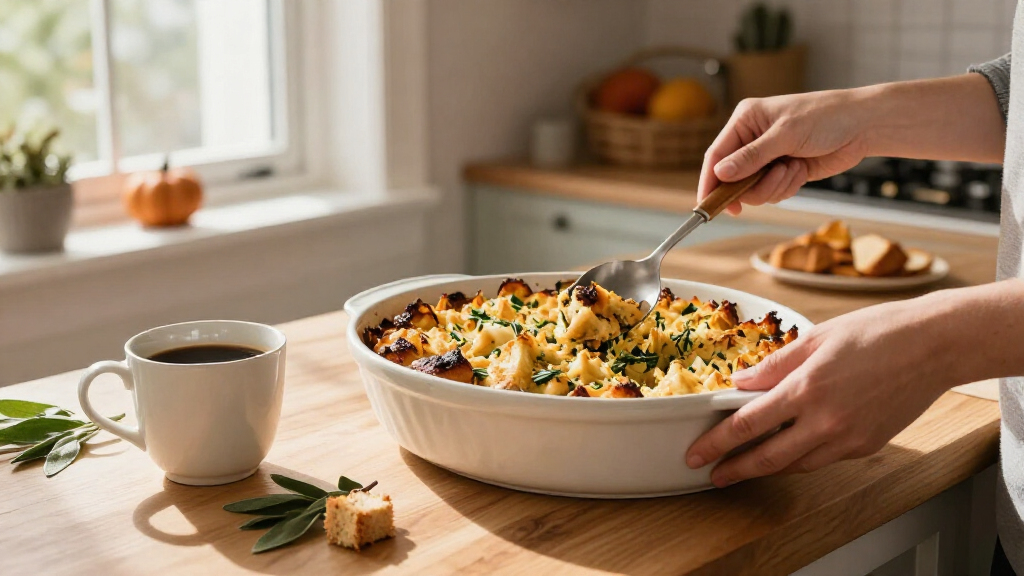
The vegetable and broth mixture is tossed with the toasted bread, then beaten eggs are folded in. The stuffing goes into a greased 3-quart casserole dish, covered with foil for 10 minutes, and then baked uncovered for another 15 to 20 minutes, until golden brown. Good Housekeeping describes the intended result as a crisp exterior and a softer, custardy center.
A Make-Ahead-Friendly Holiday Side
Stuffing is a familiar part of many Thanksgiving meals, and a recipe with a stated yield and cooking schedule can help hosts plan oven time and portions. This one produces 10 servings and relies on common ingredients, while its two-stage bake aims to brown the top without leaving the center dry.
The recipe’s reported nutrition estimate is 140 calories per half-cup, with 390 milligrams of sodium per serving. Those figures are estimates for the listed recipe and portion, not a guarantee for every preparation; ingredient brands, serving size and substitutions can change the result.
The headline’s “best” label should be read as promotional judgment, not a tested consensus. The supplied report does not describe a comparison with other stuffing recipes or provide reader ratings. What it confirms is a specific, straightforward method that readers can assess for themselves.
Products Worth Considering

Cuisinart Chef's Classic Stainless Steel Pots and Pans Set, 17-Piece

Le Creuset Heritage Stoneware Rectangular Baking Dish Set, 3-Piece, Marseille

Breville Barista Express Manual Espresso Machine with Built-In Grinder, Brushed Stainless Steel
As an affiliate, we earn on qualifying purchases.
How the Recipe Builds Its Texture
The method separates the recipe into two stages: bread is toasted before it absorbs the seasoned broth, and the assembled mixture is baked first under foil and then uncovered. Toasting the bread helps it hold its shape as liquid is added, while the final uncovered bake is intended to create a browned surface.
The flavor base comes from butter-cooked onions and celery, with sage and parsley stirred into the broth mixture. Eggs are added after the bread and vegetables are combined. The source presents this as a classic bread stuffing; it does not specify a sausage, fruit or nut variation.
The report gives no publication date in the supplied material. It also does not say whether the recipe was independently tested, how the calorie estimate was calculated, or whether the recipe can be prepared ahead. Those details should not be inferred from the headline or ingredient list.
“The center stays custardy while the outside forms a nice crunchy crust.”
— Good Housekeeping recipe report
Taste Claims and Recipe Details
The report does not provide comparative testing, reader review results or evidence supporting the claim that this is the best stuffing recipe. Taste depends on preference, and the supplied information does not establish how the recipe performs with different bread types or ingredient substitutions.
Food-safety instructions are also not included in the supplied recipe text. It gives an oven temperature and bake times but no internal temperature target. For safe handling, keep perishable ingredients refrigerated before cooking, avoid leaving prepared stuffing at room temperature for extended periods, and use a food thermometer to check the center reaches 165°F, particularly when eggs or broth are included. The source does not state whether the stuffing is meant to be baked inside poultry; the directions provided are for a casserole dish.
Readers Can Test the Recipe
The immediate next step for readers is to follow the listed method and decide whether the seasoning and texture suit their meal. Good Housekeeping’s report invites readers who make the dish to comment, but the supplied material includes no reader responses or follow-up test results.
Before serving, cooks can check the center with a food thermometer and refrigerate leftovers promptly in shallow containers. The recipe can be adjusted to taste, but changes to broth, salt or added ingredients may alter the nutrition information and baking result. No further update or publication schedule is provided.
Key Questions
How many people does this stuffing recipe serve?
Good Housekeeping lists a yield of 10 servings.
How long does the recipe take?
The reported total time is one hour, including 20 minutes of active preparation and 40 minutes of cooking.
What gives the stuffing its flavor?
The recipe uses onions, celery, sage and parsley, cooked with butter and combined with chicken broth, toasted bread and eggs.
Is it objectively the best Thanksgiving stuffing?
The title calls it the best, but the supplied report provides no comparative testing or evidence establishing an objective ranking. “Best” is a subjective description.
What temperature should the center reach?
The source does not give an internal temperature. For food safety, use a thermometer and check that the center reaches 165°F; the recipe’s directions are for casserole-baked stuffing.
Source: goodhousekeeping.com