
TL;DR
Moving your rig into a closet can cut noise drastically, but it needs proper airflow and strategic treatment. Focus on placement, sealing gaps, and adding damping to get the best results. It’s the easiest way to keep your workspace silent while your machine roars behind the scenes.
Ever notice how even the best soundproofing foam can’t quite quiet down a noisy GPU rig? That’s because the biggest impact comes from where you put the machine—literally. Moving your high-performance AI or gaming rig into a closet or spare room can silence your workspace more than any foam panel ever could.
This guide is about making that closet work. Not just stuffing blankets and hoping for the best, but understanding how to dampen sound, manage heat, and position your gear for maximum quiet. Once you grasp these principles, the noise problem becomes a simple fix—no more sleepless nights or distractions.
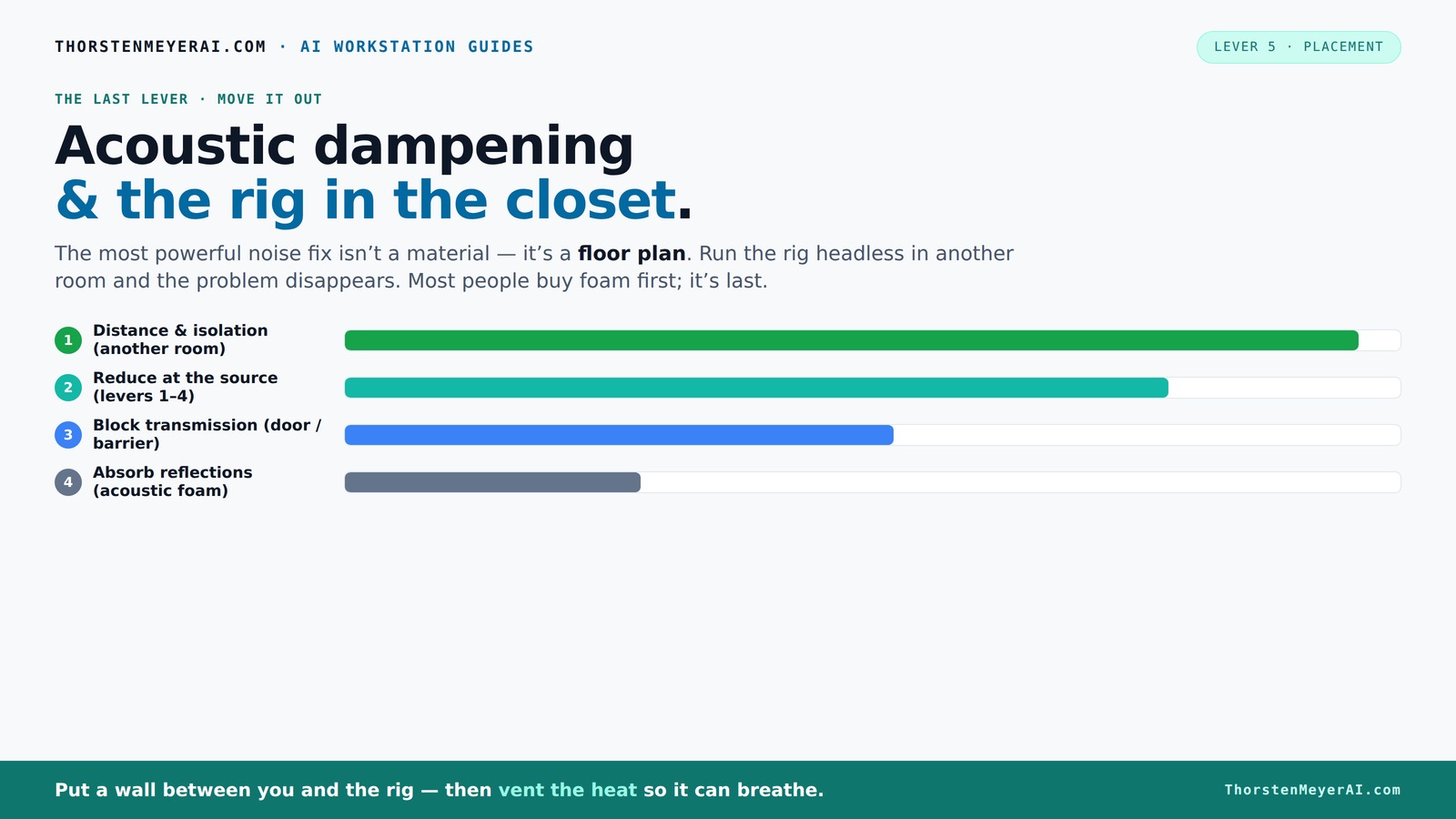
Acoustic dampening
& the rig in the closet.
The most powerful noise fix isn’t a material — it’s a floor plan. A rig you can’t hear because it’s in another room beats any amount of foam. Tap the approaches in Part 1 to see what actually works.
(another room)
(levers 1–4)
(door / barrier)
(acoustic foam)
Contain the noise, not the heat
Key Takeaways
- The biggest noise reduction comes from placing your rig in another room or closet—distance is king.
- Ventilation is critical—use active airflow, exhaust fans, or ducting to keep temperatures safe and hardware cool.
- Placement of acoustic panels at reflection points (behind the mic, side walls, ceiling) dramatically improves sound quality.
- Sealing gaps around doors and vents enhances treatment effectiveness and prevents sound leaks.
- In small spaces, bass traps in corners help control low frequencies and avoid a boomy sound.

TroyStudio Thick Acoustic Foam Panels, 12 X 12 X 4 Inch 12 Pcs Broadband Sound Absorbing Foam, Dense Soundproof Padding Tile, Recording Studio Foam Absorber, Groove Decorative 3D Wall Ceiling Panel
【SPECIFICATIONS】: Size - 12 X 12 X 4 inches, pack of 12; Coverage - 12 square feet; Weight...
As an affiliate, we earn on qualifying purchases.
As an affiliate, we earn on qualifying purchases.
Why Moving Your Rig Is the Single Best Noise Fix
The biggest reduction in noise comes from distance. When your rig is positioned in another room or a closet, sound waves weaken significantly before reaching your ears. For example, if your GPU hums at 80 dB right next to you, moving it even a few meters away can reduce perceived noise by 20-30 decibels, making it much less intrusive. This isn’t just about volume—it's about perception; the farther the source, the less disruptive it feels. This reduction is critical for maintaining focus, sleep, or a peaceful environment.
Importantly, this method also influences heat dissipation. While distance diminishes noise, it complicates airflow. You need to balance proximity and ventilation—placing the rig far away minimizes sound but requires effective cooling solutions to prevent overheating. The primary benefit, however, is that physical separation inherently reduces the direct sound energy reaching your workspace, which often surpasses what acoustic treatments alone can achieve. This approach is especially advantageous for AI workstations connected over the network, where the hardware can operate silently in a distant room without affecting your daily activities.

GAMDIAS ATX Mid Tower Gaming Computer PC Case Tempered Glass, Built-in 4X 120mm ARGB Case Fans, Front Airflow Mesh, Up to 6x120mm Fans, 340mm GPU/VGA, 360mm AIO/Radiator, 160mm CPU Cooler
【Mesh Front Panel with Built-In Fans】AURA GC1 ELITE ARGB sports an airflow-focused mesh front panel equipped with 4...
As an affiliate, we earn on qualifying purchases.
As an affiliate, we earn on qualifying purchases.
How to Ventilate a Closet Rig Without Turning It Into a Sauna
Placing a powerful, heat-generating machine in a closed closet without proper ventilation can lead to dangerous temperature spikes, performance throttling, and hardware failure. When components operate beyond their optimal temperature, they automatically slow down (thermal throttling) to prevent damage, which hampers your work. Excess heat can also cause fans to run at higher speeds, increasing noise levels, and over time, degrade component lifespan.
Effective ventilation strategies are essential. Active airflow solutions—such as exhaust fans, intake vents, or ducted systems—create a continuous exchange of hot and cool air. For more detailed airflow tactics, check out this guide on cooling solutions. For instance, installing a small, quiet exhaust fan that pulls hot air out while drawing cooler air in prevents heat buildup. Using thermostats or temperature sensors can automate this process, ensuring fans run only when necessary, reducing noise pollution. Ducting can direct airflow from outside the closet, maintaining a stable temperature without adding noise or clutter. Proper ventilation not only preserves hardware longevity but also ensures that acoustic dampening efforts are not undermined by heat-induced noise or performance issues.
For more detailed airflow tactics, check out this guide on cooling solutions.

AC Infinity Ventilation Grille, for PC Computer AV Electronic Cabinets, Also mounts one 120mm Fan
Designed to be installed into cabinets or walls to help increase ventilation
As an affiliate, we earn on qualifying purchases.
As an affiliate, we earn on qualifying purchases.
Placement Strategies: Where to Put Acoustic Treatments for Best Effect
In a tiny closet, strategic placement of acoustic treatments is crucial because it directly influences sound reflection, absorption, and overall clarity. Learn more about acoustic treatment placement at this resource. The most critical reflection point is typically the wall behind your microphone, where sound waves bounce back into the mic capsule, coloring your recordings with harsh echoes. Addressing this reflection reduces muddiness and creates a cleaner, more accurate sound profile.
Next, focus on treating side walls, the ceiling, and even the floor, since sound can bounce in multiple directions, causing comb filtering and unwanted resonances. Using thick panels (2-4 inches) provides better absorption of mid and high frequencies, while bass traps in the corners absorb low-frequency energy that tends to accumulate there, preventing booming or muddy sounds. For more on acoustic treatments, visit this resource. Rugs or carpets on the floor help dampen reflections from below, further improving sound quality.
Effective placement involves understanding your room’s reflection points—use a mirror to find where panels should be placed for maximum impact. Remember, the goal isn’t just to absorb sound but to control reflections that color or muddy your recordings, ensuring a natural and balanced sound.
soundproofing materials for server closet
As an affiliate, we earn on qualifying purchases.
As an affiliate, we earn on qualifying purchases.
What To Buy for a Closet Studio: Cheap Tricks vs. Serious Gear
Budget solutions like moving blankets, thick rugs, and reflection filters can significantly reduce reflections and echo, especially when placed at key reflection points. These options are affordable and easy to implement, making them excellent starting points. However, they primarily address mid and high frequencies and may not effectively dampen low-frequency buildup common in small, enclosed spaces.
For professional results, investing in thick acoustic panels, bass traps, and sealed soundproof cabinets offers a more comprehensive solution. These treatments absorb a broader spectrum of sound, including low frequencies, and help prevent sound leaks. Sealed soundproof enclosures or drywall with damping compounds increase the mass and reduce transmission, creating a more controlled environment. Combining absorption (panels, traps) with isolation (sealed enclosures) provides a balanced approach—cost-effective for small setups but with significant performance gains. The key tradeoff is cost versus effectiveness; choose solutions that match your needs and budget while understanding their limitations.
Sealing Gaps and Soundproofing the Door — Why It Matters
Gaps around doors and windows act like open windows for sound to escape, significantly undermining your acoustic treatment efforts. Sealing these gaps effectively can be explored in this guide on acoustic sealing. Sealing these cracks with weatherstripping or acoustic sealant is a simple yet powerful step. It prevents sound leaks, enhances the effectiveness of your absorptive treatments, and creates a more controlled environment. Without sealing, even the best panels can be bypassed through small openings, rendering your efforts less effective.
For example, sealing the door in your closet with weatherstripping can reduce noise leaks by up to 80%, especially when combined with a door sweep that blocks sound transmission underneath. This not only improves sound isolation but also prevents external noise from entering, creating a more consistent acoustic environment. Remember, small gaps are often overlooked but can have a disproportionately large impact on sound leakage. Proper sealing ensures your treatment works as intended and maximizes the benefits of your acoustic investments.
Handling Low Frequencies: Do You Need Bass Traps in a Small Closet?
Low frequencies are especially challenging in small, enclosed spaces because they tend to reflect and resonate, creating standing waves that amplify certain bass notes. This results in a boomy, muddy sound that can obscure details and make recordings sound unnatural. Bass traps in the corners of your closet absorb these resonant low-frequency waves, preventing them from building up and causing uneven frequency response. Without proper treatment, the low end can dominate your recordings, making them sound hollow or overly bass-heavy. Properly placed bass traps help achieve a balanced sound by controlling these resonances, leading to clearer, more natural recordings.
For instance, installing small foam or mineral wool bass traps in the corners of your closet can significantly reduce low-frequency buildup, resulting in a more accurate and full-bodied sound. This is especially important for vocals, acoustic instruments, or any source where clarity and natural tone are essential. Neglecting low-frequency treatment often results in a 'boxy' or 'muddy' sound, which is difficult to correct later—so proactive treatment is key for professional results.
Key Tips for a Quiet, Cool, Closet Setup
- Place the rig in a well-ventilated, insulated closet or room to prevent heat buildup, which can cause hardware throttling and increased noise from cooling fans.
- Seal all gaps around doors and vents with weatherstripping and acoustic sealant to prevent sound leaks and improve overall insulation.
- Use thick acoustic panels on reflection points—behind the mic, on side walls, ceiling—to absorb sound and reduce echo.
- Install a quiet exhaust fan or ducted airflow system to manage heat without adding noise, ensuring optimal operating temperatures.
- Use rugs, blankets, and bass traps to soften reflections and control low-end resonances, creating a more natural sound environment.
- Connect your rig over a wired network to avoid cable noise and ensure stable data transfer, especially important in enclosed spaces.
Frequently Asked Questions
How much treatment do I need in a closet?
Start with panels at reflection points—behind the mic, side walls, and ceiling. Add bass traps if low-end buildup occurs. You don’t need to cover every surface—target the key reflection points for best results.Where should acoustic panels go first?
Place panels behind the microphone—this reduces harsh reflections directly affecting your voice. Next, treat side walls and ceiling based on your room’s size and reflection patterns.Do I need bass traps in a small closet?
Yes, especially if your recordings sound boomy or hollow. Corner bass traps absorb low-frequency standing waves, giving recordings clarity and fullness.Is a closet actually soundproof, or just less echoey?
A closet mainly reduces echo and reflections, making it less 'boxy.' It’s not true soundproofing; sound still leaks through gaps and walls. Sealing gaps enhances sound isolation.What is better: acoustic foam, moving blankets, or thick panels?
Thick panels and bass traps are more effective than foam for absorbing low frequencies. Moving blankets are a good budget fix for reducing reflections but don’t block sound transmission.Conclusion
The simplest, most effective way to quiet down a noisy rig isn’t just better insulation or foam—it’s moving it out of your workspace altogether. When you combine strategic placement, proper ventilation, and targeted acoustic treatment, your closet transforms into a silent, professional-grade studio.
Remember: the goal isn’t just noise reduction but creating a space where your work sounds clear and your hardware stays cool. Keep these principles in mind, and your closet will become your best studio secret—quiet, cool, and ready for anything.